Forest Park in St. Louis, Missouri — The American Midwest (Upper Plains)
Can We Control Nature?
History Underfoot: 1929, 1931
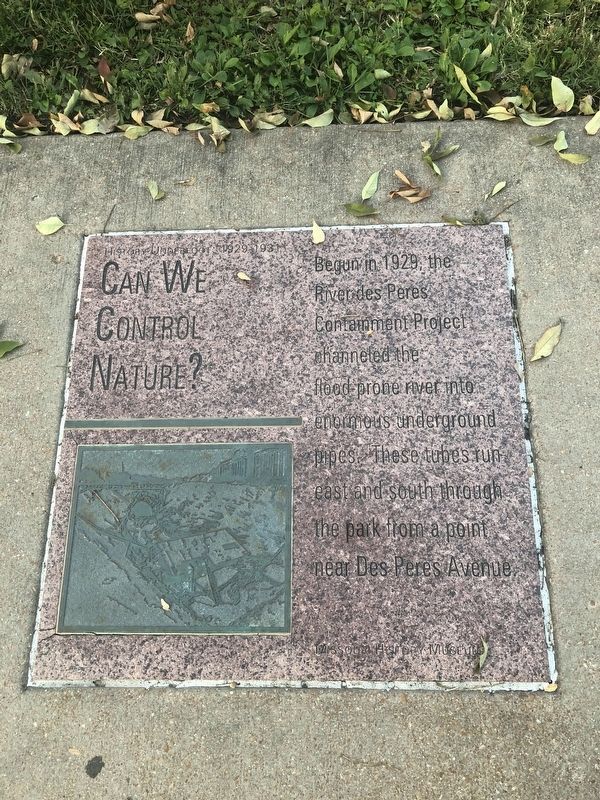
Erected by Missouri History Museum.
Topics and series. This historical marker is listed in these topic lists: Charity & Public Work • Parks & Recreational Areas • Waterways & Vessels. In addition, it is included in the Missouri, St. Louis - History Underfoot series list. A significant historical year for this entry is 1929.
Location. 38° 38.622′ N, 90° 17.107′ W. Marker is in St. Louis, Missouri. It is in Forest Park. It is at the intersection of Grand Drive and Grand Drive, on the right when traveling west on Grand Drive. Touch for map. Marker is at or near this postal address: 5620 Grand Drive, Saint Louis MO 63112, United States of America. Touch for directions.

Regionally, this marker is in the American Midwest, in the Lewis & Clark Corridor, in the Corn Belt, and in the Great River Road Region. Globally, it is in North America, the Western Hemisphere, the Western World, and the Anglosphere.
this page online
Other nearby markers. At least 8 other markers are within walking distance of this marker: Should Park Space Serve Other Uses? (within shouting distance of this marker); This is Everyone's Park. (within shouting distance of this marker); A Fair Legacy: The Zoo (within shouting distance of this marker); How Will We Renew the Park? (within shouting distance of this marker); Are Trees and Lawns Enough? (about 300 feet away, measured in a direct line); Can Private Generosity Serve Public Good? (about 300 feet away); How Do We Take Care of One Another? (about 300 feet away); Meet Me in St. Louis, Louie! (about 300 feet away). Touch for a list and map of all markers in St. Louis.
Additional commentary.
1. Controlling nature vs controlling the flow of a stream
The question of controlling nature, to me, is a bit overreaching when the subject here is really just about capturing the flow of River des Peres to prevent its dangerous flooding from destroying assets and killing people. In 1915 the river flooded beyond records due to hurricane storms coming up from the Gulf through Texas and stalling over STL. 11 people along Manchester Road and in the Dogtown area drowned from excessively high water. This caused a voracious public outcry for the city of STL to take action. They did but it wasn't until 1924 when the settling of political maneuvering and acquisition of funding allowed the actual construction of the Board of Public Services Chief Engineer, W. W. Horner's plan to be put into place and construction begun.
However, to be completely accurate, containment of River des Peres began more than 22 years before that municipal project when the clearing of Forest Park, excavation of the river, and building of multiple underground wooden channels going into and through Forest Park was started in preparation for the World's Fair. It entered from the north side underneath the Chicago, Rock Island, & Pacific RR tracks and literally flowed underneath the Pike and the streets and even Palaces of the Fairgrounds. It wound its way around the Palace of Varied Industries, along the Palace of Manufactures, underneath the Louisiana Purchase Monument where so many important celebrations, official events, and the speeches of the most important dignitaries were all delivered! It then turned sharply before the Palace of Liberal Arts, angled eastward and out of the Fairgrounds where it rejoined its original riverbed. So, indeed they did "control nature's river" through that section quite successfully considering they never had flooding issues with it after that.
Then, as this marker accurately describes, in the project that ended in 1931 it was redesigned and diverted into the huge concrete tubes that are buried right in front of (and under) today's MO History Museum and along Lindell Blvd turning south before reaching Kings Highway. It remains underground until reaching Manchester Road near Macklind Ave. where it becomes exposed and the great stone embankments that were built by the WPA contain it (almost always). This is particularly impressive considering that the man-made Taylor-Kindle River that "flows" through Forest Park ambles along on the surface in some places directly above River des Peres well below it!
— Submitted June 15, 2025, by Garrett Koch of Saint Louis, Missouri.
Credits. This page was last revised on June 26, 2025. It was originally submitted on September 18, 2019, by Devry Becker Jones of Washington, District of Columbia. This page has been viewed 249 times since then and 25 times this year. Photo 1. submitted on September 18, 2019, by Devry Becker Jones of Washington, District of Columbia.
