Greenwich Village in Manhattan in New York County, New York — The American Northeast (Mid-Atlantic)
Mercer Playground
.43 acres
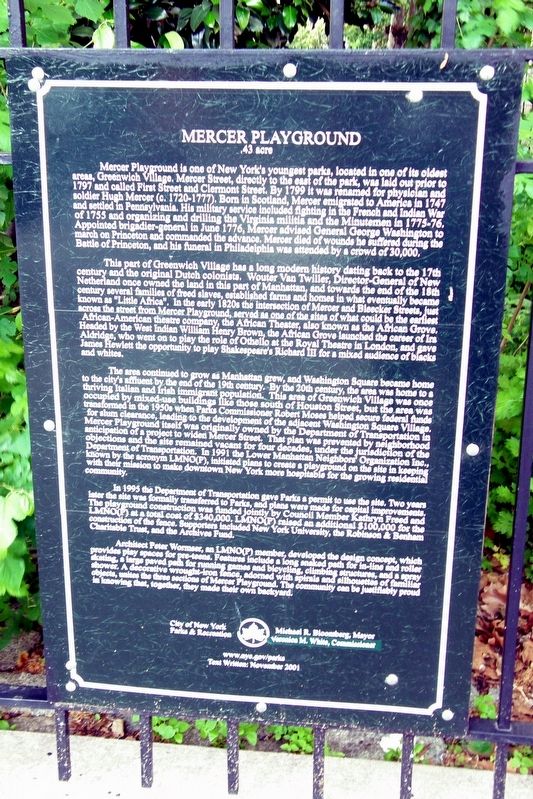
Photographed by Larry Gertner, May 25, 2014
1. Mercer Playground Marker
This part of Greenwich Village has a long modern history dating back to the 17th century and the original Dutch colonists. Wouter Van Twiller, Director-General of New Netherland once owned the land in this part of Manhattan, and towards the end of the 18th century several families of freed slaves, (sic) established farms and homes in what eventually became known as “Little Africa.” In the early 1820s the intersection of Mercer and Bleeker Streets, just across the street from Mercer Playground, served as one of the sites of what could be the earliest African-American theatre company, the African Theater, also known as the African Grove. Headed by the West Indian William Henry Brown, the African Grove launched the career of Ira Aldridge, who went on to play the role of Othello at the Royal Theatre in London, and gave James Hewett the opportunity to play Shakespeare’s Richard III for a mixed audience of blacks and whites.
The area continued to grow as Manhattan grew, and Washington Square became home to the
this page online
Architect William Wormser, an LMNO(P) member, developed the design concept, which provides play spaces for pre-teens.
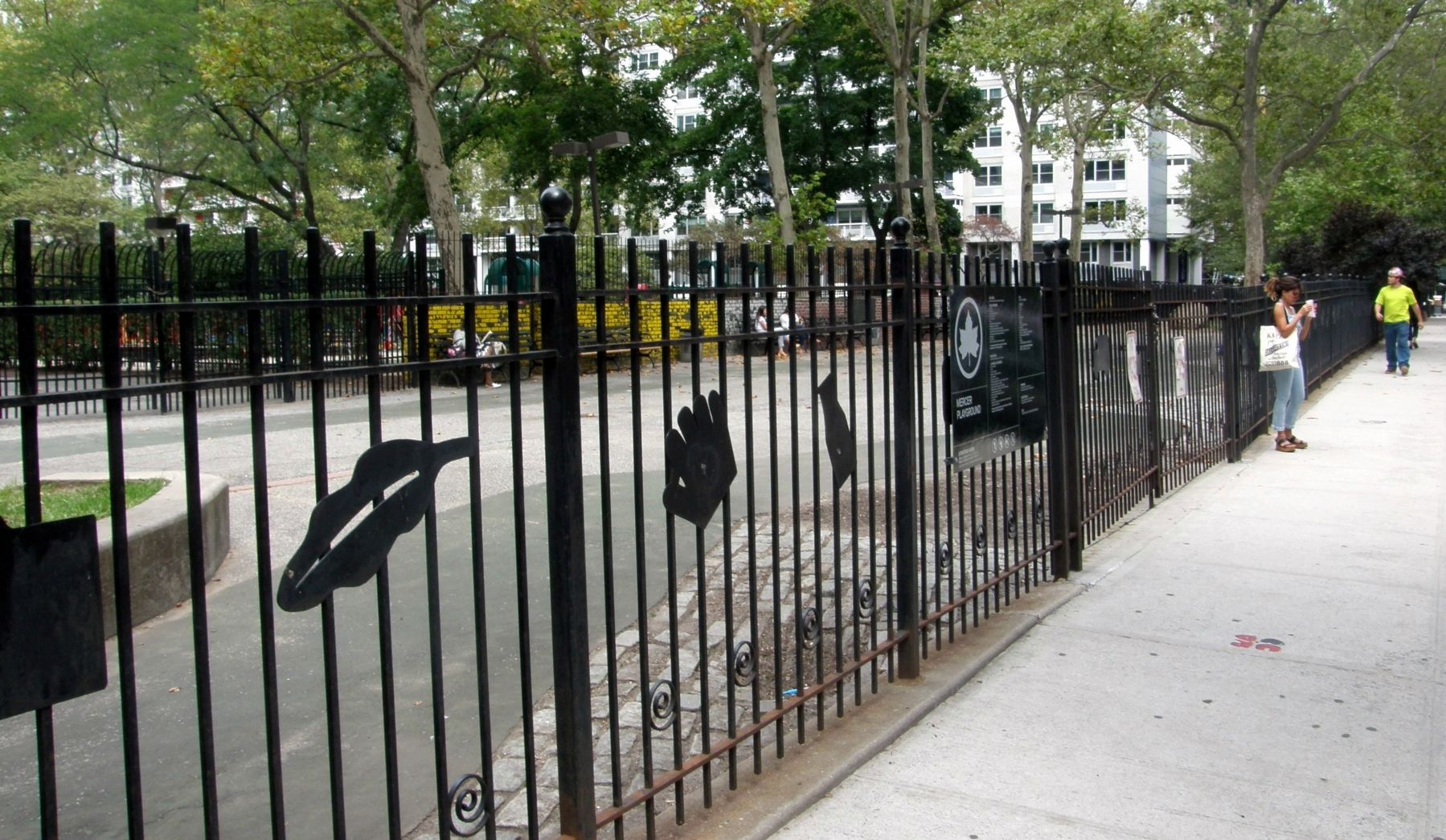
Photographed by Larry Gertner, August 14, 2019
2. Mercer Playground
The "decorative wrought-iron fence, adorned with spiral and silhouettes of familiar objects"
City of New York Parks and Recreation
Michael R. Bloomberg, Mayor
Veronica M. White, Commissioner
Text written: November 2001
Erected 2001 by City of New York Parks and Recreation.
Topics and series. This historical marker is listed in these topic lists: African Americans • Colonial Era • Parks & Recreational Areas • Settlements & Settlers. In addition, it is included in the NYC Parks series list. A significant historical month for this entry is June 1776.
Location. This marker has been replaced by another marker nearby. It was located near 40° 43.657′ N, 73° 59.77′ W. Marker was in Manhattan, New York, in New York County. It was in Greenwich Village. It was on Mercer Street near West 3rd Street, on the right when traveling south. Touch for map. Marker was in this post office area: New York NY 10012, United States of America. Touch for directions.

Regionally, this marker was in New York City. It was also in the American Northeast, in the Mid-Atlantic, and on the Eastern Seaboard. Globally, it was in the North Atlantic Region, North America, the Western Hemisphere, the Western World, and the Anglosphere. Historically, it found itself in what was once New Netherland and also one of the original Thirteen Colonies.
Other nearby markers. At least 8 other markers are within walking distance of this location: Mercer Park (within shouting distance of this marker); ASHRAE Centennial 1894-95 – 1994-95 (about 300 feet away, measured in a direct line); Charles Mingus (1922-1979) (about 600 feet away); NYU Community Memorial (about 600 feet away); Founders Memorial (about 600 feet away); Site of Elizabeth Blackwell's Infirmary for Women and Children (about 700 feet away); Stonecutters Memorial (about 700 feet away); The Weitz & Luxenberg Building (about 700 feet away). Touch for a list and map of all markers in Manhattan.
Related marker. Click here for another marker that is related to this marker. This marker has been replaced with the linked marker.
Also see . . . Mercer Playground, NYC Parks. (Submitted on October 9, 2019, by Larry Gertner of New York, New York.)
Credits. This page was last revised on January 20, 2025. It was originally submitted on October 9, 2019, by Larry Gertner of New York, New York. This page has been viewed 685 times since then and 59 times this year. Photos: 1, 2. submitted on October 9, 2019, by Larry Gertner of New York, New York. • Michael Herrick was the editor who published this page.
