
Democracy and the Gymnastics Movement
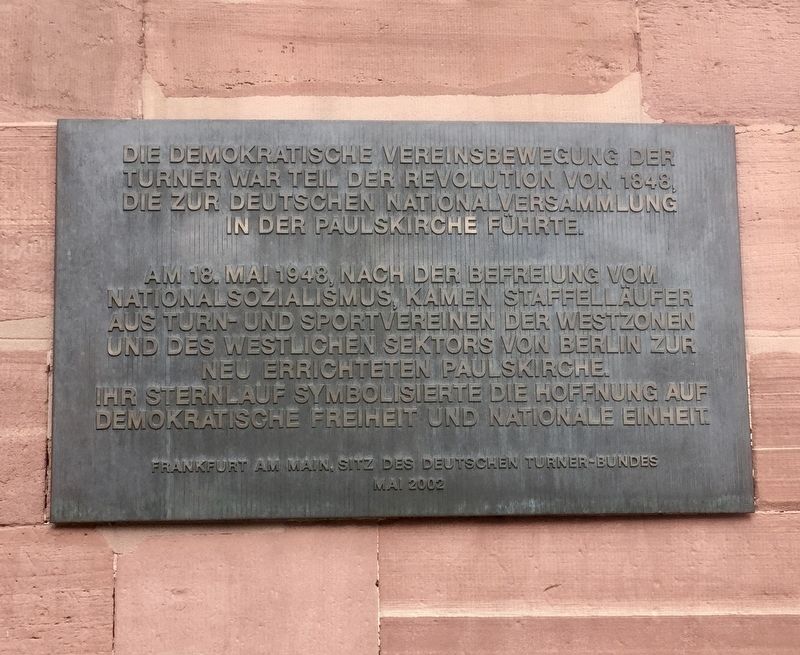

Am 18. Mai 1948, nach der Befreiung vom Nationalsozialismus, kamen Staffellaeufer Aus Turn- und Sportvereinen der Westzonen und des Westlichen Sektors von Berlin zur neu errichteten Paulskirche. Ihr Sternlauf Symbolisierte die Hoffnung auf Demokratische Freiheit und Nationale Einheit.
Frankfurt am Main, Sitz der Deutschen Turner-Bundes
Mai 2002
-
The democratic association movement of
gymnasts was part of the Revolution of 1848
that led to the meeting of the German National Assembly
here in the Paulskirche.
On May 18, 1948, after the liberation from
National Socialism, runners forming a relay came
from the sports and gymnastics clubs of West Germany
and the Western Sector of Berlin to the
newly rebuilt Paulskirche. Their run symbolized the hopes for
democratic freedom and national unity.
Frankfurt am Main, Seat of the German Gymnastics Federation
May 2002
Erected 2002.
Topics. This historical marker
this page online
Location. 50° 6.682′ N, 8° 40.845′ E. Marker is in Frankfurt am Main, Hessen (Hesse). It is in Innenstadt I. It is at the intersection of Berliner Strasse and Paulsplatz, on the right when traveling east on Berliner Strasse. Touch for map. Marker is at or near this postal address: Paulsplatz 11, Frankfurt am Main HE 60311, Germany. Touch for directions.
Regionally, it is in Europe, the European Union, Atlantic Europe, Central Europe, the Schengen Area, Western Europe, and the Western World. Historically, it finds itself in what was once the Roman Empire and specifically also the Holy Roman Empire.
Other nearby markers. At least 8 other markers are within walking distance of this marker: Johanna Kirchner (a few steps from this marker); Mahnmal für den Widerstand gegen NS-Terror / Memorial for the Resistance Against Nazi Terror (within shouting distance of this marker); Theodor Heuss (within shouting distance of this marker); John F. Kennedy Spoke Here (within shouting distance of this marker); Heinrich von Gagern (within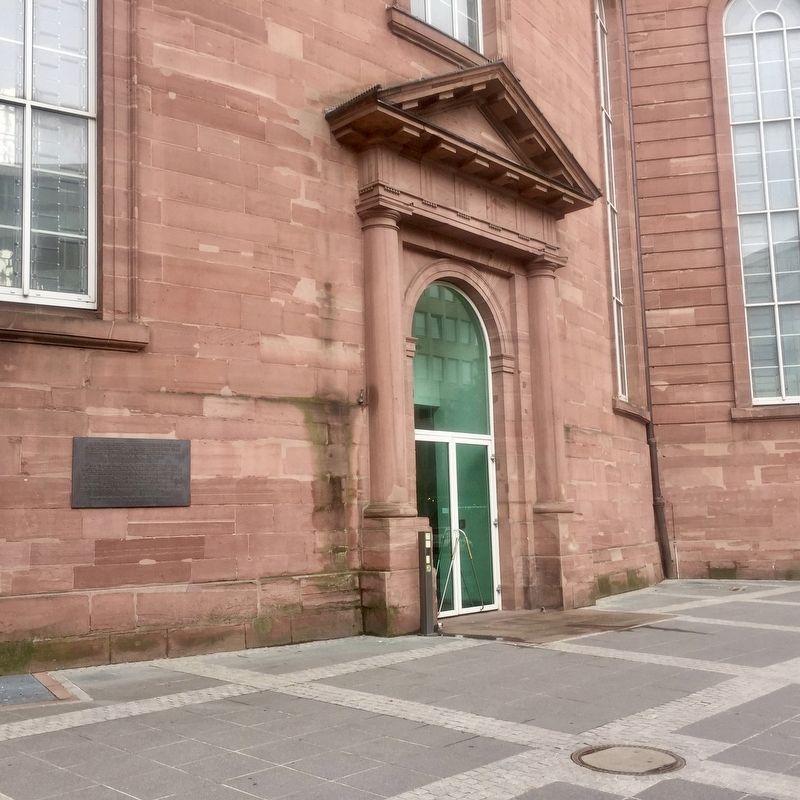
More about this marker. The marker is attached to the north side of the Paulskirche.
Also see . . . Älter als die Olympischen Spiele der Moderne (Deutsche Welle, in German). "Frankfurt is a special venue. The role of gymnasts in history is not without controversy. In the 19th century, the gymnastics movement had developed. The aim was to make young men fit through sport - to support the idea of an all-German state. In the Third Reich, the gymnasts were harnessed by the National Socialists for their own purposes. Frankfurt and gymnastics, however, stands for the history of the German freedom movement. In the Frankfurt Paulskirche the National Assembly met after the March Revolution of 1848. Among the deputies of the first freely elected Parliament was also "Father of Gymnastics", Friedrich Ludwig Jahn. A plaque on the Paulskirche reminds of the time of the first attempt at democracy on German soil. "The democratic association movement of gymnsasts was part of the Revolution of 1848" is written there." (Submitted on October 26, 2019.)
Additional keywords. Gedenktafel
Credits. This page was last revised on January 28, 2022. It was originally submitted on October 26, 2019, by Andrew Ruppenstein of Lamorinda, California. This page has been viewed 188 times since then and 11 times this year. Photos: 1, 2. submitted on October 26, 2019, by Andrew Ruppenstein of Lamorinda, California.
