This Concretion
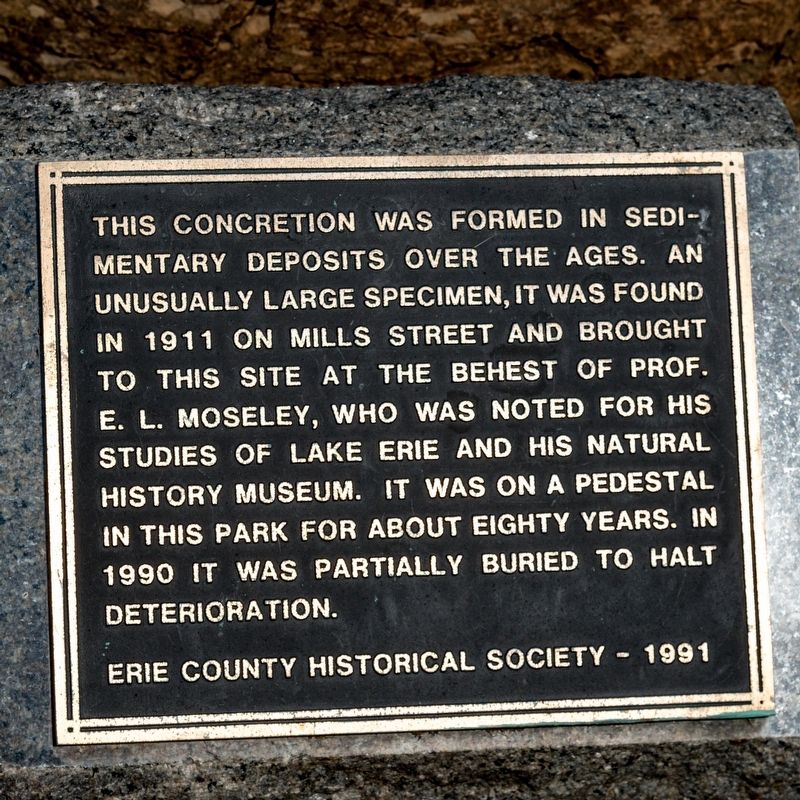
Erected 1991 by Erie County Historical Society.
Topics. This historical marker is listed in this topic list: Natural Features. A significant historical year for this entry is 1911.
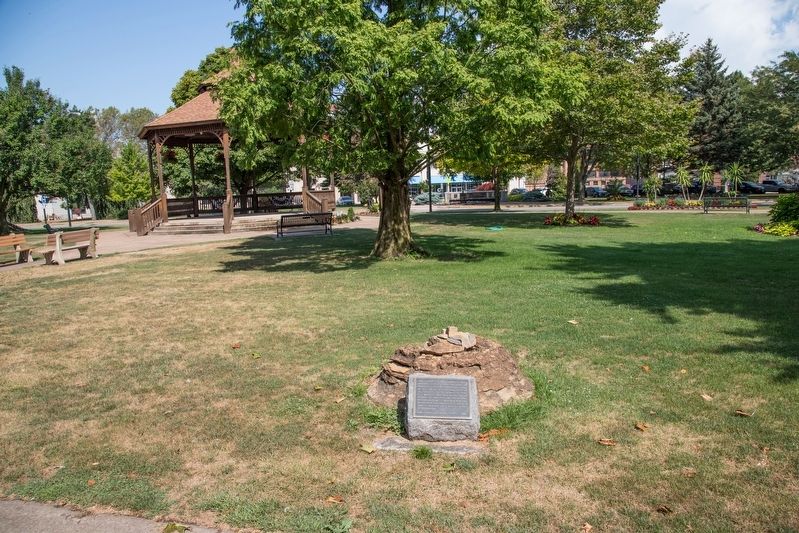
Location. 41° 27.295′ N, 82° 42.589′ W. Marker is in Sandusky, Ohio, in Erie County. It can be reached from East Washington Street (U.S. 6) near Colulmbus Avenue. It is in Washington Park between Columbus Avenue and Wayne Street, near the Gazebo. Touch for map. Marker is in this post office area: Sandusky OH 44870, United States of America. Touch for directions.

Regionally, this marker is on Ohio’s Lake Erie Shore and in the Western Reserve. It is also in the American Midwest and in the Corn Belt. Globally, it is in North America, on the Great Lakes,
this page online
Other nearby markers. At least 8 other markers are within walking distance of this marker: Kilbourne Plat (within shouting distance of this marker); Grace Episcopal Church (within shouting distance of this marker); The Signers of the Declaration Of Independence (within shouting distance of this marker); The Ninteenth Amendment (within shouting distance of this marker); Surrender - World War II (within shouting distance of this marker); Perry's Monument (within shouting distance of this marker); John F. Kennedy's Inaugural Address (within shouting distance of this marker); Emancipation Proclamation (within shouting distance of this marker). Touch for a list and map of all markers in Sandusky.
Regarding This Concretion. Profession Edwin Lincoln Moseley (1865-1948) taught at Sandusky High School between 1889 and 1914. Science professor at Bowling Green Normal College, now Bowling Green State

Also see . . .
1. Spherical wonders: Geologists have a few theories about how concretions formed. 2015 article by Laura Arenschield in The Columbus Dispatch. Includes photos of other concretions. Excerpt:
At the end of the Devonian Period, there was a mass extinction—one of five great extinctions that scientists say occurred during Earth’s history. Some of the life that became extinct, scientists say, could have been the seed for the concretions we now see. If that is true, concretions could have formed the way oysters turn grains of sand into pearls, said Eric Mumper, an Ohio State University doctoral student who has studied concretions. Scientists have found fossils in the cores of some concretions, lending credence to that theory. But not all concretions have fossils at their hearts, and not all fossils became concretions.(Submitted on October 31, 2019.)
Another theory: Concretions might have formed when water flowed beneath the floor of the inland sea, bringing new minerals to the shale and soil. Concretions are made up of varying materials. Their cores are generally soft rock, which can wash away over time.Their shells are harder.Photographed by J. J. Prats, August 7, 20193. The Concretion in Washington Park Near the Gazebo
“Geologists liken it to a Tootsie Roll Pop—you’ve got that hard outside and soft inside,” Rich Niccum said.
2. Edwin Lincoln Moseley (1865-1948): Naturalist, Scientist, Educator. Link is to Amazon.com. Publisher’s synopsis:
Edwin Lincoln Moseley was born March 29, 1865 in Union City, Michigan, attended public schools, and graduated at the age of 15. In 1885, he graduated with the degree of Master of Arts from the University of Michigan, the youngest member of the class of 82 students. He began his teaching career at Central High School in Grand Rapids, MI, and taught science and mathematics. After a University of Michigan scientific expedition to the Philippine Islands for 12 months, Moseley continued to travel widely in China and Japan. In 1889, he was appointed teacher of science at Sandusky High School, in Sandusky, OH, and opened a museum of natural history in the high school. He continued to teach and learn his entire life and published numerous scientific papers, and became nationally known for his accurate long-range weather forecasts.(Submitted on October 31, 2019.)Until the publication of this book, no book had been written on the life of Edwin Lincoln Moseley (1865-1948). Moseley was probably the most widely known (and the most colorful) member of the original faculty of the Bowling Green Normal School, now Bowling Green State University. He has been recognized for his wide scientific qualification, his popular and numerous field trips, his frugal habits, his financial support of students, and the many legends generated about him—attributes of Moseley that have become the focus of this book.
Unlike most biographies, which are written in a chronological sequence, this book presents Moseley's life by topics, developed in 20 chapters. Information presented is based on writings by people who knew Moseley personally (college presidents, former students, and local friends).
Credits. This page was last revised on October 31, 2019. It was originally submitted on October 31, 2019, by J. J. Prats of Powell, Ohio. This page has been viewed 407 times since then and 24 times this year. Photos: 1, 2, 3. submitted on October 31, 2019, by J. J. Prats of Powell, Ohio.
