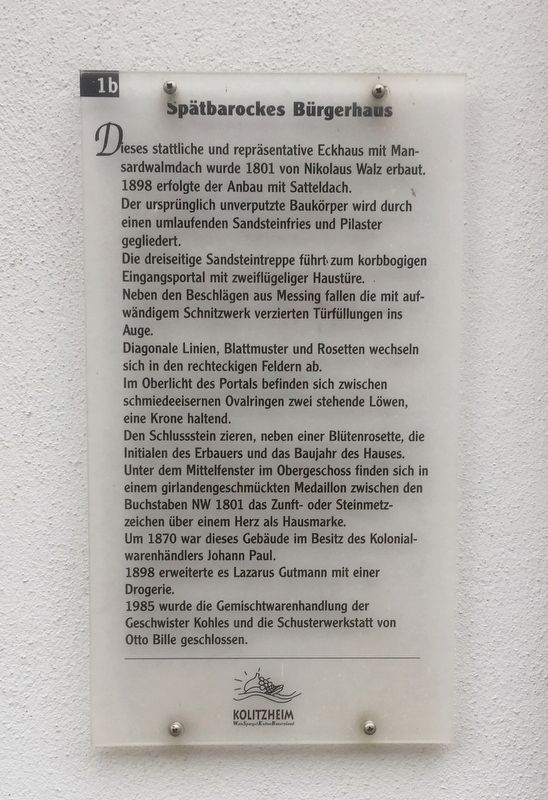
Spätbarockes Bürgerhaus
⎯⎯⎯
Late Baroque Patrician House

Der ursprünglich unverputzte Baukörper wird durch einen umlaufenden Sandsteinfries und Pilaster gegliedert.
Die dreiseitige Sandsteintreppe führt zum korbbogigen Eingangsportal mit zweiflügeliger Haustüre.
Neben den Beschlägen aus Messing fallen die mit aufwändigem Schnitzwerk verzierten Türfüllungen ins Auge.
Diagonale Linien, Blattmuster und Rosetten wechseln sich in den rechteckigen Feldern ab.
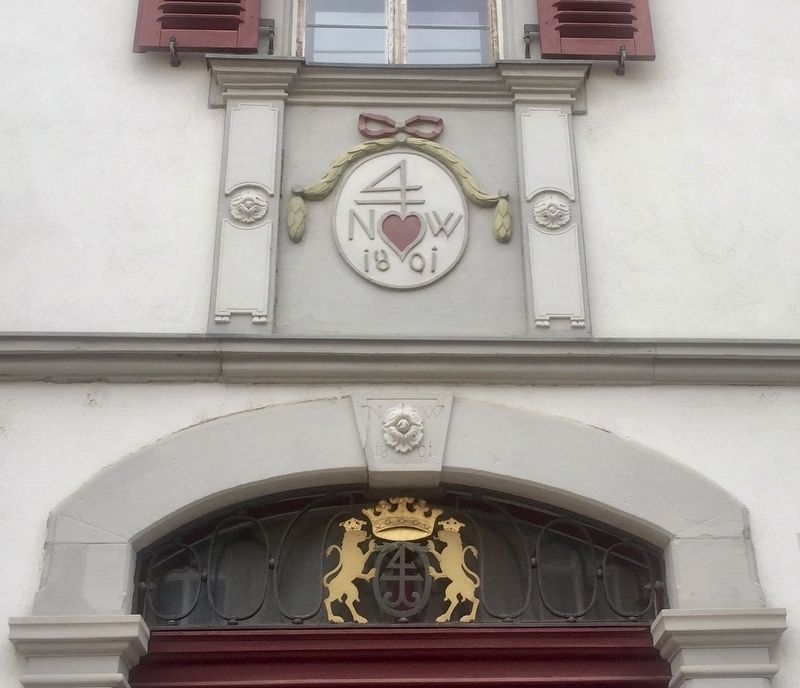
Im Oberlicht des Portals befinden sich zwischen schmiedeeisernen Ovalringen zwei stehende Löwen, eine Krone haltend.
Den Schlussstein zieren, neben einer Blütenrosette, die Initialen des Erbauers und das Baujahr des Hauses.
Unter dem Mittelfenster im Obergeschoss finden sich in einem girlandengeschmückten Medaillon zwischen den Buchstaben NW 1801 das Zunft- oder Steinmetz- zeichen über einem Herz als Hausmarke.
Um 1870 war dieses Gebäude im Besitz des Kolonial- warenhändlers Johann Paul.
1898 erweiterte es Lazarus Gutmann mit einer Drogerie.
1985 wurde die Gemischtwarenhandlung der Geschwister Kohles und die Schusterwerkstatt von Otto Bille geschlossen.
-
This stately and representative corner house with a mansard roof was built in 1801 by Nikolaus Walz. In 1898, the gable roof was added.
The originally unplastered structure is divided by a surrounding sandstone frieze and pilaster.
The three-sided sandstone staircase leads to the arched entrance portal with double-winged front door.
In addition to brass fittings, the door panels are decorated with elaborate carving.
Diagonal lines, leaf patterns and rosettes alternate in rectangular fields.
In the skylight between wrought-iron oval
Next to a rosette, the keystone adorns the initials of the builder and the year of construction of the house.
Below the center window on the upper floor, in a garland-adorned medallion between the letters NW 1801, there is the guild or stonemason symbol over a heart as a private sign.
Around 1870 this building was owned by the colonial merchant Johann Paul.
In 1898 Lazarus Gutmann extended it with a drugstore.
In 1985 the general store of the Kohles siblings and the cobbler workshop of Otto Bille were closed. (Marker Number 1b.)
this page online
Topics. This historical marker is listed in these topic lists: Architecture • Industry & Commerce. A significant historical year for this entry is 1801.
Location. 49° 53.888′ N, 10° 16.079′ E. Marker is in Zeilitzheim, Bayern (Bavaria), in Schweinfurt. It is at the intersection of Johann-Pröschel-Straße and Marktplatz, on the right when traveling west on Johann-Pröschel-Straße. Touch for map. Marker is at or near this postal address: Johann-Pröschel-Straße 2, Zeilitzheim BY 97509, Germany. Touch for directions.
Regionally, it is in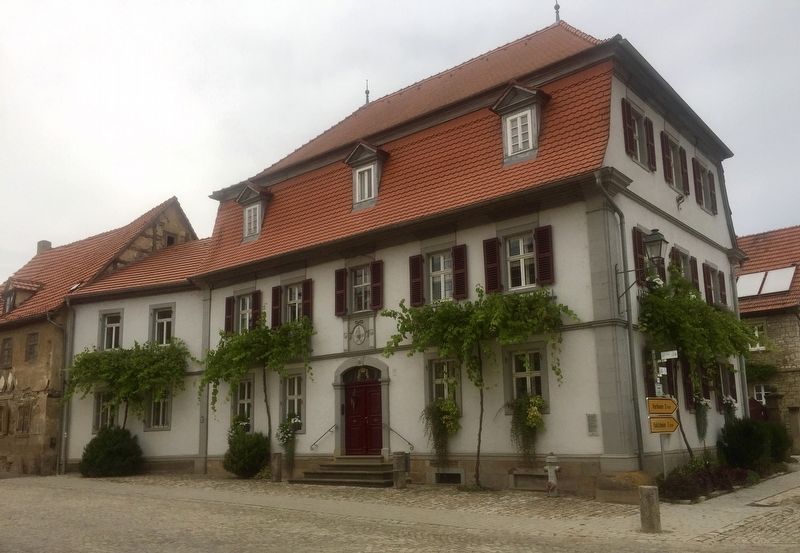
Other nearby markers. At least 8 other markers are within walking distance of this marker: Das Schloss / The Chateau (a few steps from this marker); Gasthaus "Zur Sonne" / Inn "at the Sun" (a few steps from this marker); Ehem. Dorfbrauerei / Former Village Brewery (within shouting distance of this marker); Ehemalige Gendarmeriestation / Former Police Station (within shouting distance of this marker); ehem. Pfarrhaus - Pfarrhof / Former Rectory - Vicarage (within shouting distance of this marker); Gemeindebäckerei / Community Bake-House (about 90 meters away, measured in a direct line); Gerberhaus / Tanner's House (Brueckenstrasse 5) (about 90 meters away); Haus der Begegnung / "House of Encounter" (about 90 meters away). Touch for a list and map of all markers in Zeilitzheim.
Credits. This page was last revised on January 28, 2022. It was originally submitted on October 31, 2019, by Andrew Ruppenstein of Lamorinda, California. This page has been viewed 167 times since then and 14 times this year. Photos: 1, 2, 3. submitted on October 31, 2019, by Andrew Ruppenstein of Lamorinda, California.
