Near Sandston in Henrico County, Virginia — The American South (Mid-Atlantic)
The Trent House
McClellan’s Headquarters
| — | 1862 Peninsula Campaign | — |
Photographed by Bill Coughlin, April 25, 2007
1. The Trent House - McClellan’s Headquarters marker
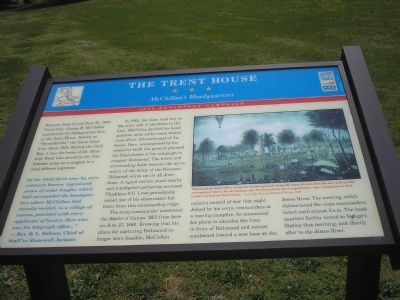
Between June 12 and June 28, 1862, Union Gen. George B. McClellan maintained his headquarters here at Trent House. Known as “Reynoldsville,” the house dates from about 1825. During the Civil War, it was the home of Dr. Peterfield Trent who served in the Confederate army as a surgeon in a local defense regiment.
In 1862, the main road ran on the other side of the house to the west. McClellan pitched his headquarters tents under some walnut trees about 100 yards east of the house. Here, accompanied by his extensive staff, the general planned the final phases of his campaign to conquer Richmond. The house and surrounding fields became the nerve center of the Army of the Potomac. Telegraph wires ran in all directions. A signal station stood nearby and intelligence-gathering aeronaut Thaddeus S.C. Lowe periodically raised one of his observation balloons from this commanding ridge.
The army commander monitored the Battle of Gaines’ Mill from here on June 27, 1862. Knowing that his plans for capturing Richmond no longer were feasible, McClellan called a council of war that night. Joined by his corps commanders at a roaring
this page online
“At the Trent farm near by, were extensive bowers, ingeniously woven of cedar boughs, which had surrounded the headquarters where McClellan had recently resided, in a village of canvas, provided with every appliance of luxury. Here also was his telegraph office…”
— Rev. R. L. Dabney, Chief of Staff to Stonewall Jackson.
Erected by Virginia Civil War Trails.
Topics and series. This historical marker is listed in this topic list: War, US Civil. In addition, it is included in the Virginia Civil War Trails series list. A significant historical date for this entry is June 12, 1894.
Location. This marker has been replaced by another marker nearby. It was located near 37° 32.626′ N, 77° 16.601′ W. Marker was near Sandston, Virginia, in Henrico County. It was on Grapevine Road 0.3 miles south of Old Hanover Road, on the right
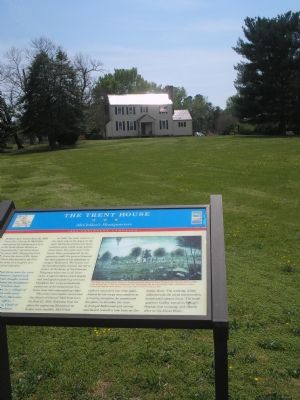
Photographed by Bill Coughlin, April 25, 2007
2. McClellan’s Headquarters
This marker is part of the 1862 Peninsula Campaign of the Virginia Civil War Trails.

Regionally, this marker was in the Piedmont, in Central Virginia, and in the Richmond Metropolitan Area. It was also in the American South, specifically in the Upper South, and on the Eastern Seaboard. Globally, it was in the North Atlantic Region, North America, the Western Hemisphere, the Western World, and the Anglosphere. Historically, it found itself in what was once the territory of the Mississippian Culture, one of the original Thirteen Colonies, one of the Confederate States of America, and the Antebellum South.
Other nearby markers. At least 8 other markers are within 2 miles of this location, measured as the crow flies: A different marker also named The Trent House (here, next to this marker); a different marker also named The Trent House (approx. 0.3 miles away); Grapevine Bridge (approx. half a mile away); Seven Days Battles (approx. half a mile away); Chickahominy Water Trail (approx. 0.6 miles away); a different marker also named Seven Days Battles (approx. 1.1 miles away); Savage Station (approx. 1.2 miles away); Route to White Oak Swamp and Malvern Hill (approx. 1.2 miles away). Touch for a list and map of all markers in Sandston.
More about this marker. On the upper right is "This sketch by Union officer Robert K. Sneden probably shows the house 20 years after the war, with an 1862 scene painted into it. You are looking east. The Trent House sits on a prominent ridge, making this an ideal location for balloon observations." - Copyright Virginia Historical Society, 1999
Related marker. Click here for another marker that is related to this marker. This marker has been replaced with the linked marker.
Credits. This page was last revised on June 19, 2025. It was originally submitted on November 20, 2007, by Bill Coughlin of Woodland Park, New Jersey. This page has been viewed 3,459 times since then and 93 times this year. Last updated on December 7, 2008, by Bernard Fisher of Richmond, Virginia. Photos: 1, 2. submitted on November 20, 2007, by Bill Coughlin of Woodland Park, New Jersey. • Craig Swain was the editor who published this page.
