Slingerlands in Albany County, New York — The American Northeast (Mid-Atlantic)
Helderberg-Hudson Rail Trail
Photographed by Steve Stoessel, November 8, 2019
1. Helderberg-Hudson Rail Trail Marker
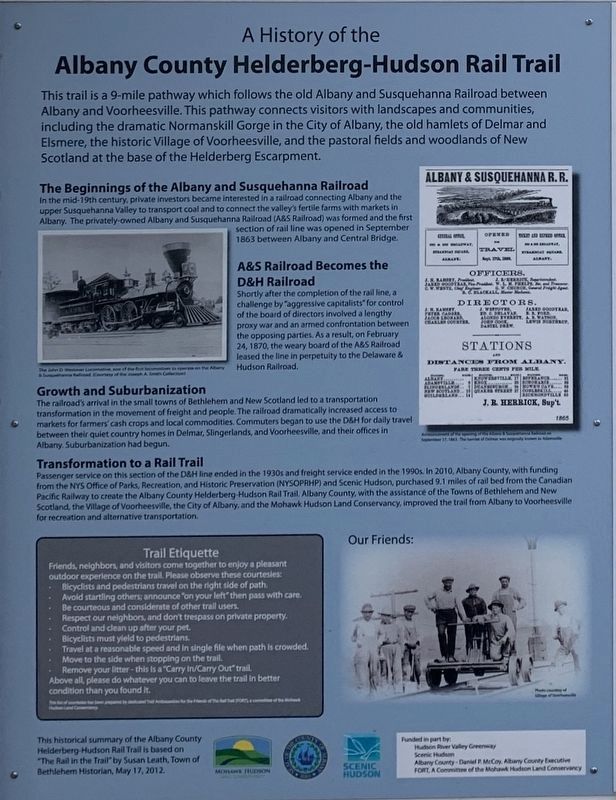
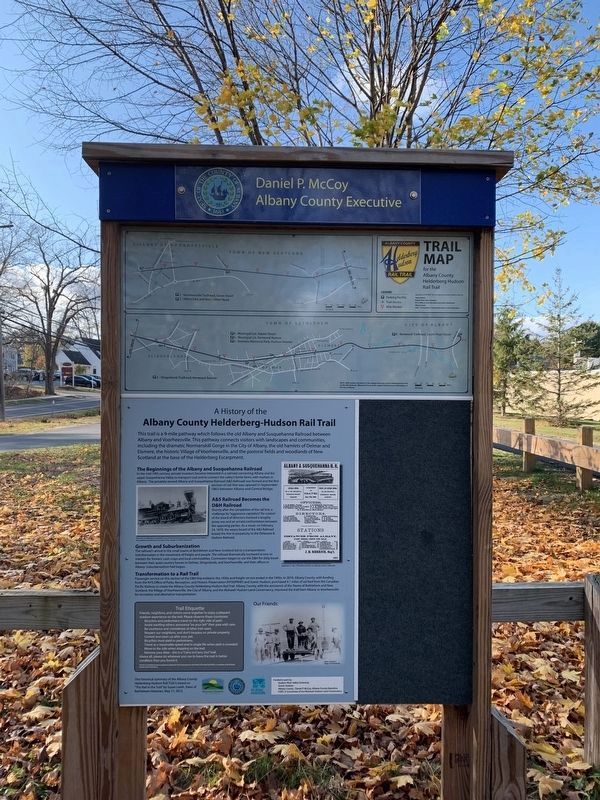
This trail is a 9-mile pathway which follows the old Albany and Susquehanna Railroad between Albany and Voorheesville. This pathway connects visitors with landscapes and communities, including the dramatic Normanskill Gorge in the City of Albany, the old hamlets of Delmar and Elsmere, the historic Village of Voorheesville, and the pastoral fields and woodlands of New Scotland at the base of the Helderberg Escarpment.
The Beginnings of the Albany and Susquehanna Railroad
In the mid-19th century, private investors became interested in a railroad connecting Albany and the upper Susquehanna Valley to transport coal and to connect the valley's fertile farms with markets in Albany. The privately-owned Albany and Susquehanna Railroad (A&S Railroad) was formed and the first section of rail line was opened in September 1863 between Albany and Central Bridge.
A&S Railroad Becomes the D&H Railroad
Shortly after the completion of the rail line, a challenge by "aggressive capitalists” for control of the board of directors involved a lengthy proxy war and
this page online
Growth and Suburbanization
The railroad's arrival in the small towns of Bethlehem and New Scotland led to a transportation transformation in the movement of freight and people. The railroad dramatically increased access to markets for farmers' cash crops and local commodities. Commuters began to use the D&H for daily travel between their quiet country homes in Delmar, Slingerlands, and Voorheesville, and their offices in Albany. Suburbanization had begun.
Transformation to a Rail Trail
Passenger service on this section of the D&H line ended in the 1930s and freight service ended in the 1990s. In 2010, Albany County, with funding from the NYS Office of Parks, Recreation, and Historic Preservation (NYSOPRHP) and Scenic Hudson, purchased 9.1 miles of rail bed from the Canadian Pacific Railway to create the Albany County Helderberg-Hudson Rail Trail. Albany County, with the assistance of the Towns of Bethlehem and New Scotland, the Village
Photographed by Steve Stoessel, November 8, 2019
2. Helderberg-Hudson Rail Trail Marker
This historical summary of the Albany County Helderberg-Hudson Rail Trail is based on "The Rail in the Trail” by Susan Leath, Town of Bethlehem Historian, May 17, 2012
Left Photo: The John D. Westover, one of the first locomotives to operate on the Albany & Susquehanna Railroad.
Right Advertisement: Announcement of the opening of the Albany and Susquehanna Railroad on September 17, 1863.
Erected by Albany County Helderberg-Hudson Rail Trail.
Topics. This historical marker is listed in these topic lists: Parks & Recreational Areas • Railroads & Streetcars. A significant historical date for this entry is February 24, 1870.
Location. 42° 37.74′ N, 73° 51.723′ W. Marker is in Slingerlands, New York, in Albany County. It is on Kenwood Avenue 0.1 miles east of New Scotland Avenue (New York State Route 85), on the right when traveling west. Touch for map. Marker is in this post office area: Slingerlands NY 12159, United States of America. Touch for directions.

Regionally,
Photographed by Steve Stoessel
3. Helderberg-Hudson Rail Trail Marker
Other nearby markers. At least 8 other markers are within one mile of this marker, measured as the crow flies: The Slingerlands Train Station (a few steps from this marker); Slingerland Family Burial Vault Erected 1852 (approx. 0.2 miles away); Slingerland Home (approx. ¼ mile away); Albert Slingerland House (approx. ¼ mile away); Andrew Conning (approx. 0.3 miles away); Slingerlands National Historic District (approx. ¾ mile away); Burial Site of Soldiers of the Revolutionary War (approx. one mile away); LaGrange Farm (approx. 1.1 miles away). Touch for a list and map of all markers in Slingerlands.
Also see . . .
1. Albany and Susquehanna Railroad. Wikipedia entry (Submitted on November 8, 2019, by Steve Stoessel of Niskayuna, New York.)
2. The Delaware & Hudson Railroad. Wikipedia entry (Submitted on November 8, 2019, by Steve Stoessel of Niskayuna, New York.)
3. Delaware & Hudson Railway, "The Bridge Line". American Rails website entry (Submitted on November 8, 2019, by Steve Stoessel of Niskayuna, New York.)
4. The Albany and Susquehanna Railroad and the War for its Control. This presentation was given as part of the Bethlehem Historic Association Speaker Series and was recorded live at the Bethlehem Public Library in Delmar, NY on October 16, 2024.
Included in the description for this video:(Submitted on September 1, 2025, by Trudi Jacobson of Slingerlands, New York.)
In 1852, a railroad was proposed to run from Albany to Binghamton to help bring farm products to Albany and New York City, and to bring cheaper coal to Albany. The line was completed in January 1869. “Robber Baron” James Fisk of the Erie RR tried to get control of the line to connect it to his Erie RR, by controlling the board of directors of the Albany and Susquehanna road. In August 1869, a “war” between conflicting boards of directors broke out, which soon spread to violence on the railroad line itself. This is the story of the railroad (better known as the D&H), which is part of the Helderberg Hudson Rail Trail that passes through Delmar, the struggle for its control, and the outcome.
Credits. This page was last revised on September 20, 2025. It was originally submitted on November 8, 2019, by Steve Stoessel of Niskayuna, New York. This page has been viewed 583 times since then and 44 times this year. Photos: 1, 2, 3. submitted on November 8, 2019, by Steve Stoessel of Niskayuna, New York. • Michael Herrick was the editor who published this page.
