Sugar Valley in Walker County, Georgia — The American South (South Atlantic)
Snake Creek Gap
Sherman's First Flanking Movement
Atlanta Campaign Heritage Trail
Photographed by Mark Hilton, November 19, 2019
1. Snake Creek Gap Marker
Inscription.
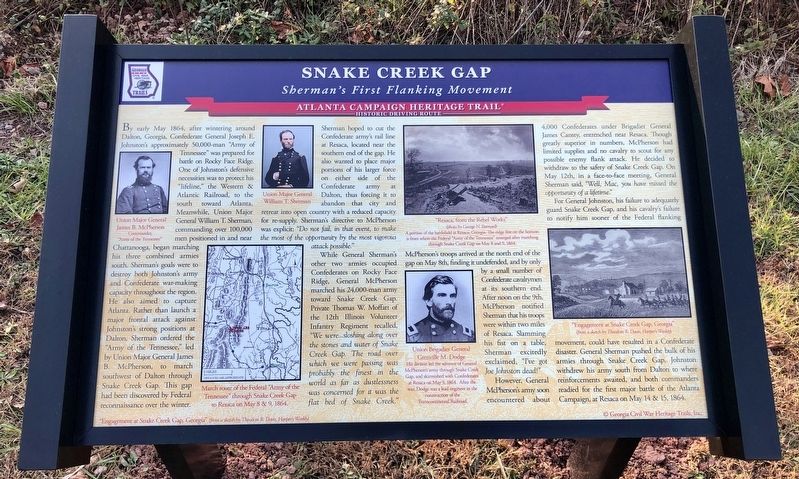
Snake Creek Gap. Sherman's First Flanking Movement. By early May 1864, after wintering around Dalton, Georgia, Confederate General Joseph E. Johnston's approximately 50,000-man Army of Tennessee was prepared for battle on Rocky Face Ridge. One of Johnston's defensive necessities was to protect his "lifeline," the Western and Atlantic Railroad, to the south toward Atlanta. Meanwhile, Union Major General William T. Sherman, commanding over 100,000 men positioned in and near Chattanooga, began marching his three combined armies south. Sherman's goals were to destroy both Johnston's army and Confederate war-making capacity throughout the region. He also aimed to capture Atlanta. Rather than launch a major frontal attack against Johnston's strong positions at Dalton, Sherman ordered the Army of the Tennessee, led by Union Major General James B. McPherson, to march southwest of Dalton through Snake Creek Gap. This gap had been discovered by Federal reconnaissance over the winter., Sherman hoped to cut the Confederate army's rail line at Resaca, located near the southern end of the gap. He also wanted to place major portions of his larger force on either side of the Confederate army at Dalton, thus forcing it to abandon that city and retreat into open country with a reduced capacity for re-supply. Sherman's directive to McPherson was explicit: Do not fail, in that event, to make most of the opportunity by the most vigorous attack possible. , While General Sherman's other two armies occupied Confederates on Rocky Face Ridge, General McPherson marched his 24,000-man army toward Snake Creek Gap. Private Thomas W. Moffatt of the 12th Illinois Volunteer Infantry Regiment recalled, We were...sloshing along over the stones and water of Snake Creek Gap. The road over which we were passing was probably the finest in the world as far as dustlessness was concerned for it was the flat bed of Snake Creek., McPherson's troops arrived at the north end of the gap on May 8th, finding it undefended, and by only by a small number of Confederate cavalrymen at its southern end. After noon on the 9th, McPherson notified Sherman that his troops were within two miles of Resaca. Slamming his fist on a table, Sherman excitedly exclaimed, I've got Joe Johnston dead! However, General McPherson's army soon encountered about 4,000 Confederates under Brigadier General James Cantey, entrenched near Resaca. Though greatly superior in numbers, McPherson had limited supplies and no cavalry to scout for any possible enemy flank attack. He decided to withdraw to the safety of Snake Creek Gap. On May 12th, in a face-to-face meeting, General Sherman said, "Well, Mac, you have missed the opportunity of a lifetime.", For General Johnston, his failure to adequately guard Snake Creek Gap, and his cavalry's failure to notify him sooner of the Federal flanking movement, could have resulted in a Confederate disaster. General Sherman pushed the bulk of his armies through Snake Creek Gap, Johnston withdrew his army south from Dalton to where reinforcements awaited, and both commanders readied for the first major battle of the Atlanta Campaign, at Resaca on May 14 and 15, 1864.
By early May 1864, after wintering around
Dalton, Georgia, Confederate General Joseph E.
Johnston's approximately 50,000-man Army of
Tennessee was prepared for
battle on Rocky Face Ridge.
One of Johnston's defensive
necessities was to protect his
"lifeline," the Western &
Atlantic Railroad, to the
south toward Atlanta.
Meanwhile, Union Major
General William T. Sherman,
commanding over 100,000
men positioned in and near
Chattanooga, began marching
his three combined armies
south. Sherman's goals were to
destroy both Johnston's army
and Confederate war-making
capacity throughout the region.
He also aimed to capture
Atlanta. Rather than launch a
major frontal attack against
Johnston's strong positions at
Dalton, Sherman ordered the
Army of the Tennessee, led
by Union Major General James
B. McPherson, to march
southwest of Dalton through
Snake Creek Gap. This gap
had been discovered by Federal
reconnaissance over the winter.
Sherman hoped to cut the
Confederate army's rail line
at Resaca, located near the
southern end of the gap. He
also wanted to place major
portions of his larger force
on either side of the
Confederate army at
Dalton, thus forcing it to
abandon that city and
retreat into open country with a reduced capacity
for re-supply. Sherman's directive to McPherson
was explicit:
Click or scan to see this page online
Do not fail, in that event, to make
most of the opportunity by the most vigorous
attack possible.
While General Sherman's
other two armies occupied
Confederates on Rocky Face
Ridge, General McPherson
marched his 24,000-man army
toward Snake Creek Gap.
Private Thomas W. Moffatt of
the 12th Illinois Volunteer
Infantry Regiment recalled,
We were...sloshing along over
the stones and water of Snake
Creek Gap. The road over
which we were passing was
probably the finest in the
world as far as dustlessness
was concerned for it was the
flat bed of Snake Creek.
McPherson's troops arrived at the north end of the
gap on May 8th, finding it undefended, and by only
by a small number of
Confederate cavalrymen
at its southern end.
After noon on the 9th,
McPherson notified
Sherman that his troops
were within two miles
of Resaca. Slamming
his fist on a table,
Sherman excitedly
exclaimed, I've got
Joe Johnston dead!
However, General
McPherson's army soon
encountered about
4,000 Confederates under Brigadier General
James Cantey, entrenched near Resaca. Though
greatly superior in numbers, McPherson had
limited supplies and no cavalry to scout for any
possible enemy flank attack. He decided to
withdraw to the safety of Snake Creek Gap. On
May 12th, in a face-to-face meeting, General
Sherman said, "Well, Mac,
Photographed by Mark Hilton, November 19, 2019
2. Snake Creek Gap Marker at the Pinhoti Trail Trailhead.
you have missed the
opportunity of a lifetime."
For General Johnston, his failure to adequately
guard Snake Creek Gap, and his cavalry's failure
to notify him sooner of the Federal flanking
movement, could have resulted in a Confederate
disaster. General Sherman pushed the bulk of his
armies through Snake Creek Gap, Johnston
withdrew his army south from Dalton to where
reinforcements awaited, and both commanders
readied for the first major battle of the Atlanta
Campaign, at Resaca on May 14 & 15, 1864.
Erected 2019 by Georgia Civil War Heritage Trails, Inc. (Marker Number 13.)
Topics and series. This historical marker is listed in this topic list: War, US Civil. In addition, it is included in the Georgia Civil War Trails series list. A significant historical month for this entry is May 1864.
Location. 34° 39.847′ N, 85° 3.583′ W. Marker is in Sugar Valley, Georgia, in Walker County. It can be reached from Resaca Lafayette Road NW (Georgia Route 136) 4.1 miles north of Connector Route 136 Connector Road, on the right when traveling north. Located at the Pinhoti Trail Trailhead within the Chattahoochee-Oconee National Forests. Touch for map. Marker is at or near this postal address: Resaca Lafayette Road NW, La Fayette GA 30728, United States of America. Touch for directions.
Regionally, this marker is in Georgia’s Mountains. It is also in the American South, specifically in the Deep South, in Appalachia, and specifically in Southern Appalachia. Globally, it is in the North Atlantic Region, North America, the Western Hemisphere, the Western World, and the Anglosphere. Historically, it finds itself in what was once the original Cherokee Nation, the territory of the Mississippian Culture, one of the original Thirteen Colonies, one of the Confederate States of America, and the Antebellum South.
Other nearby markers. At least 8 other markers are within 6 miles of this marker
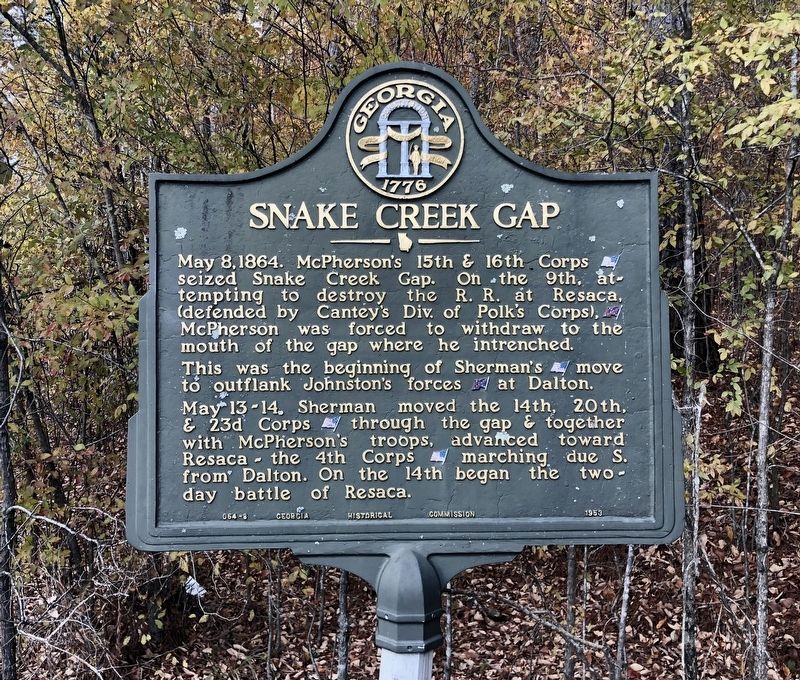
4. Another nearby Snake Creek Gap Marker 3.9 miles south on GA-136.
Credits. This page was last revised on October 31, 2024. It was originally submitted on November 23, 2019, by Mark Hilton of Montgomery, Alabama. This page has been viewed 2,309 times since then and 166 times this year. Photos:1, 2, 3, 4. submitted on November 23, 2019, by Mark Hilton of Montgomery, Alabama.