
Calhoun Depot
The War Years - 1861 - 1865
| — | Atlanta Campaign Heritage Trail | — |
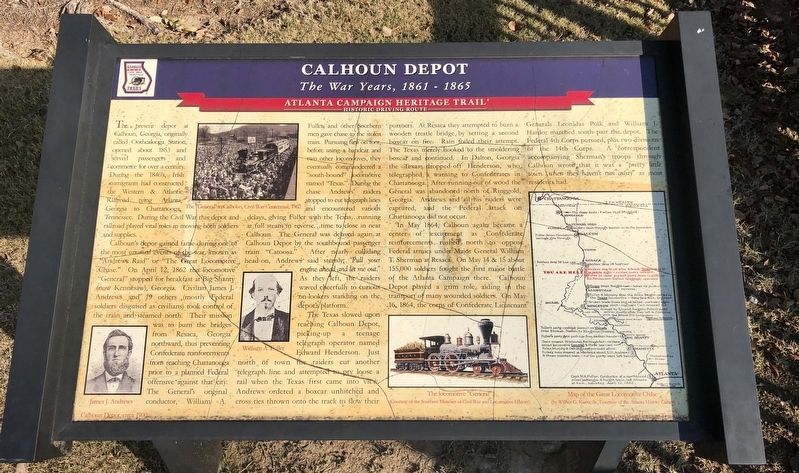
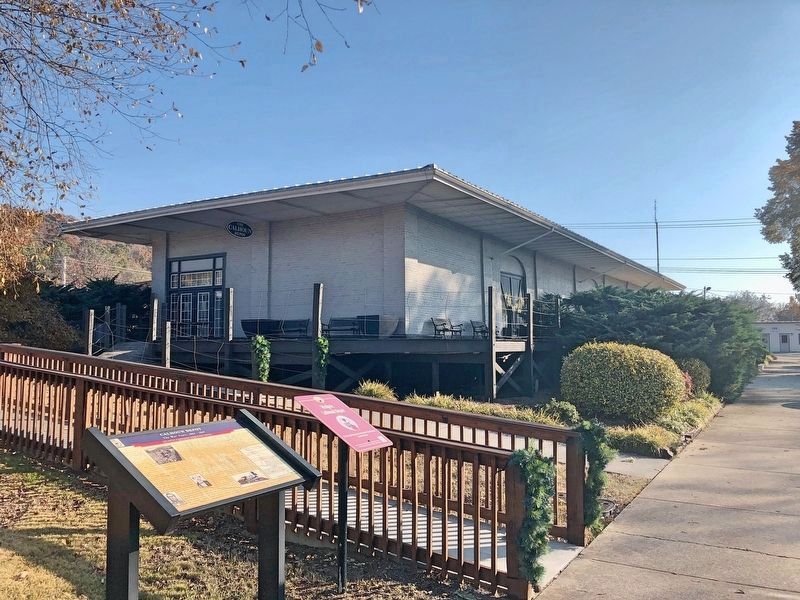
The present depot at Calhoun, Georgia, originally called Oothcalooga Station, opened about 1853 and served passengers and commerce for over a century. During the 1840's, Irish immigrants had constructed the Western & Atlantic Railroad tying Atlanta, Georgia to Chattanooga, Tennessee. During the Civil War this depot and railroad played vital roles in moving both soldiers and supplies.
Calhoun's depot gained fame during one of the most unusual events of the war, known as "Andrews Raid” or “The Great Locomotive Chase." On April 12, 1862 the locomotive “General” stopped for breakfast at Big Shanty (now Kennesaw), Georgia. Civilian James J. Andrews and 19 others (mostly Federal soldiers disguised as civilians) took control of the train and steamed north. Their mission was to burn the bridges from Resaca, Georgia northward, thus preventing Confederate reinforcements from reaching Chattanooga prior to a planned Federal offensive against that city. The General's original conductor, William A. Fuller, and other Southern men gave chase to the stolen train. Pursuing first on foot, before using a handcar and two other locomotives, they eventually commandeered a “south-bound" locomotive named “Texas.” During the chase Andrews' raiders stopped to cut telegraph lines and encountered various delays, giving Fuller with the Texas...running at full steam in reverse...time to close in near Calhoun. The General was delayed again at of Calhoun Depot by the southbound passenger train “Catoosa." After nearly colliding head-on, Andrews said sternly, "Pull your engine ahead and let me out." As they left, the raiders waved cheerfully to curious on-lookers standing on the depots platform.
The Texas slowed upon reaching Calhoun Depot, picking-up a teenage telegraph operator named Edward Henderson. Just north of town the raiders cut another telegraph line and attempted to pry loose a rail when the Texas first came into view. Andrews ordered a boxcar unhitched and cross ties thrown onto the track to slow their pursuers. At Resaca they attempted to burn a wooden trestle bridge by setting a second boxcar on fire. Rain foiled their attempt. The Texas merely hooked to the smoldering boxcar and continued. In Dalton, Georgia the Texas dropped-off Henderson, who telegraphed a warning to Confederates in Chattanooga. After running out of wood the General was abandoned north of Ringgold, Georgia. Andrews, and all his raiders were captured, and the Federal attack on Chattanooga did not occur.
In May 1864, Calhoun again became a center of excitement as Confederate
reinforcements rushed north to oppose Federal armies under Major General William
T. Sherman at Resaca. On May 14 & 15 about 155,000 soldiers fought the first major battle of the Atlanta Campaign there. Calhoun Depot played a grim role, aiding in the
transport of many wounded soldiers. On May 16, 1864, the corps of Confederate Lieutenant Generals Leonidas Polk and William J. Hardee marched south past the depot. The Federal 4th Corps pursued, plus two divisions of the 14th Corps. A correspondent
accompanying Sherman's troops through Calhoun wrote that it was a “pretty little
town...when they haven't run away” as most residents had.
Erected by Georgia
this page online
Topics and series. This historical marker is listed in these topic lists: Railroads & Streetcars • War, US Civil. In addition, it is included in the Georgia Civil War Trails series list. A significant historical date for this entry is April 12, 1862.
Location. 34° 30.136′ N, 84° 57.194′ W. Marker is in Calhoun, Georgia, in Gordon County. It is at the intersection of South King Street and Court Street (Georgia Route 136), on the right when traveling north on South King Street. Touch for map. Marker is at or near this postal address: 109 South King Street, Calhoun GA 30701, United States of America. Touch for directions.

Regionally, this marker is in Georgia’s Mountains. It is also in the American South, specifically in the Deep South, in Appalachia, and specifically in Southern Appalachia. Globally, it is in the North Atlantic Region, North America, the Western Hemisphere, the Western World, and the Anglosphere. Historically, it finds itself in what was once the original Cherokee Nation, the territory of the Mississippian Culture, one of the original Thirteen Colonies, one
Other nearby markers. At least 8 other markers are within 3 miles of this marker, measured as the crow flies: A different marker also named The Calhoun Depot (within shouting distance of this marker); Gordon County (about 700 feet away, measured in a direct line); Calhoun, Ga, May 18, 1864. (about 800 feet away); Roland Hayes (approx. ¼ mile away); Johnston's Rear Guard Stops McPherson (approx. 0.8 miles away); Richard Peters Plantation (approx. 2 miles away); Calhoun War Memorial (approx. 2.1 miles away); Sequoyah (approx. 2.2 miles away). Touch for a list and map of all markers in Calhoun.
Also see . . . Wikipedia article on the Calhoun Depot. (Submitted on November 25, 2019, by Mark Hilton of Montgomery, Alabama.)
Credits. This page was last revised on November 25, 2020. It was originally submitted on November 25, 2019, by Mark Hilton of Montgomery, Alabama. This page has been viewed 1,195 times since then and 84 times this year. Photos: 1, 2, 3. submitted on November 25, 2019, by Mark Hilton of Montgomery, Alabama.
