Near Frazer in Valley County, Montana — The American West (Mountains)
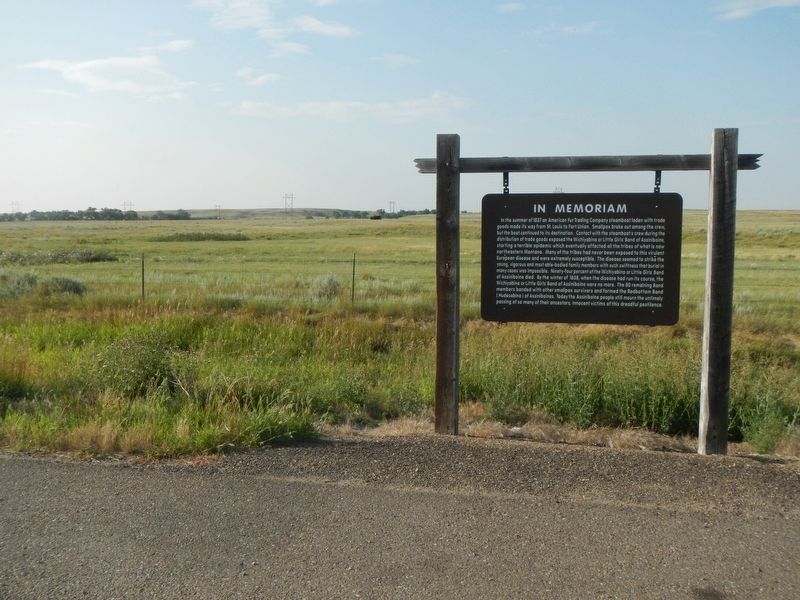
In Memoriam

Photographed by Barry Swackhamer, August 15, 2019
1. In Memoriam Marker
this page online
Erected by Montana Department of Transportation.
Topics. This historical marker is listed in these topic lists: Disasters • Indigenous Peoples and Communities. A significant historical year for this entry is 1837.
Location. 48° 3.57′ N, 106° 1.107′ W. Marker is near Frazer, Montana, in Valley County. It is at the intersection of U.S. 2 at milepost 573 and McConnell Road, on the left when traveling east on U.S. 2. Touch for map. Marker is at or near this postal address: 57260 U.S Highway 2, Frazer MT 59225, United States of America. Touch for directions.

Regionally, this marker is on the Fort Peck Indian Reservation and in Missouri River Country. It is also in the American Mountain West, in the Lewis & Clark Corridor, on the prairies, on the Great Plains, and specifically on the Northern Plains. Globally, it is in North America, the Western Hemisphere, the Western World, and the Anglosphere. Historically, it finds itself in what was once Rupert’s Land and also the Louisiana Purchase.
Also see . . .
1. Smallpox in the Blankets -- HistoryNet. Plains Indians kept track of the passing years by winter counts, pictures painted in spirals, often on the smooth inner hide of buffalo robes. Each tribe recorded its own version of what was important. But one event on virtually all Plains Indian winter counts was the “smallpox winter.” The smallpox epidemic of 1837–38 all but destroyed the Mandans and severely reduced the Arikaras and Hidatsas, who also lived in fortified villages along the Missouri River...
Photographed by Barry Swackhamer, August 15, 2019
2. In Memoriam Marker
2. 1837 Great Plains smallpox epidemic -- Wikipedia. More than 17,000 Indigenous people died along the Missouri River alone, with some bands becoming nearly extinct. Having witnessed the effects of the epidemic on the Mandan tribe, fur trader Francis Chardon wrote, "the small-pox had never been known in the civilized world, as it had been among the poor Mandans and other Indians. Only twenty-seven Mandans were left to tell the tale." (Submitted on November 26, 2019, by Barry Swackhamer of Brentwood, California.)
Credits. This page was last revised on December 28, 2024. It was originally submitted on November 26, 2019, by Barry Swackhamer of Brentwood, California. This page has been viewed 1,597 times since then and 138 times this year. Photos: 1, 2. submitted on November 26, 2019, by Barry Swackhamer of Brentwood, California.
