Biotech and MCV District in Richmond, Virginia — The American South (Mid-Atlantic)
Propeller shaft of the Iron-Clad Virginia
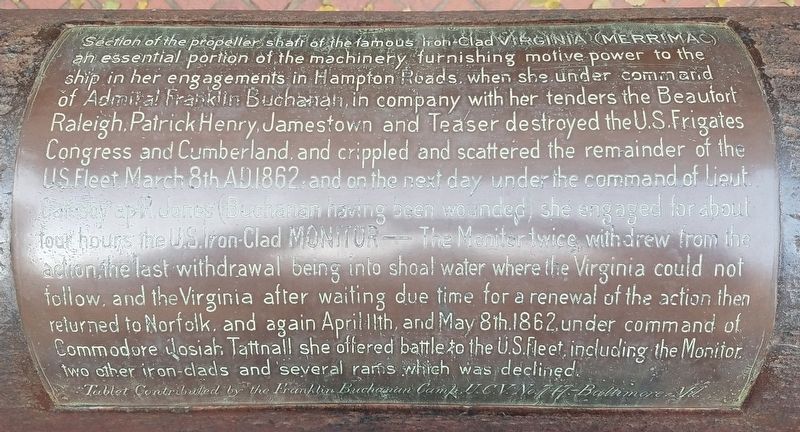
Photographed by Kevin W., November 21, 2019
1. Propeller shaft of the Iron-Clad Virginia Marker
Erected by Franklin Buchanan Camp, U.C.V. No. 747. ~ Baltimore, Md.
Topics. This
this page online
Location. 37° 32.439′ N, 77° 25.768′ W. Marker is in Richmond, Virginia. It is in the Biotech and MCV District. It is on East Clay Street. Located at the White House of the Confederacy. Touch for map. Marker is at or near this postal address: 1201 East Clay Street, Richmond VA 23219, United States of America. Touch for directions.

Regionally, this marker is in Central Virginia. It is also in the American South and specifically in the Upper South. Globally, it is in North America, the Western Hemisphere, the Western World, and the Anglosphere. Historically, it finds itself in what was once the territory of the Mississippian Culture, one of the original Thirteen Colonies, one of the Confederate States of America, and the Antebellum South.
Other nearby markers. At least 8 other markers are within walking distance of this marker: President’s Mansion (within shouting distance of this marker); White House of the Confederacy (within shouting distance of this marker); Wickham-Valentine House (about 500 feet away, measured
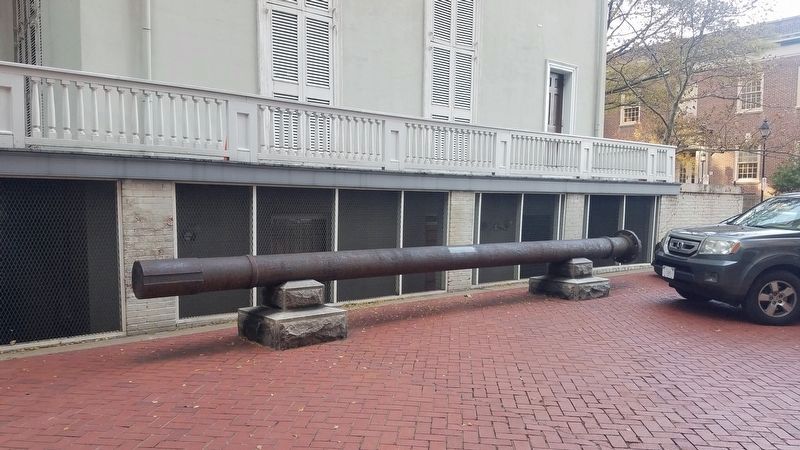
Photographed by Kevin W., November 21, 2019
2. Propeller shaft of the Iron-Clad Virginia Marker
Other markers no longer nearby. Alexander H. Stephens House Site (was within shouting distance of this marker but has been permanently removed); Maupin - Maury House (was about 500 feet away but has been permanently removed); Matthew Fontaine Maury (was about 500 feet away but has been permanently removed); a different marker also named Egyptian Building (was about 500 feet away but has been permanently removed).
Credits. This page was last revised on February 1, 2023. It was originally submitted on November 30, 2019, by Kevin W. of Stafford, Virginia. This page has been viewed 447 times since then and 28 times this year. Photos: 1, 2. submitted on November 30, 2019, by Kevin W. of Stafford, Virginia.
