Manassas, Virginia — The American South (Mid-Atlantic)
War on the Landscape
1861
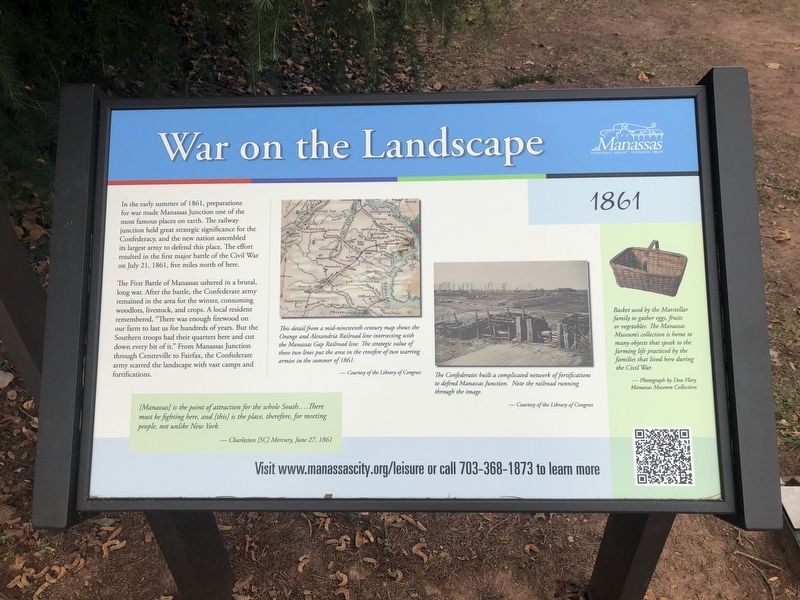
In the early summer of 1861, preparations for war made Manassas Junction one of the most famous places on earth. The railway junction held great strategic significance for the Confederacy, and the new nation assembled its largest army to defend this place. The effort resulted in the first major battle of the Civil War on July 21, 1861, five miles north of here.
The First Battle of Manassas ushered in a brutal, long war. After the battle, the Confederate army remained in the area for the winter, consuming woodlots, livestock, and crops. A local resident remembered, "There was enough firewood on our farm to last us for hundreds of years. But the Southern troops had their quarters here and cut down every bit of it." From Manassas Junction through Centreville to Fairfax, the Confederate army scarred the landscape with vast camps and fortifications.
[Manassas] is the point of attraction for the whole South.... There must be fighting here, and [this] is the place, therefore, for meeting people, not unlike New York.
— Charleston [SC] Mercury, June 27, 1861
[Captions:]
This detail from a mid-nineteenth century map shows the Orange and Alexandria Railroad line intersecting with the Manassas Gap Railroad line. The strategic value of these two lines put the area in the crossfire of two warring armies in the summer of 1861.
— Courtesy of the Library of Congress
The Confederates built a complicated network of fortifications to defend Manassas Junction. Note the railroad running through the image.
— Courtesy of the Library of Congress
Basket used by the Marsteller family to gather eggs, fruits, or vegetables. The Manassas Museum's collection is home to many objects that speak to the farming life practiced by the families that lived here during the Civil War.
— Photograph by Don Flory
Manassas Museum Collection
Erected by City
this page online
Topics and series. This historical marker is listed in these topic lists: Forts and Castles • Railroads & Streetcars • Settlements & Settlers • War, US Civil. In addition, it is included in the Orange and Alexandria Railroad, and the Virginia, City of Manassas series lists. A significant historical date for this entry is June 27, 1861.
Location. This marker has been replaced by another marker nearby. It was located near 38° 44.931′ N, 77° 28.299′ W. Marker was in Manassas, Virginia. It could be reached from Prince William Street just west of Main Street, on the left when traveling west. Touch for map. Marker was at or near this postal address: 9101 Prince William Street, Manassas VA 20110, United States of America. Touch for directions.

Regionally, this marker was in the Washington Metropolitan Area and in Northern Virginia. It was also in the American South, specifically in the Upper South, and in the Mid-Atlantic. Globally, it was in North America, the Western Hemisphere, the Western World, and the Anglosphere. Historically, it found itself in what was once the territory of the Mississippian
Other nearby markers. At least 8 other markers are within walking distance of this location: A different marker also named War on the Landscape (here, next to this marker); a different marker also named Manassas (a few steps from this marker); Manassas Veterans Memorial (within shouting distance of this marker); The Museum Garden (within shouting distance of this marker); a different marker also named Wartime Manassas (within shouting distance of this marker); Occupation or Liberation (about 300 feet away, measured in a direct line); Burning of Manassas (about 400 feet away); Liberty Street / First African-American School (about 400 feet away). Touch for a list and map of all markers in Manassas.
Other markers no longer nearby. The Manassas Museum (was a few steps from this marker but has been replaced with another marker now near it); Manassas (was a few steps from this marker but has been replaced with another marker now near it); Wartime Manassas (was a few steps from this marker but has been replaced with another marker now near it); Manassas 1905 - The Great Fire (was about 400 feet away but has been permanently removed).
Credits. This page was last revised on July 11, 2026. It was originally submitted on November 30, 2019, by Devry Becker Jones of Washington, District of Columbia. This page has been viewed 424 times since then and 22 times this year. Photos: 1, 2. submitted on November 30, 2019, by Devry Becker Jones of Washington, District of Columbia.
