Jordan in Garfield County, Montana — The American West (Mountains)
Indian Country
Photographed by Barry Swackhamer, August 17, 2019
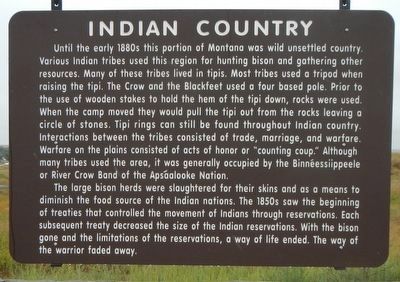
1. Indian Country Marker
The large bison herds were slaughtered for their skins and as a means to diminish the food source of the Indian nations. The 1850s saw the beginning of treaties that controlled the movement of Indians through reservations. Each subsequent treaty decreased the size of the Indian reservations. With the bison gone and the limitations
this page online
Erected by Montana Department of Transportation.
Topics. This historical marker is listed in this topic list: Indigenous Peoples and Communities.
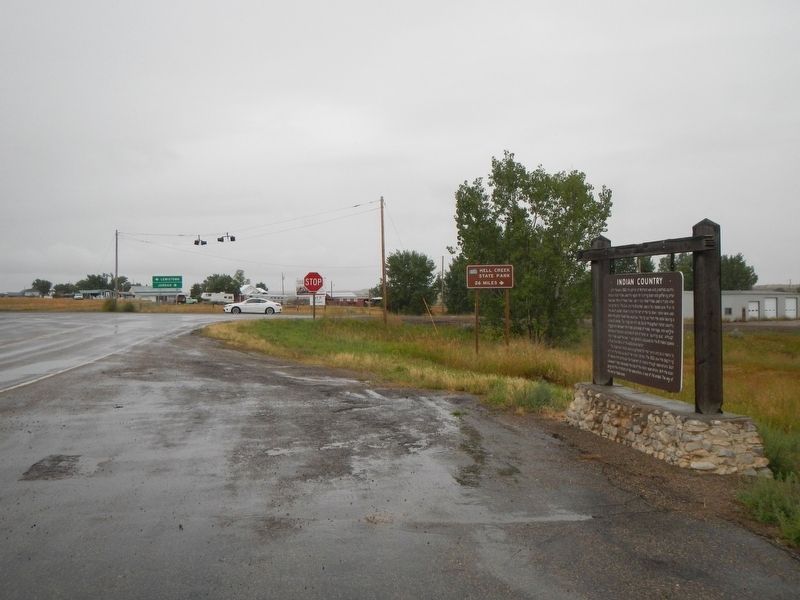
Location. 47° 18.757′ N, 106° 54.564′ W. Marker is in Jordan, Montana, in Garfield County. It is at the intersection of State Highway 59 and State Highway 200 on State Highway 59. Touch for map. Marker is in this post office area: Jordan MT 59337, United States of America. Touch for directions.

Regionally, this marker is in the American Mountain West, in the Lewis & Clark Corridor, on the prairies, on the Great Plains, and specifically on the Northern Plains. Globally, it is in North America, the Western Hemisphere, the Western World, and the Anglosphere. Historically, it finds itself in what was once Rupert’s Land and also the Louisiana Purchase.
Other nearby markers. At least one other marker is within walking distance of this marker: In Memory of this B-17F Flying Fortress Crew (approx. half a mile away).
More about this marker. The marker
Photographed by Barry Swackhamer, August 17, 2019
2. Indian Country Marker
Photographed by Wikipedia
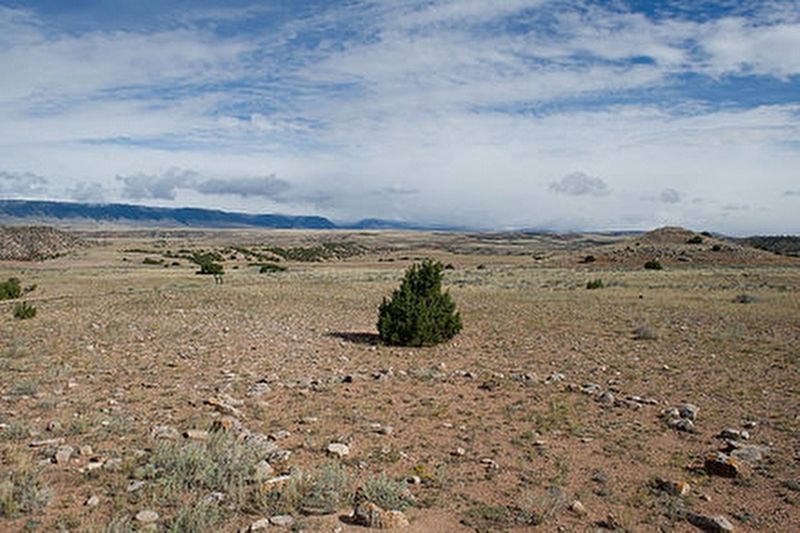
3. Tipi Ring
Credits. This page was last revised on December 9, 2019. It was originally submitted on December 9, 2019, by Barry Swackhamer of Brentwood, California. This page has been viewed 496 times since then and 50 times this year. Photos: 1, 2, 3. submitted on December 9, 2019, by Barry Swackhamer of Brentwood, California.
