St. Augustine in St. Johns County, Florida — The American South (South Atlantic)
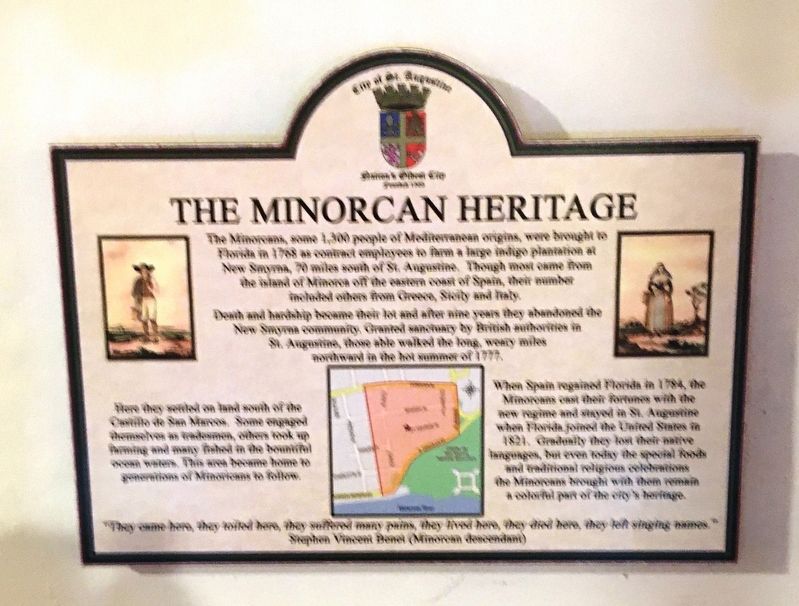
The Minorcan Heritage
Photographed by Brandon D Cross, December 9, 2019
1. The Minorcan Heritage Marker
brought to Florida in 1768 as contract employees to farm a large indigo
plantation at New Smyrna, 70 miles south of St. Augustine. Though most
came from the island of Minorca off the eastern coast of Spain,
their number included others from Greece, Sicily and Italy.
Death and hardship became their lot and after nine years they abandoned
the New Smyrna community. Granted sanctuary by British authorities
in St. Augustine, those able walked the long, weary miles
Northward in the hot summer of 1777.
Here they settled on land south of the Castillo de San Marcos. Some engaged themselves as tradesmen, others took up farming and many fished in the beautiful ocean waters. This area became home to generations of Minoricans [sic] to follow.
When Spain regained Florida in 1784, the Minorcans cast their fortunes with the new regime and stayed in St. Augustine when Florida joined the United States in 1821. Gradually they lost their native languages, but even today the special foods and traditional religious celebrations the Minorcans brought with
this page online
"They came here, they toiled here, they suffered many pains, they lived here, they left singing names.”
Topics. This historical marker is listed in these topic lists: Colonial Era • Settlements & Settlers.
Location. 29° 53.691′ N, 81° 18.813′ W. Marker is in St. Augustine, Florida, in St. Johns County. It is at the intersection of Spanish Street and Hypolita Street, on the left when traveling south on Spanish Street. Touch for map. Marker is in this post office area: Saint Augustine FL 32084, United States of America. Touch for directions.

Regionally, this marker is in First Coast and in Greater Jacksonville. It is also in the American South and on the Eastern Seaboard. Globally, it is in the North Atlantic Region, North America, a Gulf of Mexico state, the Western Hemisphere, the Western World, and the Anglosphere. Historically, it finds itself in what was once New Spain, the territory of the Mississippian Culture, one of the Confederate States of America, and the Antebellum South.
Other nearby markers. At
Photographed by Brandon D Cross, December 9, 2019
2. The Minorcan Heritage Marker
Credits. This page was last revised on January 5, 2020. It was originally submitted on December 12, 2019, by Brandon D Cross of Flagler Beach, Florida. This page has been viewed 748 times since then and 55 times this year. Photos: 1, 2. submitted on December 12, 2019, by Brandon D Cross of Flagler Beach, Florida. • Michael Herrick was the editor who published this page.
