
Former Walter Reed Army Medical Center in Northwest Washington in Washington, District of Columbia — The American Northeast (Mid-Atlantic)
Walter Reed General Hospital
Former Walter Reed Army Medical Center
| — | Walking Tour | — |
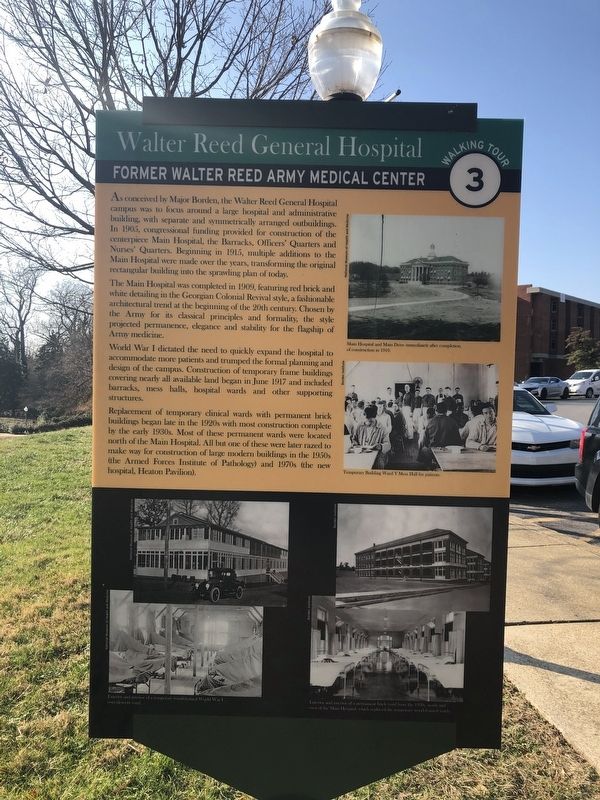
The Main Hospital was completed in 1909, featuring red brick and white detailing in the Georgian Colonial Revival style, a fashionable architectural trend at the beginning of the 20th century. Chosen by the Army for its classical principles and formality, the style projected permanence, elegance and stability for the flagship of Army medicine.
World War I dictated the need to quickly expand the hospital to accommodate more patients and trumped the formal planning and design of the campus. Construction of temporary frame buildings covering nearly all available land began in 1917 and included barracks, mess halls, hospital
this page online
Replace of temporary clinical wards with permanent brick buildings began late in the 1920s with most construction complete by the early 1930s. Most of these permanent wards were located north of the Main Hospital. All but one of these were later razed to make way for construction of large modern buildings in the 1950s (the Armed Forces Institute of Pathology) and 1970s (the new hospital, Heaton Pavilion). (Marker Number 3.)
Topics. This historical marker is listed in these topic lists: Architecture • Science & Medicine • War, World I. A significant historical year for this entry is 1905.
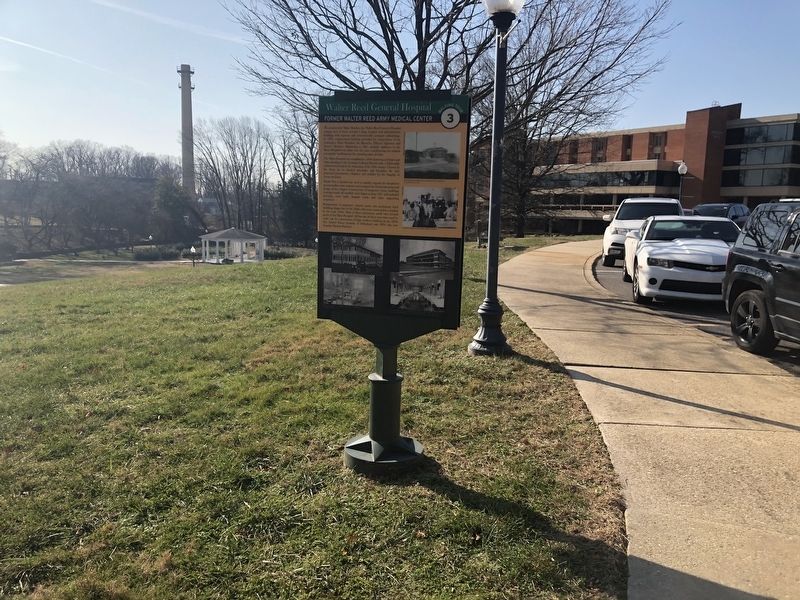
Location. 38° 58.472′ N, 77° 1.758′ W. Marker is in Northwest Washington in Washington, District of Columbia. It is in Former Walter Reed Army Medical Center. It is on Main Drive Northwest 0.1 miles west of 12th Street Northwest, on the left when traveling west. Touch for map. Marker is in this post office area: Northwest Washington DC 20307, United States of America. Touch for directions.

Regionally, this marker is in the Washington Metropolitan Area. It is also in the American Northeast, in the
![Walter Reed General Hospital Marker [Reverse] image. Click for full size.](Photos5/505/Photo505667.jpg?1220201935600PM "Walter Reed General Hospital Marker [Reverse]. Click for full size.")
Photographed by Devry Becker Jones (CC0), December 20, 2019
2. Walter Reed General Hospital Marker [Reverse]
Other nearby markers. At least 8 other markers are within walking distance of this marker: Borden's Dream (within shouting distance of this marker); Walter Reed Army Medical Center (within shouting distance of this marker); Borden's Dream Realized (within shouting distance of this marker); a different marker also named Walter Reed Army Medical Center (within shouting distance of this marker); Cameron's Creek and the Rose Garden (about 400 feet away, measured in a direct line); WRAMC - Modern Era (about 400 feet away); Battle of Fort Stevens (about 400 feet away); Site of a Tulip Tree (about 500 feet away). Touch for a list and map of all markers in Northwest Washington.
Photographed by Devry Becker Jones (CC0), December 24, 2019
4. Signage on the perimeter of the former Walter Reed Army Medical Center
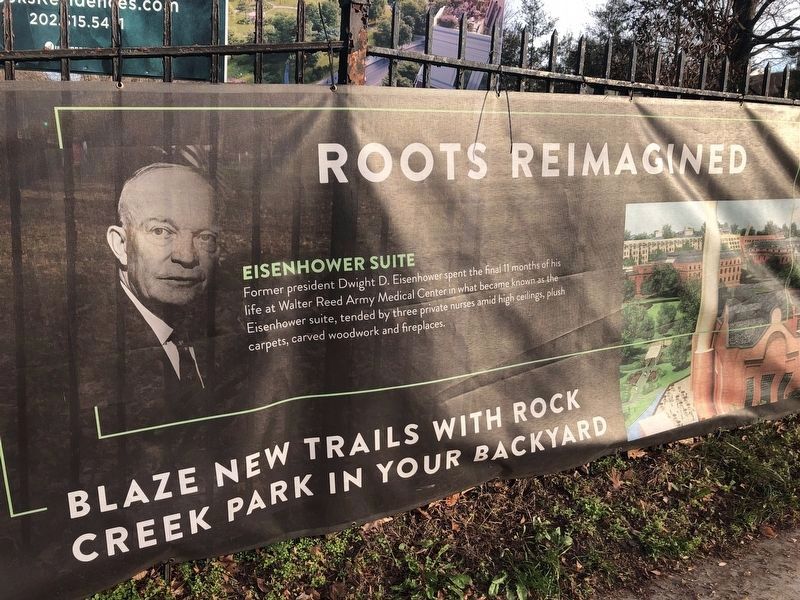
Eisenhower Suite
Former president Dwight D. Eisenhower spent the final 11 months of his life at Walter Reed Army Medical Center in what became known as the Eisenhower suite, tended by three private nurses amid high ceilings, plush carpets, carved woodwork and fireplaces.
Former president Dwight D. Eisenhower spent the final 11 months of his life at Walter Reed Army Medical Center in what became known as the Eisenhower suite, tended by three private nurses amid high ceilings, plush carpets, carved woodwork and fireplaces.
Photographed by Devry Becker Jones (CC0), December 24, 2019
5. Signage on the perimeter of the former Walter Reed Army Medical Center
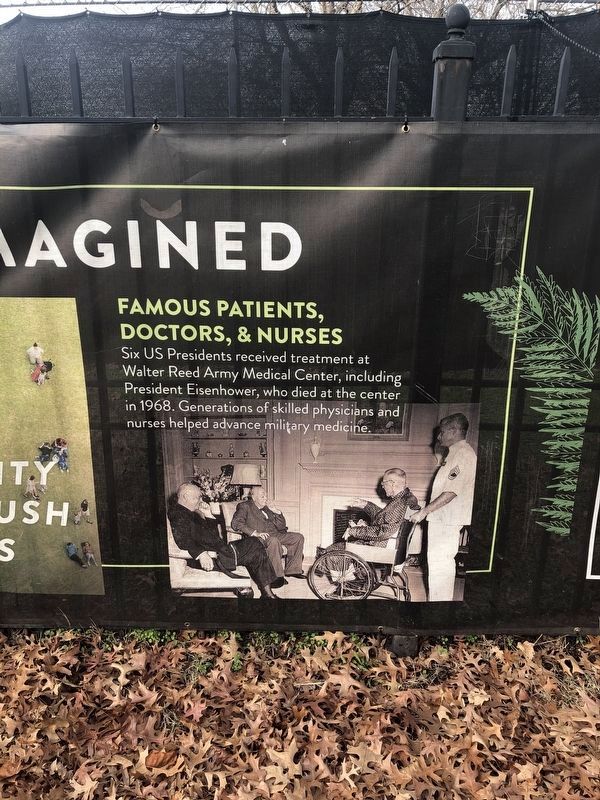
Famous Patients, Doctors, & Nurses
Six US Presidents received treatment at Walter Reed Army Medical Center, including President Eisenhower, who died at the center in 1968. Generations of skilled physicians and nurses helped advance military medicine.
Six US Presidents received treatment at Walter Reed Army Medical Center, including President Eisenhower, who died at the center in 1968. Generations of skilled physicians and nurses helped advance military medicine.
Credits. This page was last revised on April 10, 2023. It was originally submitted on December 20, 2019, by Devry Becker Jones of Washington, District of Columbia. This page has been viewed 701 times since then and 46 times this year. Photos: 1, 2, 3. submitted on December 20, 2019, by Devry Becker Jones of Washington, District of Columbia. 4, 5. submitted on December 24, 2019, by Devry Becker Jones of Washington, District of Columbia.
