Clear Lake Habitat
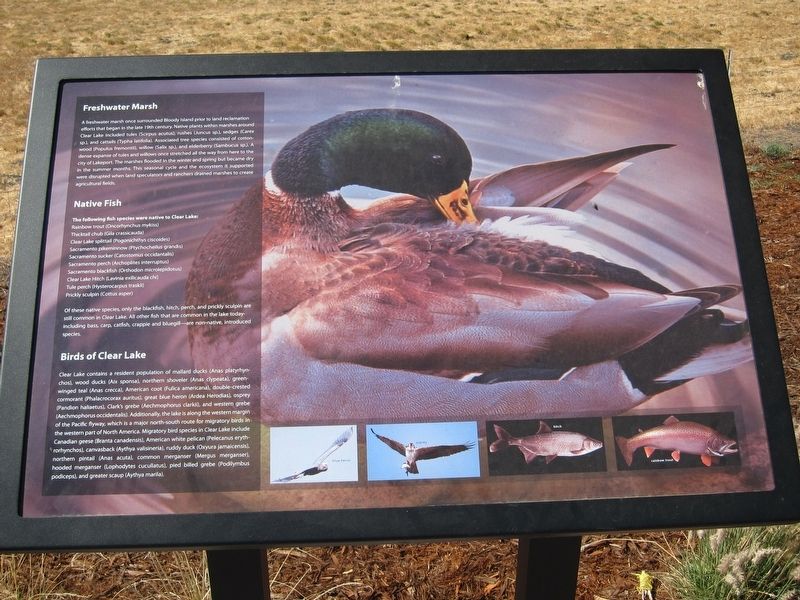
Freshwater Marsh
A freshwater marsh once surrounded Bloody Island prior to land reclamation efforts that began in the late 19th century. Native plants within marshes around Clear Lake included tules (Scirpus acutus), rushes (Juncus sp.), sedges (Carex sp.), and cattails (Typha latifolia). Associated tree species consisted of cottonwood (Populus fremontii), willow (Salix sp.), and elderberry (Sambucus sp.). A dense expanse of tules and willows once stretched all the way from here to the city of Lakeport. The marshes flooded in the winter and spring but became dry in the summer months. This seasonal cycle and the ecosystem it supported were disrupted when land speculators and ranchers drained marshes to create agricultural fields.
Native Fish
The following fish species were native to Clear Lake:
Rainbow trout (Oncorhynchus mykiss)
Thicktail chub (Gila crassicauda)
Clear Lake splittail (Pogonichthys ciscoides)
Sacramento pikeminnow (Ptychocheilus grandis)
Sacramento sucker (Catostomus occidantalis)
Sacramento perch (Archoplites interruptus)
Sacramento blackfish (Orthodon microlepidotus)
Clear Lake Hitch
this page online
Tule perch (Hysterocarpus traskii)
Prickly sculpin (Cottus asper)
Of these native species, only the blackfish, hitch, perch, and prickly sculpin are still common in Clear Lake. All other fish that are common in the lake today- including bass, carp, catfish, crappie and bluegill-are non-native, introduced species.
Birds of Clear Lake
Clear Lake contains a resident population of mallard ducks (Anas platyrhyn-
chos), wood ducks (Aix sponsa), northern shoveler (Anas clypeata), green-
winged teal (Anas crecca), American coot (Fulica americana), double-crested
cormorant (Phalacrocorax auritus), great blue heron (Ardea Herodias), osprey
(Pandion haliaetus), Clark's grebe (Aechmophorus clarkii), and western grebe
(Aechmophorus occidentalis). Additionally, the lake is along the western margin
of the Pacific flyway, which is a major north-south route for migratory birds in
the western part of North America. Migratory bird species in Clear Lake include
Canadian geese (Branta canadensis), American white pelican (Pelecanus eryth-
rorhynchos), canvasback (Aythya valisineria), ruddy duck (Oxyura jamaicensis),
northern
Topics. This historical marker is listed in these topic lists: Animals • Environment.
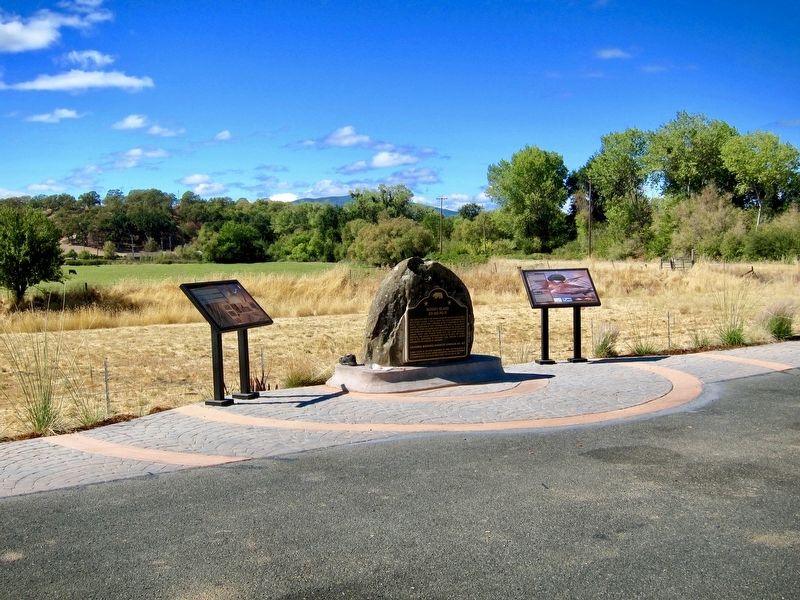
Location. 39° 8.936′ N, 122° 53.267′ W. Marker is in Upper Lake, California, in Lake County. It is at the intersection of State Highway 20 and Reclamation Road, on the left when traveling west on State Highway 20. Touch for map. Marker is in this post office area: Upper Lake CA 95485, United States of America. Touch for directions.

Regionally, this marker is in California’s Wine Country and on the Coast Ranges. It is also on the American Pacific Coast. Globally, it is in North America, on the Ring of Fire, on the Pacific Rim, in the Western Hemisphere, in the Western World, and in the Anglosphere. Historically, it finds itself in what was once New Spain and also Mexico’s Alta California.
Other nearby markers. At least 8 other markers are within 2 miles of this marker, measured as the crow flies: Bloody Island (here, next to this marker); The Pomo (here, next to this marker); a different marker also named Bloody Island (approx. 0.3 miles away); The Old Gas Station (approx. 1.6 miles away); Drug and Prescription Store (approx. 1.6 miles away); Diamond Match Lumber Co. (approx. 1.6 miles away); The IOOF Hall (approx. 1.6 miles away); The West Side of Main Street (approx. 1.6 miles away). Touch for a list and map of all markers in Upper Lake.
Another marker is no longer nearby. Upper Lake Through Time (was approx. 1.6 miles away but has been permanently removed).
Credits. This page was last revised on December 23, 2019. It was originally submitted on December 23, 2019, by Andrew Ruppenstein of Lamorinda, California. This page has been viewed 495 times since then and 24 times this year. Photos: 1, 2. submitted on December 23, 2019, by Andrew Ruppenstein of Lamorinda, California.
