Oberlin in Lorain County, Ohio — The American Midwest (Great Lakes)
Westwood Cemetery

Photographed by J. J. Prats, August 24, 2019
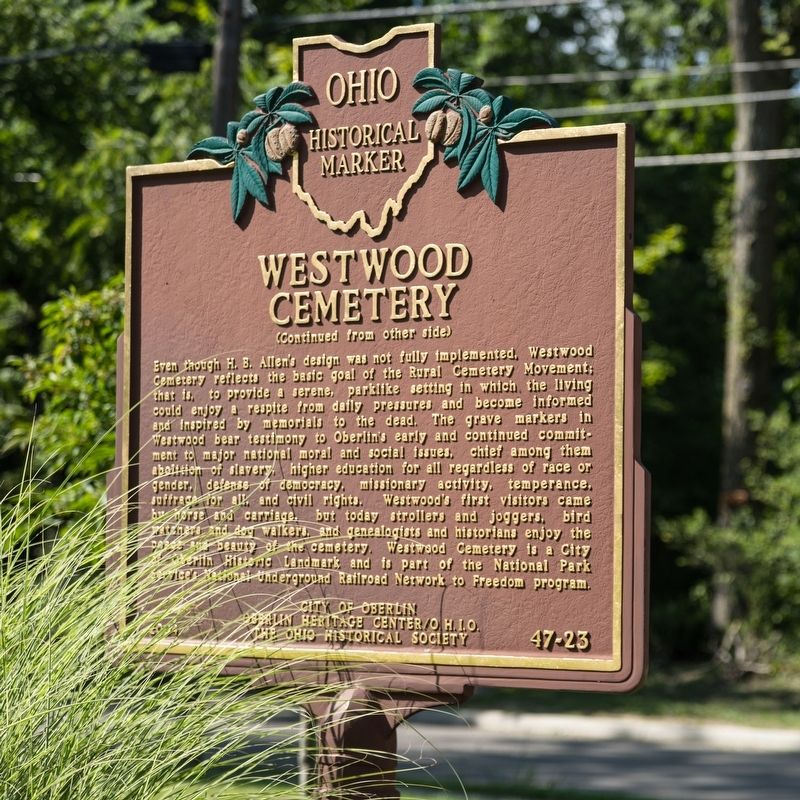
1. Westwood Cemetery Marker, side one
Even though H.B. Allen’s design was not fully implemented, Westwood Cemetery reflects the basic goal of the Rural Cemetery Movement; that is, to provide a serene, park-like setting in which the living could enjoy a respite from daily pressures and become informed and inspired by memorials to the dead. The grave markers in Westwood bear testimony to Oberlin’s early and continued commitment
this page online
Erected 2004 by City of Oberlin, Oberlin Heritage Center / O.H.I.O., and The Ohio Historical Society. (Marker Number 47-23.)
Topics and series. This historical marker is listed in this topic list: Cemeteries & Burial Sites. In addition, it is included in the Ohio Historical Society / The Ohio History Connection series list. A significant historical month for this entry is July 1864.
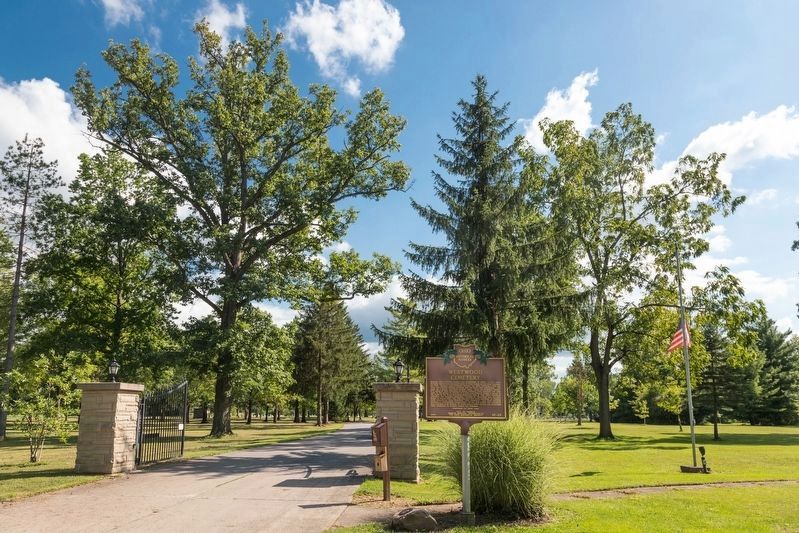
Location. 41° 17.219′ N, 82° 13.96′ W. Marker is in Oberlin, Ohio, in Lorain County. It is on Morgan Street 0.7 miles west of South Professor Street, on the right when traveling west. It is just outside the entrance to the cemetery. Touch for map. Marker is in this post office area: Oberlin OH 44074, United States of America. Touch for directions.

Regionally, this marker is in Greater
Photographed by J. J. Prats, August 24, 2019
2. Westwood Cemetery Marker, side two
Other nearby markers. At least 8 other markers are within walking distance of this marker: Charles M. Hall and Frank M. Jewett (approx. 0.7 miles away); Welcome to Oberlin Heritage Center (approx. 0.7 miles away); Willard Van Orman Quine (approx. 0.7 miles away); Oberlin College and Community / Abolitionism in Oberlin (approx. ¾ mile away); Memorial Arch (approx. 0.8 miles away); Massacred (approx. 0.8 miles away); Downtown Oberlin Historic District (approx. 0.8 miles away); Peter Pindar Pease (approx. 0.9 miles away). Touch for a list and map of all markers in Oberlin.
Also see . . . Downtown Oberlin Walking Tour of Civil War Monuments - Westwood Cemetery. Excerpt:
On June 8, 1864, citizens and students gathered at the cemetery to help clear the heavily forested acreage. Women of the community served dinner to the workers at noon. On the motion of James Fitch, the Oberlin Sunday School Superintendent, the name “Westwood”(Submitted on January 9, 2020.)was adopted. An area was chosen and set aside for a place of burial for Civil War soldiers. The area is called, “Soldier’s Rest.”Photographed by J. J. Prats, August 24, 20193. Westwood Cemetery Entrance and Marker
The site was formally dedicated on July 16, 1864. The program included an address by Professor James Fairchild, music conducted by Professor C.H. Churchill and a prayer given by Oberlin College President Charles Finney. In 1944 The Cemetery Association transferred control of the cemetery to the City of Oberlin. In 1946 Frank Zavodsky became sexton for Westwood and re-mained such until his retirement in 1984. He was active and helpful in the affairs of Westwood until his death in 1997.
As in widespread 19th-century cemetery tradition, Westwood had a “Potter’s Field” (now indicated on cemetery maps as “OAP”) where poor residents whose families couldn’t afford a burial site were placed. This caused a class division that Oberlin recognized early on. The practice was discontinued and these types of burials are now conducted throughout the cemetery.
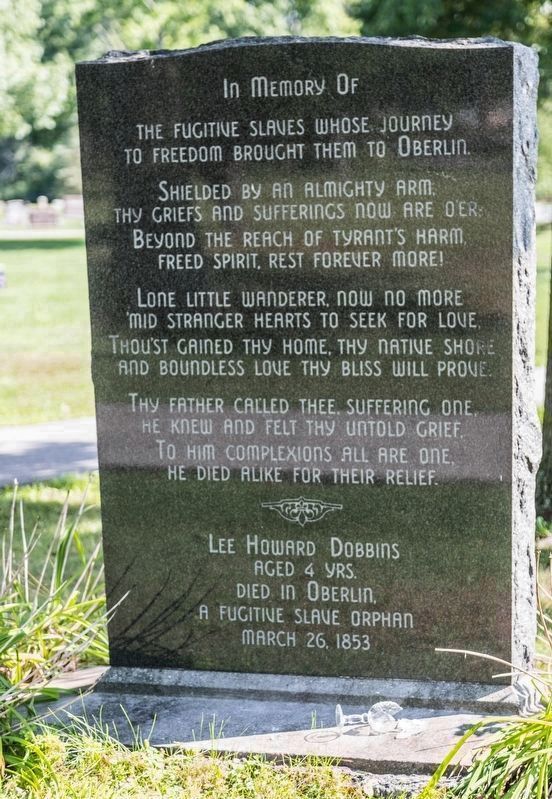
Today the cemetery is thought of as a memorial park. Many city residents walk, jog and bike the cemetery pathways. In comparison with other cemeteries, Westwood’s monuments are generally simple and plain; however, upon closer inspection, the inscriptions document who these people were that settled here during the formativedecades.Monument installed in 1993. Photograph by J.J. Prats, August 24, 20194. The Underground Railroad Monument“In memory of
The fugitive slaves whose journey
To freedom brought them to Oberlin.
Shielded by an Almighty arm,
Thy griefs and sufferings now are over,
Beyond the reach of tyrant’s harm.
Freed Spirit, rest forever more!
Lone little wanderer, now no more
’Mid stranger hearts to seek for love,
Thou’st gained thy home, thy native short
and boundless love thy bliss will prove.
Thy Father called thee, suffering one,
He knew and felt thy untold grief.
To him complexions are all one.
He died alike for their relief.
Lee Howard Dobbins • Aged 4 yrs.
Died in Oberlin • A fugitive slave orphan
March 26, 1853.”
The cemetery binds together Oberlin’s founding fathers with its city residents and whispers a story of a unique and profoundly dedicated town.

Photographed by J. J. Prats, August 24, 2019
5. Westwood Cemetery, Oberlin Ohio
Credits. This page was last revised on January 9, 2020. It was originally submitted on January 9, 2020, by J. J. Prats of Powell, Ohio. This page has been viewed 761 times since then and 46 times this year. Photos: 1, 2, 3, 4, 5. submitted on January 9, 2020, by J. J. Prats of Powell, Ohio.
