Near West Liberty in Logan County, Ohio — The American Midwest (Great Lakes)
The Broad and Fertile Acres
They Lived Long on the Land
Photographed by Joel Seewald, October 12, 2019
1. The Broad and Fertile Acres Marker
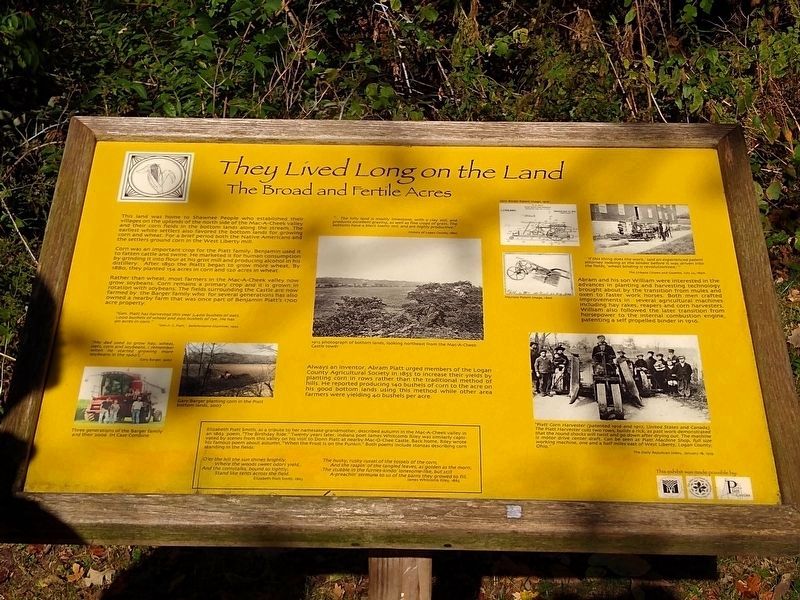
This land was home to Shawnee People who established their villages on the uplands of the north side of the Mac-A-Cheek valley and their corn fields in the bottom lands along the stream. The earliest white settlers also favored the bottom lands for growing corn and wheat. For a brief period both the Native Americans and the settlers ground corn in the West Liberty mill.
Corn was an important crop for the Piatt family. Benjamin used it to fatten cattle and swine. He marketed it for human consumption by grinding it into flour at his grist mill and producing alcohol in his distillery. After 1850 the Piatts began to grow more wheat. By 1880, they planted 154 acres in corn and 120 acres in wheat.
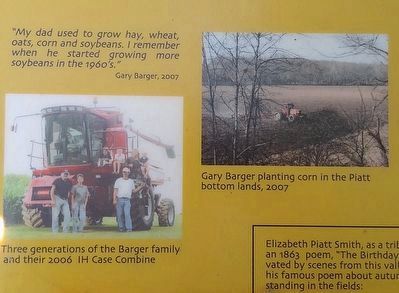
Rather than wheat, most farmers in the Mac-A-Cheek valley now grow soybeans. Corn remains a primary crop and it is grown in rotation with soybeans. The fields surrounding the Castle are now farmed by the Barger family who for several generations has also owned a nearby farm that was once part of Benjamin Piatt's 1700 acre property.
"Gen. Piatt has harvested this year 5,400 bushels of oats, 1,000 bushels of wheat and 900 bushels
this page online
"Gen. A. S. Piatt," Bellefontaine Examiner, 1902
"My dad used to grow hay, wheat, oats, corn and soybeans. I remember when he started growing more soybeans in the 1960's."
Gary Barger, 2007
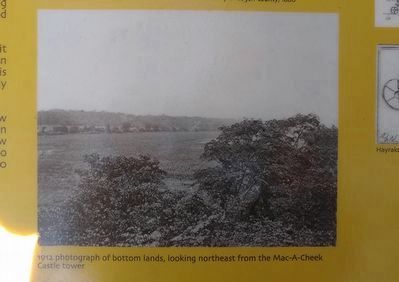
"... The hilly land is mostly limestone, with a clay soil, and produces excellent grazing, as well as fine crops of grain. The bottoms have a black loamy soil, and are highly productive."
History of Logan County, 1880
Always an inventor, Abram Piatt urged members of the Logan County Agricultural Society in 1855 to increase their yields by planting corn in rows rather than the traditional method of hills. He reported producing 140 bushels of corn to the acre on his good bottom lands using this method while other area farmers were yielding 40 bushels per acre.
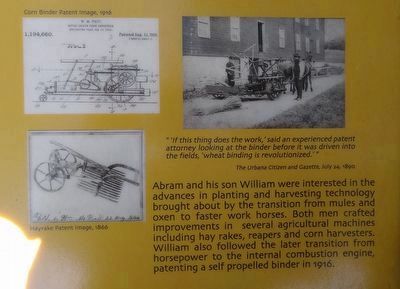
Abram and his son William were interested in the advances in planting and harvesting technology brought about by the transition from mules and oxen to faster work horses. Both men crafted improvements in several agricultural machines including hay rakes, reapers and corn harvesters. William also followed the later transition from
2. The Broad and Fertile Acres Marker — left images
Left: Three generations of the Barger family and their 2006 IH Case Combine
Right: Gary Barger planting corn in the Piatt bottom lands, 2007
Right: Gary Barger planting corn in the Piatt bottom lands, 2007
Elizabeth Piatt Smith, as a tribute to her namesake grandmother, described autumn in the Mac-A-Cheek valley in an 1863 poem, "The Birthday Ride." Twenty years later, Indiana poet James Whitcomb Riley was similarly captivated by scenes from this valley on his visit to Donn Piatt at nearby Mac-O-Chee Castle. Back home, Riley wrote his famous poem about autumn, "When the Frost is on the Punkin." Both poems include stanzas describing corn standing in the fields:
O'er the hill the sun shines brightly,
Where the woods sweet odors yield,
And the cornstalks, bound so tightly,
Stand like tents across the field.
Elizabeth Piatt Smith, 1863
The husky, rusky russel of the tossels of the corn,
And the raspin' of the tangled leaves, as golden as the morn;
The stubble in the furries-kindo lonesome-like, but still
A-preachin' sermuns to us of the barns they growed to fill.
James Whitcomb Riley, 1883
Erected by Ohio Humanities Council, The Mac-A-Cheek Foundation for the Humanities, Piatt Castles.
3. The Broad and Fertile Acres Marker — middle image
1912 photograph of bottom lands, looking northeast from the Mac-A-Cheek Castle tower
Topics. This historical marker is listed in this topic list: Agriculture. A significant historical year for this entry is 1850.
Location. 40° 15.078′ N, 83° 43.583′ W. Marker is near West Liberty, Ohio, in Logan County. It can be reached from Township Road 47 0.1 miles south of Ohio Route 245. Marker is behind the Mac-A-Cheek Castle, which is about 700 feet from Township Road 47. Touch for map. Marker is at or near this postal address: 10051 Township Road 47, West Liberty OH 43357, United States of America. Touch for directions.

Regionally, this marker is in the Till Plains. It is also in the American Midwest and in the Corn Belt. Globally, it is in North America, the Western Hemisphere, the Western World, and the Anglosphere. Historically, it finds itself in what was once the Viceroyalty of New France, the Haudenosaunee (Iroquois) Confederacy, the territory of the Mississippian Culture, and the Northwest Territory.
Other nearby markers. At least 8 other markers are within walking distance of this marker: Limestone: Seabed to Castle Wall (within shouting distance of this marker); Let's Play (within shouting distance of
4. The Broad and Fertile Acres Marker — upper right images
Top: Corn Binder Patent Image, 1916
Bottom: Hayrake Patent Image, 1966
" 'If this thing does the work,' said an experienced patent attorney looking at the binder before it was driven into the fields, 'wheat binding is revolutionized.' "
The Urbana Citizen and Gazette, July 24, 1890
Bottom: Hayrake Patent Image, 1966
" 'If this thing does the work,' said an experienced patent attorney looking at the binder before it was driven into the fields, 'wheat binding is revolutionized.' "
The Urbana Citizen and Gazette, July 24, 1890
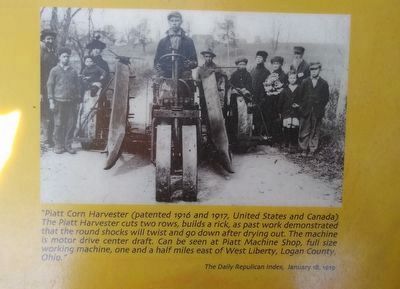
5. The Broad and Fertile Acres Marker — lower right image
"Piatt Corn Harvester (patented 1916 and 1917, United States and Canada)
The Piatt Harvester cuts two rows, builds a rick, as past work demonstrated that the round shocks will twist and go down after drying out. The machine is motor drive center draft. Can be seen at Piatt Machine Shop, full size working machine, one and a half miles east of West Liberty, Logan County, Ohio."
the Daily Repulbican Index, January 18, 1919
The Piatt Harvester cuts two rows, builds a rick, as past work demonstrated that the round shocks will twist and go down after drying out. The machine is motor drive center draft. Can be seen at Piatt Machine Shop, full size working machine, one and a half miles east of West Liberty, Logan County, Ohio."
the Daily Repulbican Index, January 18, 1919
Photographed by Joel Seewald, October 12, 2019
6. The Broad and Fertile Acres Marker
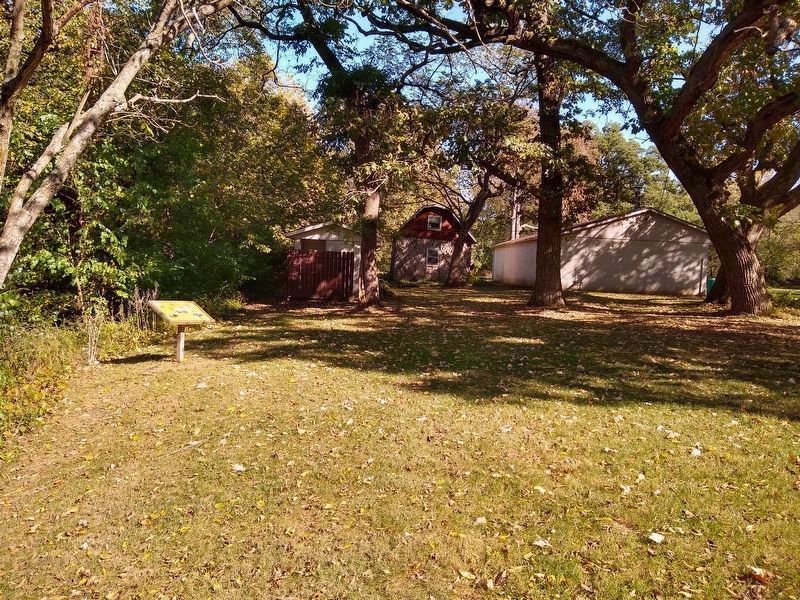
View looking toward the east from Mack-A-Cheek castle.
Credits. This page was last revised on January 23, 2020. It was originally submitted on January 20, 2020, by Joel Seewald of Madison Heights, Michigan. This page has been viewed 352 times since then and 27 times this year. Photos: 1, 2, 3, 4, 5, 6. submitted on January 20, 2020, by Joel Seewald of Madison Heights, Michigan.
