Marker Logo
THE HISTORICAL
MARKER DATABASE
“Bite-Size Bits of Local, National, and Global History”
Tuscaloosa in Tuscaloosa County, Alabama — The American South (East South Central)
 

First African Baptist Church

Tuscaloosa Civil Rights History Trail
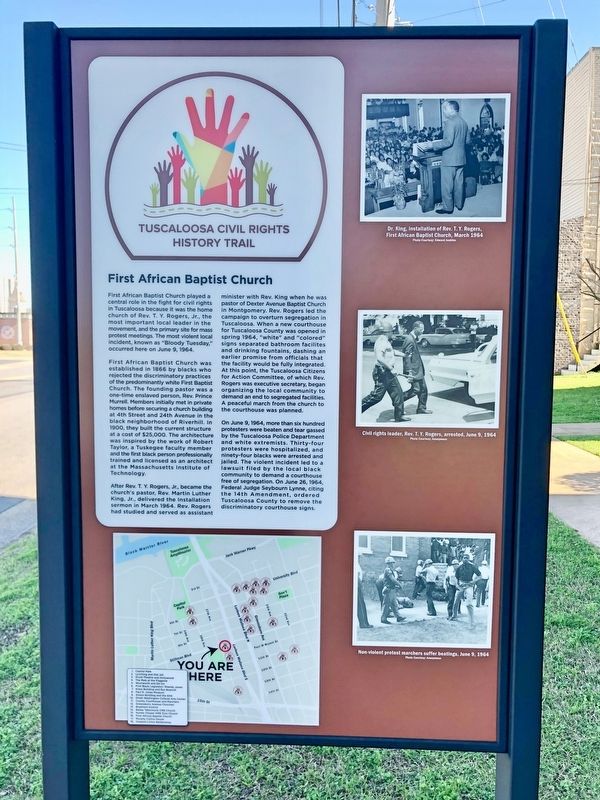
 
 
First African Baptist Church Marker image. Click for full size.
Photographed by Mark Hilton, January 19, 2020
1. First African Baptist Church Marker
Inscription. First African Baptist Church played a central role in the fight for civil rights in Tuscaloosa because it was the home church of Rev. T. Y. Rogers, Jr., the most important local leader in the movement, and the primary site for mass protest meetings. The most violent local incident, known as "Bloody Tuesday," occurred here on June 9, 1964.

First African Baptist Church was established in 1866 by blacks who rejected the discriminatory practices of the predominantly white First Baptist Church. The founding pastor was a one-time enslaved person, Rev. Prince Murrell. Members initially met in private homes before securing a church building at 4th Street and 24th Avenue in the black neighborhood of Riverhill. In 1900, they built the current structure at a cost of $25,000. The architecture was inspired by the work of Robert Taylor, a Tuskegee faculty member and the first black person professionally trained and licensed as an architect at the Massachusetts Institute of Technology.

After Rev. T. Y. Rogers, Jr., became the church's pastor, Rev. Martin Luther King, Jr., delivered the Installation sermon in March 1964. Rev. Rogers had studied and served as assistant minister with Rev. King when he was pastor of Dexter Avenue Baptist Church in Montgomery. Rev. Rogers led the campaign to overturn segregation in Tuscaloosa. When a new courthouse for Tuscaloosa County was opened in spring 1964, "white" and "colored” signs separated bathroom facilities and drinking fountains, dashing an earlier promise from officials that the facility would be fully integrated. At this point, the Tuscaloosa Citizens for Action Committee, of which Rev. Rogers was executive secretary, began organizing the local community to demand an end to segregated facilities. A peaceful march from the church to the courthouse was planned.

On June 9, 1964, more than six hundred protesters were beaten and tear gassed by the Tuscaloosa Police Department and white extremists. Thirty-four protesters were hospitalized, and ninety-four blacks were arrested and jailed. The violent incident led to a lawsuit filed by the local black community to demand a courthouse free of segregation. On June 26, 1964, Federal Judge Seybourn Lynne, citing the 14th Amendment, ordered Tuscaloosa County to remove the discriminatory courthouse signs.
 
Erected 2019

Paid Advertisement
Click or scan to see
this page online
by Tuscaloosa Civil Rights History Task Force. (Marker Number 16.)
 
Topics. This historical marker is listed in these topic lists: African AmericansCivil RightsReligion & Religious Structures. A significant historical month for this entry is March 1964.
 
Location. 33° 12.292′ N, 87° 34.231′ W. Marker is in Tuscaloosa, Alabama, in Tuscaloosa County. It is on Stillman Boulevard east of T.Y. Rogers Jr Avenue, on the right when traveling east. Touch for map. Marker is at or near this postal address: 2621 Stillman Boulevard, Tuscaloosa AL 35401, United States of America. Touch for directions.

Regionally, this marker is in the American South and specifically in the Deep South. Globally, it is in North America, a Gulf of Mexico state, the Western Hemisphere, the Western World, and the Anglosphere. Historically, it finds itself in what was once the territory of the Mississippian Culture, one of the Confederate States of America, and the Antebellum South.

Other nearby markers. At least 8 other markers are within walking distance of this marker: A different marker also named First African Baptist Church (here, next to this marker);
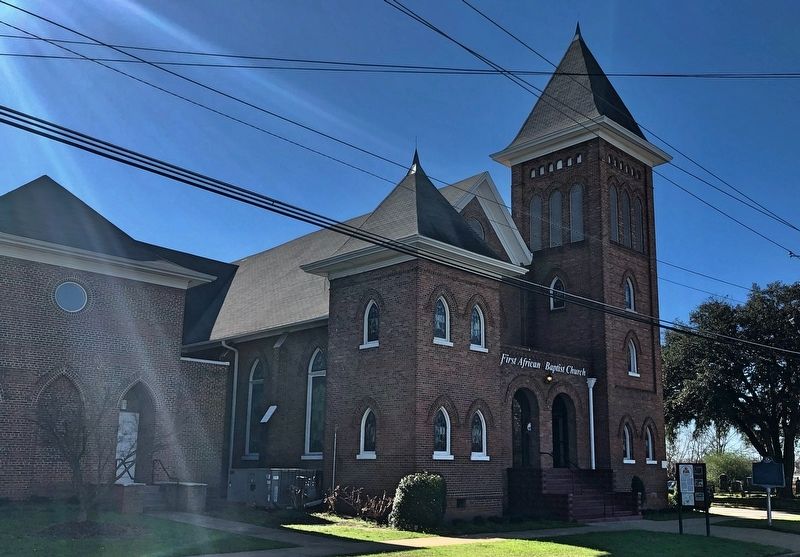
First African Baptist Church and Marker. image. Click for full size.
Photographed by Mark Hilton, January 19, 2020
2. First African Baptist Church and Marker.
Greenwood Cemetery (about 300 feet away, measured in a direct line); Tuscaloosa Confederate Monument (about 300 feet away); St. John The Baptist Catholic Church (about 800 feet away); First Presbyterian Church (approx. 0.2 miles away); Tuscaloosa First United Methodist Church (approx. Ό mile away); Lynching in America / Lynching in Tuscaloosa County (approx. Ό mile away); Tushkalusa (approx. Ό mile away). Touch for a list and map of all markers in Tuscaloosa.
 
Also see . . .  History of the First African Baptist Church from its website. (Submitted on January 23, 2020, by Mark Hilton of Montgomery, Alabama.)
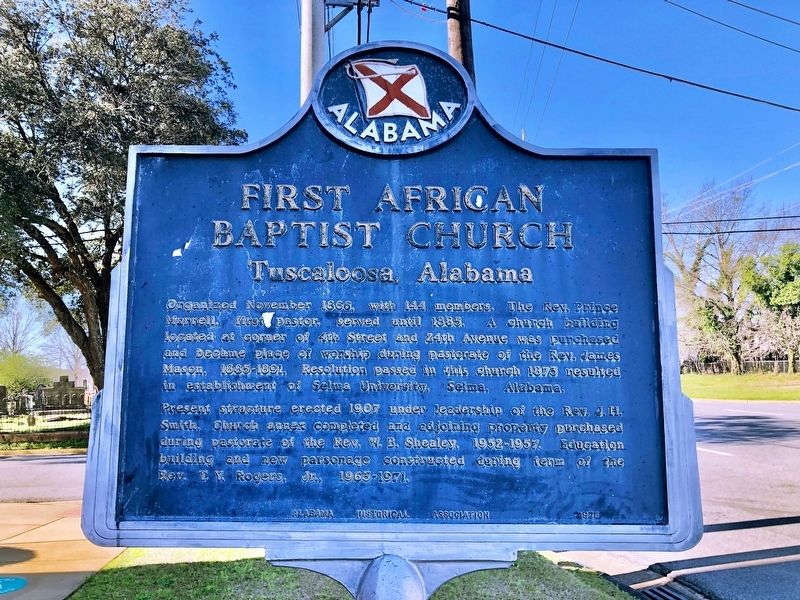
 
View of this marker and another First African Baptist Church marker. image. Click for full size.
Photographed by Mark Hilton, January 19, 2020
3. View of this marker and another First African Baptist Church marker.
This is a view looking west on Stillman Boulevard.
A nearby different First African Baptist Church marker. image. Click for full size.
Photographed by Mark Hilton, January 19, 2020
4. A nearby different First African Baptist Church marker.
 
 
Credits. This page was last revised on January 23, 2020. It was originally submitted on January 23, 2020, by Mark Hilton of Montgomery, Alabama. This page has been viewed 602 times since then and 26 times this year. Photos:   1, 2, 3, 4. submitted on January 23, 2020, by Mark Hilton of Montgomery, Alabama.

m=144855

CeraNet Cloud Computing sponsors the Historical Marker Database.
This website earns income from purchases you make after using our links to Amazon.com. We appreciate your support.
Paid Advertisement
Jul. 12, 2026