Mission Valley in San Diego in San Diego County, California — The American West (Pacific Coastal)
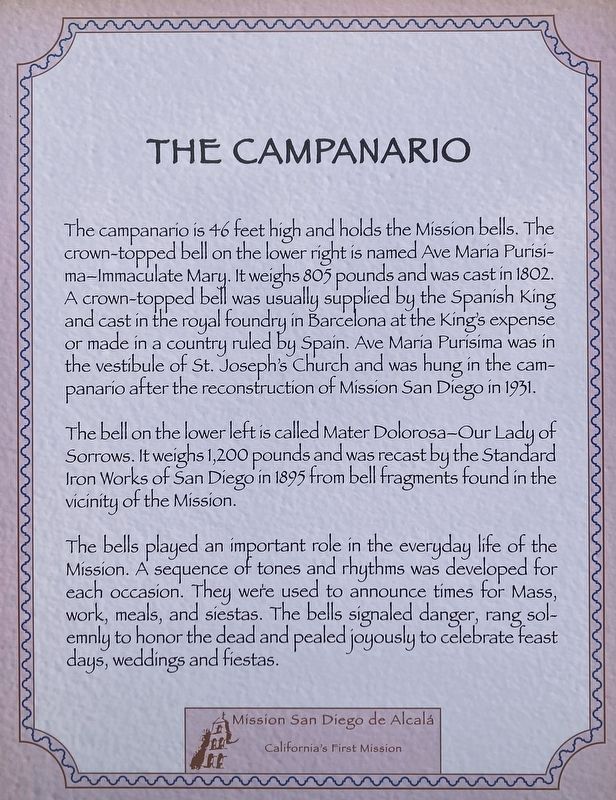
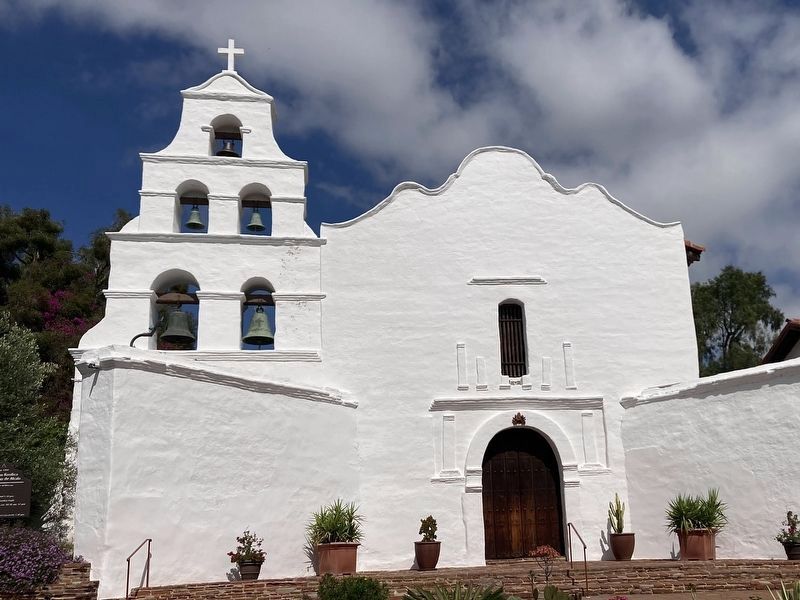
The Campanario
Mission San Diego de Alcala
Photographed by Craig Baker, March 10, 2026
1. Campanario Marker
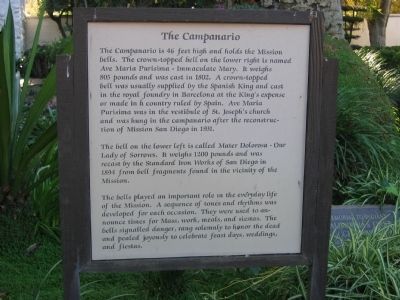
The bell on the lower left is called Mater Dolorosa – Our Lady of Sorrows. I weighs 1200 pounds and was recast by the Standard Iron Works of San Diego in 1894 from bell fragments found in the vicinity of the Mission.
The bells played an important role in the everyday life of the Mission. A sequence of tones and rhymes was developed for each occasions. They were used to announce times for Mass, work, meals, and siestas. The bells signaled danger, rang solemnly to honor the dead and pealed joyously to celebrate feast days, weddings, and fiestas.
Topics. This historical marker is listed in these topic lists:
this page online
Location. 32° 47.078′ N, 117° 6.39′ W. Marker is in San Diego, California, in San Diego County. It is in Mission Valley. It can be reached from San Diego Mission Road. Marker is located in the garden of the Mission. Touch for map. Marker is at or near this postal address: 10818 San Diego Mission Road, San Diego CA 92108, United States of America. Touch for directions.

Regionally, this marker is in California’s Peninsular Ranges. It is also in the American Borderlands and on the Pacific Coast. Globally, it is in North America, on the Ring of Fire, in the Pacific Rim, in the Western Hemisphere, in the Western World, and in the Anglosphere. Historically, it finds itself in what was once New Spain and also Mexico’s Alta California.
Other nearby markers. At least 8 other markers are within walking distance of this marker: Mission San Diego de Alcala (a few steps from this marker); Spanish Explorations (a few steps from this marker); The Façade
Photographed by Syd Whittle, November 27, 2005
2. Original Marker
Additional commentary.
1. Are the bells original?
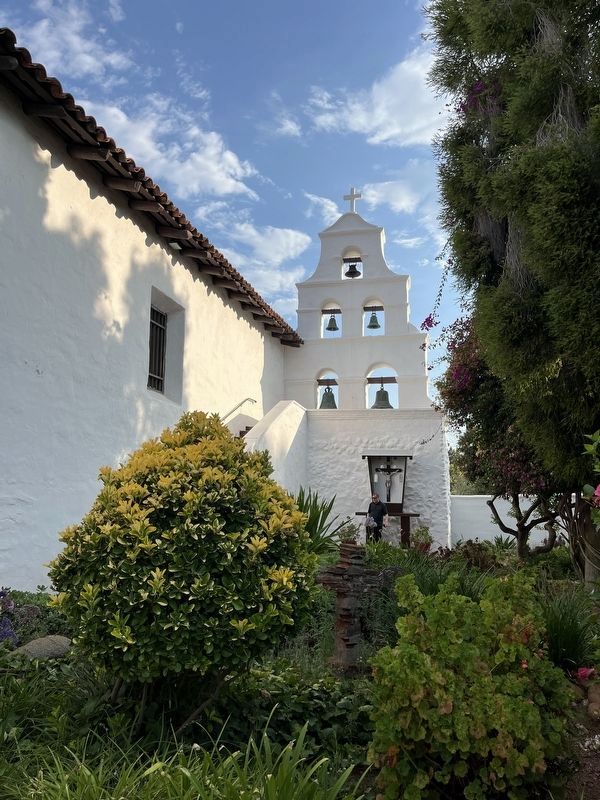
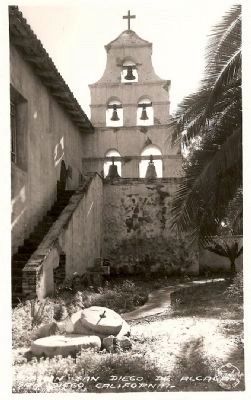
One of the bells is original - it is one of the larger bells and it is distinguishable because it has a conan or crown on top of it and is dated 1802. When the King of Spain wanted bells forged for the missions, he required that they have a crown. The other large bell is made up of remnants from the original bells. The middle two bells are crown bells and all five bells are rung in unison only once a year and that is on the birthday of the mission. The large bell on the bottom (non-crown) is rung twice a day (at noon and at six) and before every Mass on Sunday. Bells were extremely important in mission days; they were used as clocks signifying when it was time to eat, pray, work or

Photographed by Adam Margolis, July 23, 2024
3. Campanario Marker
Source: Mission San Diego de Alcala Official Web Site
— Submitted December 19, 2008, by Syd Whittle of Mesa, Arizona.
Additional keywords. California Missions
Photographed by Adam Margolis, July 23, 2024
4. The Campanario
Photographed by Frashers Foto
5. Postcard View of the Camanario
Photographed by Craig Baker, March 10, 2026
6. The Campanario
Credits. This page was last revised on March 10, 2026. It was originally submitted on December 19, 2008, by Syd Whittle of Mesa, Arizona. This page has been viewed 2,269 times since then and 111 times this year. Photos: 1. submitted on March 10, 2026, by Craig Baker of Sylmar, California. 2. submitted on December 19, 2008, by Syd Whittle of Mesa, Arizona. 3, 4. submitted on August 19, 2024, by Adam Margolis of Mission Viejo, California. 5. submitted on December 19, 2008, by Syd Whittle of Mesa, Arizona. 6. submitted on March 10, 2026, by Craig Baker of Sylmar, California.
