
Rioverde, San Luis Potosí, Mexico — The Northeast (and Central Highlands)
The Water Wheel
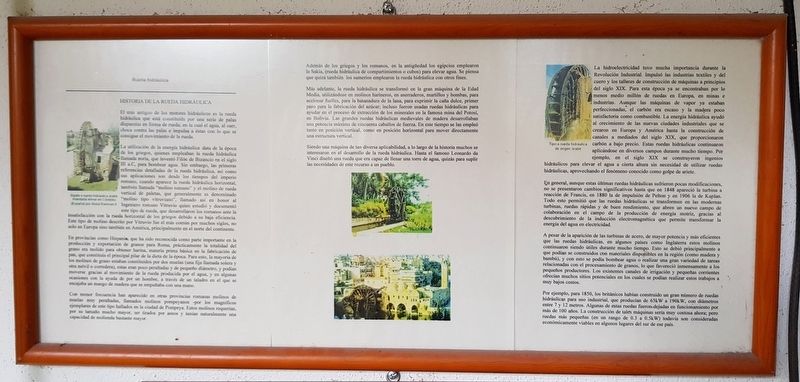
Photographed by J. Makali Bruton, January 17, 2020
1. The Water Wheel Marker

Historia de la Rueda Hidraúlica
El más antiguo de los motores hidráulicos es la rueda hidraulica que está constituida por una serie de palas dispuestas en forma de rueda: en la cual el agua, al caer, choca contra las palas e impulsa a estas con lo que se consigue el movimiento de la rueda.
La utilización de la energia hidráulica data de la época de los griegos, quienes empleaban la rueda hidráulica llamada noria, que invento Filón de Bizancio en el siglo III a.C., para bombear agua. Sin embargo, las primeras referencias detalladas de la rueda hidráulica, así como sus aplicaciones son desde los tiempos del imperio romana, cuando aparece la rueda hidráulica horizontal, también llamada "molino romano" y el molino de rueda vertical de paletas, que generalmente es denominado "molino tipo vitruviano", llamado así en honor al Ingeniero romano Vitruvio quien estudió y documentó este tipo de rueda, que desarrollaron los romanos ante la insatisfacción con la rueda horizontal de los griegos debido a su baja eficiencia. Este tipo de molino descrito por Vitruvio fue el más común por muchos siglos, no solo en Europa
this page online
En provincias como Hispania, que ha sido reconocida como parte importante en la producción y exportación de granos para Roma prácticamente la totalidad del grano era molido para obtener harina, materia prima básica en la fabricación de pan, que constituia el principal pilar de la dieta de la época. Para esto, la mayoría de los molinos de grano estaban constituidos por dos muelas (una fija llamada solera y otra móvil o corredere), estas eran poco peraltadas y de pequeño diámetro, y podían moverse gracias al movimiento de la rueda producida por el agua y en algunas ocasiones con la ayuda de por un hombre, a través de un taladro en el que se encajaba un mango de madera que se empujaba con una mano.
Con menor frecuencia han aparecido en otras provincias romanas molinos de muelas muy peraltadas, llamados molinos pompeyanos – por los magnificos ejemplares de este tipo hallados en la ciudad de Pompeya. Estos molinos requerían, por su tamaño mucho mayor, ser tirados por asnos y tenían naturalmente una capacidad de molienda bastante mayor.
Además de los griegos y los romanos,
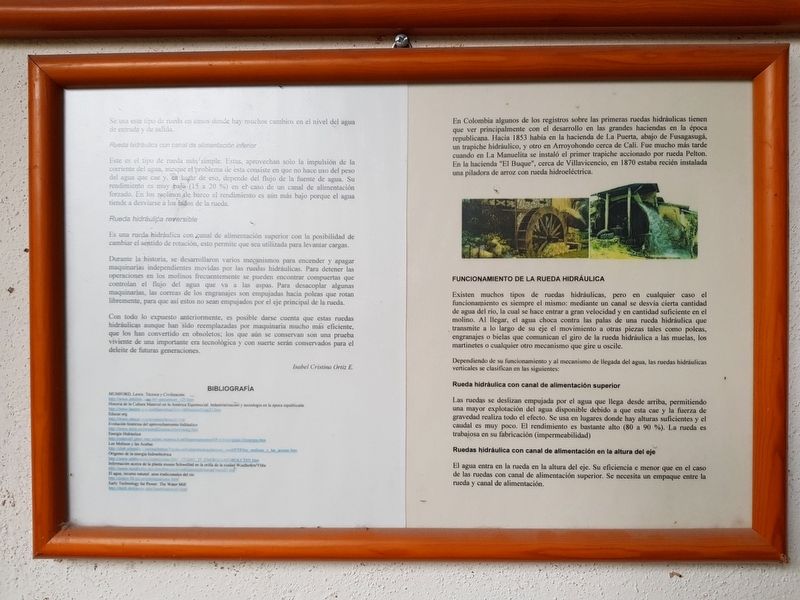
Photographed by J. Makali Bruton, January 17, 2020
2. The Water Wheel Marker
This is the second of two markers at the location.
Más adelante, la rueda hidráulica se transformó en la gran máquina de la Edad Media, utilizándose en molinos harineros, en aserraderos, martillos y bombas, para accionar fuelles, para la batanadura de la lana, para exprimir la caña dulce, primer paso para la fabricación del azúcar; incluso fueron usadas ruedas hidráulicas para ayudar en el proceso de extracción de los minerales en la famosa mina del Potosí, en Bolivia. Las grandes ruedas hidráulicas medievales de madera desarrollaban una potencia máxima de cincuenta caballos de fuerza. En este tiempo se las empleó tanto en posición vertical, como en posición horizontal para mover directamente una estructura vertical.
Siendo una máquina de tan diversa aplicabilidad, a lo largo de la historia muchos se interesaron en el desarrollo de la rueda hidráulica. Hasta el famoso Leonardo da Vinci diseñó una rueda que era capaz de llenar una torre de agua, quizás para suplir las necesidades de este
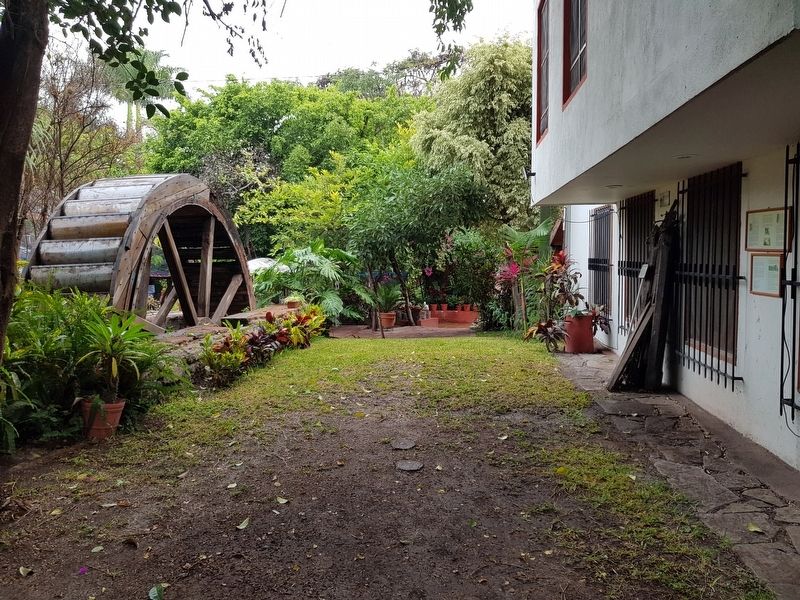
Photographed by J. Makali Bruton, January 17, 2020
3. The Water Wheel and Marker
The markers are attached to the wall on the right, with the water wheel to the left.
La hidroelectricidad tuvo mucha importancia durante la Revolución Industrial. Impulsó las industrias textiles y del cuero y los talleres de construcción de máquinas a principios del siglo XIX. Para esta época ya se encontraban por lo menos medio millón de ruedas en Europa, en minas e industrias. Aunque las máquinas de vapor ya estaban perfeccionadas, el carbón era escaso y la madera poco satisfactoria como combustible. La energia hidráulica ayudó al crecimiento de las nuevas ciudades industriales que se crearon en Europa y América hasta la construcción de canales a mediados del siglo XIX, que proporcionaron carbón a bajo precio. Estas ruedas hidráulicas continuaron aplicándose en diversos campos durante mucho tiempo. Por ejemplo, en el siglo XIX se construyeron ingenios hidráulicos para elevar el agua a cierta altura sin necesidad de utilizar ruedas hidráulicas, aprovechando el fenómeno conocido como golpe de ariete.
En general, aunque estas últimas ruedas hidráulicas sufrieron pocas modificaciones, no se presentaron cambios significativos hasta que en 1848 apareció la turbina a reacción de Francis, en 1880 la
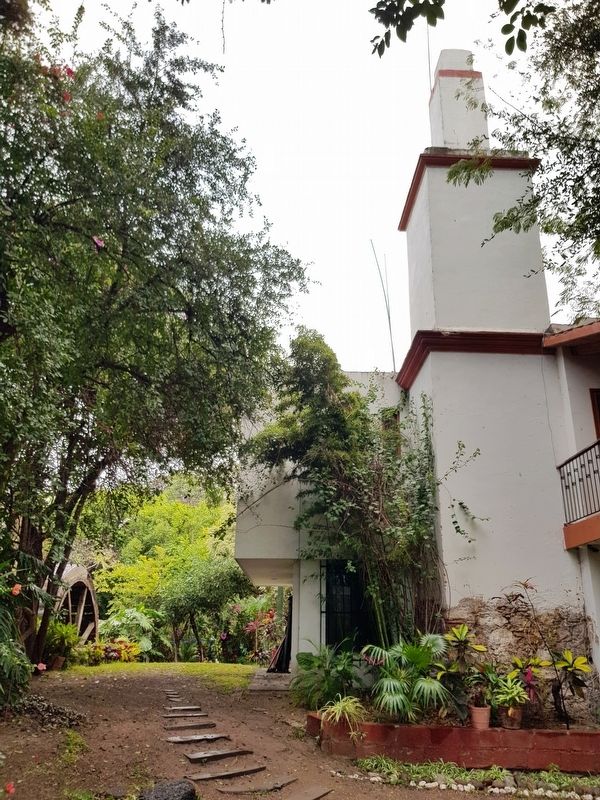
Photographed by J. Makali Bruton, January 17, 2020
4. The Water Wheel, Marker and mill remnants
Note the previous sugar cane mill's chimney, used in the processing of sugar. The property is now a hotel.
A pesar de la aparición de las turbinas de acero, de mayor potencia y más eficientes que las ruedas hidráulicas, en algunos países como Inglaterra estos molinos continuaron siendo útiles durante mucho tiempo. Esto se debió principalmente a que podían ser construidos con materiales disponibles en la región (como madera y bambú), y con esto se podía bombear agua o realizar una gran variedad de tareas relacionadas con el procesamiento de granos, lo que favoreció inmensamente a los pequeños productores. Los existentes canales de irrigación y pequeñas corrientes ofrecían muchos sitios potenciales en los cuales se podían realizar estos trabajos a muy bajos costos.
Por ejemplo, para 1850, los británicos habían construido un gran número de ruedas hidráulicas para uso
Photographed by J. Makali Bruton, January 17, 2020
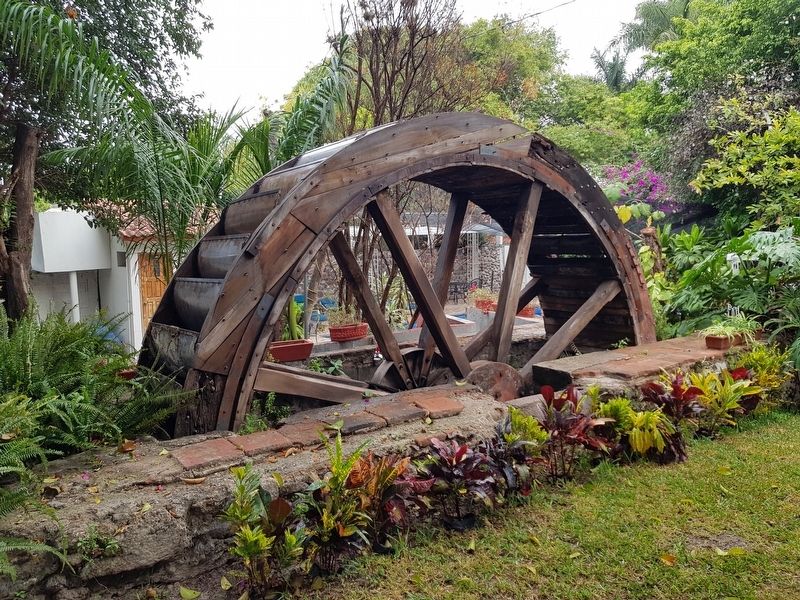
5. The Water Wheel
This is an example of a water wheel that is driven by water entering the wheel at axle height. It was moved by the water flow and not by gravity, thus having a lower efficiency.
Se usa este tipo de rueda en casos donde hay muchos cambios en el nivel del agua de entrada y de salida.
Rueda hidráulica con canal de alimentación inferior
Este es el tipo de rueda más simple. Estas, aprovechan solo la impulsión de la corriente del agua, aunque el problema de esta consiste en que no hace uso del peso del agua que cae y, en lugar de eso, depende del flujo de la fuente de agua. Su rendimiento es muy bajo (15 a 20%) en el caso de un canal de alimentación forzado. En los molinos de barco el rendimiento es aún más bajo porque el agua tiende a desviarse a los lados de la rueda.
Rueda hidráulica reversible
Es una rueda hidráulica con canal de alimentación superior con la posibilidad de cambiar el sentido de rotación, esto permite que sea utilizada para levantar cargas. Durante
Photographed by J. Makali Bruton, January 17, 2020
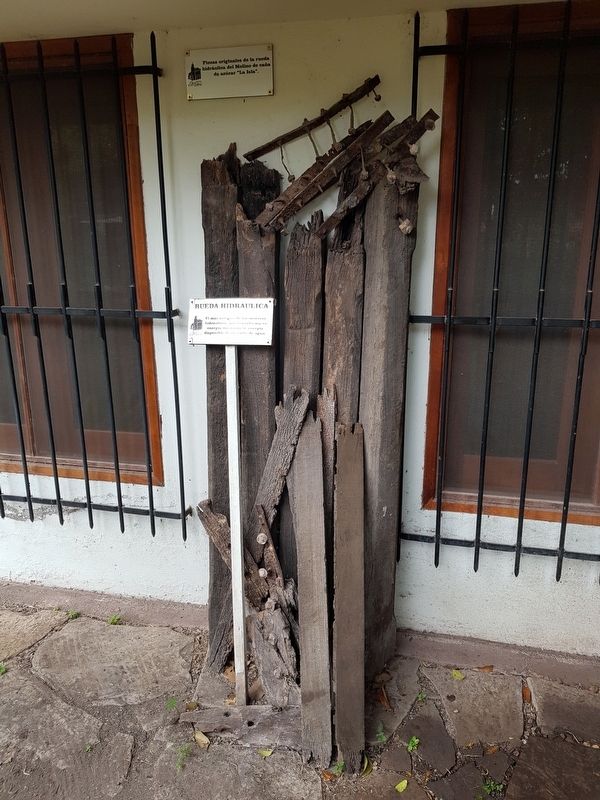
6. Water Wheel Remnants
The nearby sign notes that these are remnants of the original water wheel from the Hacienda La Isla.
Con todo lo expuesto anteriormente, es posible darse cuenta que estas ruedas hidráulicas aunque han sido reemplazadas por maquinaria mucho más eficiente, que los han convertido en obsoletos; los que aún se conservan son una prueba viviente de una importante era tecnológica y con suerte serán conservados para el deleite de futuras generaciones.
Isabel Cristina Ortiz E.
Bibliografía
Fuentes no transcritas
En Colombia algunos de los registros sobre las primeras ruedas hidráulicas tienen que ver principalmente con el desarrollo en las grandes haciendas en la época republicana. Hacia 1853 había en la hacienda de La Puerta, abajo de Fusagasugá, un trapiche hidráulico, y otro en Arroyobondo cerca de Cali. Fue mucho más tarde cuando en La Manuelita se instaló el primer trapiche accionado por rueda Pelton. En la hacienda "El Buque", cerca de Villavicencio, en 1870 estaba recién instalada una piladora de arroz con rueda hidroeléctrica.
Funcionamiento de la rueda hidráulica
Existen muchos tipos de ruedas hidráulicas, pero en cualquier caso el funcionamiento es siempre el mismo mediante un canal se desvía cierta cantidad de agua del rio, la cual se hace entrar a gran velocidad y en cantidad suficiente en el molino. Al llegar, el agua choca contra las palas de una rueda hidráulica que transmite a lo largo de su eje el movimiento a otras piezas tales como poleas, engranajes o bielas que comunican el giro de la rueda hidráulica a las muelas, los martinetes o cualquier otro mecanismo que gire u oscile.
Dependiendo de su funcionamiento y al mecanismo de llegada del agua, las ruedas hidráulicas verticales se clasifican en las siguientes:
Rueda hidraulica con canal de alimentación superior
Las ruedas se deslizan empujada por el agua que llega desde arriba, permitiendo una mayor explotación del agua disponible debido a que esta cae y la fuerza de gravedad realiza todo el efecto. Se usa en lugares donde hay alturas suficientes y el caudal es muy poco. El rendimiento es bastante alto (80 a 90 %). La rueda es trabajosa en su fabricación (impermeabilidad).
Ruedas hidraulica con canal de alimentación en la altura del eje
El agua entra en la rueda en la altura del eje. Su eficiencia e menor que en el caso de las ruedas con canal de alimentación superior. Se necesita un empaque entre la rueda y canal de alimentación.
The Hydraulic Wheel
The History of the Hydraulic Wheel
The oldest of the hydraulic motors is the hydraulic wheel that consists of a series of blades set into a wheel, in which the water, when falling, hits the blades and drives them and the movement of the wheel is achieved.
The use of hydraulic energy dates from the time of the Greeks, who used the hydraulic wheel, called a ‘noria’, which was invented by Philo of Byzantium in the 3rd century B.C., to pump water. However, the first detailed references to the hydraulic wheel, as well as its applications, are from the times of the Roman Empire, when the horizontal hydraulic wheel appears, also called the "Roman mill." The vertical axis mill, which is generally called a "Vitruvian mill" was named in honor of the Roman engineer Vitruvius, who studied and documented this type of wheel, which the Romans developed in the face of dissatisfaction with the horizontal wheel of the Greeks due to its low efficiency. This type of mill described by Vitruvius was the most common for many centuries, not only in Europe but also in the Americas, mainly in the north of the continent.
In provinces such as Hispania, which has been recognized as an important province in the production and export of grains for Rome, almost all of the grain was ground to obtain flour, a basic raw material for the manufacture of bread, which constituted the basis of people's diet at the time. For this, the majority of the grain mills were made up of two grindstones (a fixed one called “solera” and another mobile or “corredere”), these were not banked much and had a small diameter. They moved due to the direct flow of water and on some occasions with the help of a man, through a drill with a wooden handle that was pushed with one hand.
Less frequently, mills have appeared in other Roman provinces that were very banked, called Pompeian mills - for the magnificent specimens of this type found in the city of Pompeii. These mills required, due to their much larger size, to be pulled by donkeys and naturally had a much greater grinding capacity.
In addition to the Greeks and Romans, in ancient times the Egyptians used the "sakia" (a hydraulic wheel made of many compartments or buckets) to raise water. It is thought that perhaps the Sumerians also used the hydraulic wheel for other purposes.
Later, the hydraulic wheel became the great machine of the Middle Ages, being used in flour mills, sawmills, hammers, pumps, to drive bellows, for the batting of wool and to squeeze juice from sugar cane, the first step in the manufacture of sugar. Hydraulic wheels were even used to help in the process of extracting minerals at the famous Potosí mine in Bolivia. The large medieval wooden hydraulic wheels developed a maximum power of fifty horsepower. During this time they were used both vertically and horizontally.
Being a machine of such diverse applicability, throughout history many were interested in the development of the hydraulic wheel. Even the famous Leonardo da Vinci designed a wheel that was capable of filling a water tower, perhaps to supply the water resources of a town.
Hydroelectricity was very important during the Industrial Revolution. It promoted the textile and leather industries and machine building workshops in the early 19th century. By this time, at least half a million wheels were already in use in Europe, in mines and industries. Although the steam engines were already perfected, coal was scarce and wood was unsatisfactory as a fuel. Hydropower helped the growth of the new industrial cities that were created in Europe and America until the construction of canals in the mid-19th century, which provided coal at a low price. These hydraulic wheels continued to be applied in various fields for a long time. For example, in the 19th century, hydraulic mills were built to raise water to a certain height without using hydraulic wheels, taking advantage of the phenomenon known as a water hammer.
In general, although these last hydraulic wheels suffered few modifications, there were no significant changes until in 1848 when the turbine appeared using the Francis reaction, and in 1880 the Pelton drive and in 1906 that of Kaplan. All this allowed hydraulic wheels to become the modern turbines, with fast wheels and good performance, which opened a new field of collaboration in the field of motor energy production, thanks to the discovery of electromagnetic induction that allows the transformation of water energy into electricity.
Despite the emergence of steel turbines, with greater power and more efficient than hydraulic wheels, in some countries like England these mills continued to be useful during a long time. This was mainly due to the fact that they could be built with materials available in the region (such as wood and bamboo), and with this could pump water or perform a wide variety of tasks related to grain processing, which immensely favored smaller producers. The existing irrigation channels and small streams offered many potential sites where these works could be carried out at very low costs.
For example, by 1850, the British had built a large number of hydraulic wheels for industrial use, which produced from 65 kW to 190 kW, with diameters between 7 and 12 meters. Some of these wheels were left in operation for more than 100 years. The construction of such machines would be very expensive now; but smaller wheels (in a range of 0.3 to 0.5 kW) are still considered economically viable in some places in the south of that country.
This type of wheel is used in cases where there is a large difference in the input and output water level.
A hydraulic wheel with a lower feed channel
This is the simplest type of waterwheel. These take advantage only of the flow of water, although the problem of this type is that it does not use the weight of the water that falls and, instead, depends on the flow of the water source. Its performance efficiency is very low (15 to 20%) in the case of a forced feed channel. In boat mills the performance is even lower because water tends to deflect to the sides of the wheel.
A reversible hydraulic wheel
This is a hydraulic wheel with an upper feed channel with the possibility of changing the direction of rotation, this allows it to be used to lift loads. During history, several mechanisms were developed to turn on and off independent machinery moved by hydraulic wheels. To stop mill operations, you can often find floodgates that control the flow of water going to the blades. To decouple some machinery, gear belts are pushed towards freely rotating pulleys, so that they are not pushed by the main axle of the wheel.
With all of the above, it is possible to realize that these hydraulic wheels have been replaced by much more efficient machinery, that have made them obsolete; those that are still preserved are living proof of an important technological era and hopefully they will be preserved to the delight of future generations.
Isabel Cristina Ortiz E.
Bibliography
Source not transcribed
In Colombia some of the records on the first hydraulic wheels are related mainly to the development of large estates during the Republican Period. By 1853 there was a hydraulic mill at the Hacienda de la Puerta, below Fusagasugá, and another at Arroyobondo near Cali. It was much later when in La Manuelita the first Peliche wheel-driven mill was installed. In the farm "El Buque", near Villavicencio, in 1870 a rice mill was installed with a hydroelectric wheel.
Operation of the hydraulic wheel
There are many types of hydraulic wheels, but in any case the operation is always through a channel, where a certain amount of water is diverted from a river, which is made to enter the mill at high speed and in sufficient quantity. Upon arrival, the water collides with the blades of a hydraulic wheel that transmits along its axis the movement to other parts such as pulleys, gears or connecting rods that communicate the rotation of the hydraulic wheel to the wheels, the hammers or any other mechanism that rotates or oscillates.
Depending on its operation and the water arrival mechanism, the vertical hydraulic wheels are classified as follows:
Hydraulic wheels with upper feed channels
The wheel moves pushed by the water that arrives from above, allowing a greater exploitation of the available water because it falls and the force of gravity performs all the effect. It is used in places where there are sufficient heights and the flow is low. The efficiency is quite high (80 to 90%). The wheel is difficult in its manufacture, as it needs to be impermeable.
Hydraulic wheels with feed channels at axle height
Water enters the wheel at axle height. Its efficiency is lower than in the case of wheels with a higher feed channel. A gasket is needed between the wheel and feed channel.
Topics. This historical marker is listed in these topic lists: Industry & Commerce • Science & Medicine. A significant historical year for this entry is 1848.
Location. 21° 55.208′ N, 100° 0.042′ W. Marker is in Rioverde, San Luis Potosí. It is on Unnamed road just east of Porfirio Díaz, on the left when traveling east. Touch for map. Marker is in this post office area: Rioverde SL 79610, Mexico. Touch for directions.

Regionally, this marker is in Northern Mexico, in the Bajío, and in the Sierra Madre. Globally, it is in North America and the Western Hemisphere. Historically, it finds itself in what was once New Spain and also a Spanish colony.
Other nearby markers. At least one other marker is within 8 kilometers of this marker, measured as the crow flies: Media Luna Springs (approx. 6.9 kilometers away).
Also see . . . The Water Wheel. (Submitted on February 23, 2020, by J. Makali Bruton of Washington, District of Columbia.)
Credits. This page was last revised on October 6, 2021. It was originally submitted on February 23, 2020, by J. Makali Bruton of Washington, District of Columbia. This page has been viewed 598 times since then and 154 times this year. Photos: 1, 2, 3, 4, 5, 6. submitted on February 23, 2020, by J. Makali Bruton of Washington, District of Columbia.
