Smithfield in Johnston County, North Carolina — The American South (South Atlantic)
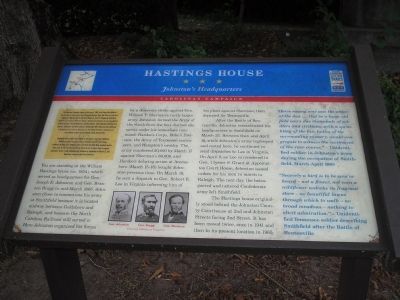
Hastings House
Johnston’s Headquarters
| — | Carolinas Campaign | — |
Photographed by Bill Coughlin, August 18, 2006
1. Hastings House Marker
The Carolinas Campaign began on February 1, 1865, when Union Gen. William T. Sherman led his army north from Savannah, Georgia, after the “March to the Sea.” Sherman's objective was to join Gen. Ulysses S. Grant in Virginia to crush Gen. Robert E. Lee's Army of Northern Virginia. Scattered Confederate forces consolidated in North Carolina, the Confederacy's logistical lifeline, where Sherman defeated Gen. Joseph E. Johnston's last-ditch attack at Bentonville. After Sherman was reinforced at Goldsboro late in March, Johnston saw the futility of further resistance and surrendered on April 26, essentially ending the Civil War.
You are standing at the William Hastings house (ca. 1854),
this page online
After the Battle of Bentonville, Johnston reestablished his headquarters in Smithfield on March 25. Between then and April 10, while Johnston’s army regrouped and rested here, he continued to send dispatches to Lee in Virginia. On April 9, as Lee surrendered to Gen. Ulysses S. Grant at
Photographed by Bill Coughlin, August 18, 2006
2. Hastings House Marker
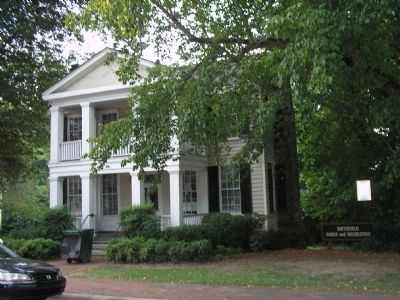
Marker is located to the right of the Hastings House, behind the "Smithfield Parks and Recreation" sign.
The Hastings house originally stood behind the Johnston County Courthouse at 2nd and Johnston Streets facing 2nd Street. It has been moved twice, once in 1941 and then to its present location in 1965.
“Horse racing now was the order of the day … Out in a large old field every day thousands of soldiers and civilians, with a sprinkling of the fair ladies of the surrounding country, would congregate to witness the excitement of the race course.” - Unidentified soldier in Johnston’s army during the occupation of Smithfield, March-April 1865
“Scarcely a bird is to be seen or heard – not a flower, not even a wildflower unlocks its fragrant store – no beautiful lawns through which to walk – no broad meadows – nothing to elicit admiration.” - Unidentified Tennessee soldier describing Smithfield after the Battle of Bentonville
Erected by North Carolina Civil War Trails.
Topics and series. This historical marker is listed in this topic list: War, US Civil. In addition,
Photographed by Bill Coughlin, August 18, 2006
3. Hastings House
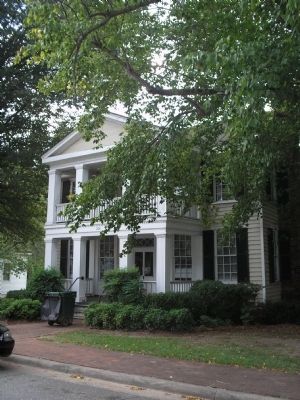
This house served as headquarters for Confederate Generals Joseph E. Johnston and Braxton Bragg.
Location. 35° 30.682′ N, 78° 20.981′ W. Marker is in Smithfield, North Carolina, in Johnston County. It is at the intersection of South Front Street and East Johnston Street, on the left when traveling north on South Front Street. Touch for map. Marker is at or near this postal address: 200 S Front St, Smithfield NC 27577, United States of America. Touch for directions.

Regionally, this marker is in North Carolina’s Piedmont. It is also in the American South and specifically in the Upper South. Globally, it is in North America, the Western Hemisphere, the Western World, and the Anglosphere. Historically, it finds itself in what was once the territory of the Mississippian Culture, one of the original Thirteen Colonies, one of the Confederate States of America, and the Antebellum South.
Other nearby markers. At least 8 other markers are within walking distance of this marker: Town of Smithfield (here, next to this marker); a different marker also named The Town of Smithfield (about 300 feet away, measured in a direct line); Edward W. Pou (about 400 feet away); Honor Roll (about 700 feet away); a different marker also named Occupation of Smithfield (about 700 feet away); Johnston County War Memorial (about 800 feet away); World War II and Korean Conflict Memorial (about 800 feet away); Johnston County Fountain Memorial (about 800 feet away). Touch for a list and map of all markers in Smithfield.
Another marker is no longer nearby. Occupation of Smithfield (was about 700 feet away but has been replaced with another marker now near it).
Credits. This page was last revised on October 25, 2023. It was originally submitted on December 24, 2008, by Bill Coughlin of Woodland Park, New Jersey. This page has been viewed 2,989 times since then and 89 times this year. Last updated on March 4, 2023, by Michael Buckner of Durham, North Carolina. Photos: 1, 2, 3. submitted on December 24, 2008, by Bill Coughlin of Woodland Park, New Jersey. • Bernard Fisher was the editor who published this page.
