Navy Yard in Philadelphia in Philadelphia County, Pennsylvania — The American Northeast (Mid-Atlantic)
The Philadelphia Naval Shipyard
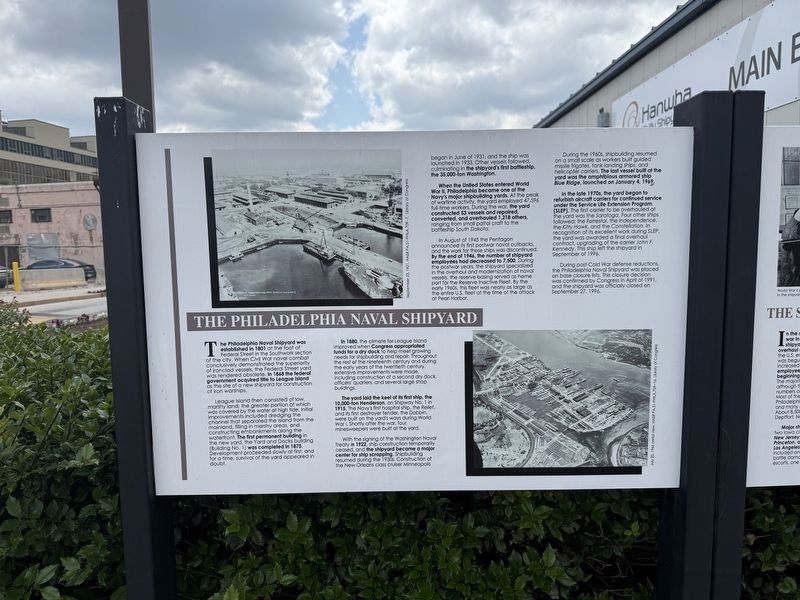
The Philadelphia Naval Shipyard was established in 1801 at the foot of Federal Street in the Southwark section of the city. When Civil War naval combat conclusively demonstrated the superiority of ironclad vessels, the Federal Street yard was rendered obsolete. In 1868 the federal government acquired title to League Island as the site of a new shipyard for construction of iron warships.
League Island then consisted of low, marshy land, the greater portion of which was covered by the water at high tide. Initial improvements included dredging the channel that separated the island from the mainland, filling in marshy areas, and constructing embankments along the waterfront. The first permanent building in the new yard, the Yard and Docks building (Building No. 1) was completed in 1875. Development proceeded slowly at first, and for a time, survival of the yard appeared in doubt.
In 1880, the climate for League Island improved when Congress appropriated funds for a dry dock to help meet growing needs for shipbuilding and repair. Throughout the rest of the nineteenth century and during the early years of the twentieth
this page online
The yard laid the keel of its first ship, the 10,000-ton Henderson, on Shipway No. 1 in 1915, The Navy's first hospital ship, the Relief, and its first destroyer tender, the Dobbin, were built on the yard's ways during World War I. Shortly after the war, four minesweeper were built at the yard.
With the signing of the Washington Naval Treaty in 1922, ship construction temporarily ceased, and the shipyard became a major center for ship scrapping. Shipbuilding resumed during the 1930s. Construction of the New Orleans class cruiser Minneapolis began in June of 1931, and the ship was launched in 1933. Other vessels followed, culminating in the shipyard's first battleship, the 35,000-ton Washington.
When the United States entered World War II, Philadelphia became one of the Navy's major shipbuilding yards. At the peak of wartime activity, the yard employed 47,596 full-time workers. During the war, the yard constructed 53 vessels and repaired, converted, and overhauled 1,218 others, ranging

Photographed by Devry Becker Jones (CC0), March 14, 2020
2. The Philadelphia Naval Shipyard Marker
This is a photo of a prior iteration of the marker. It has been replaced with signage featuring slightly different formatting and identical text.
In August of 1945 the Pentagon announced its first postwar naval cutbacks, on the work for these ships was discontinued. By the end of 1946, the number of shipyard employees had decreased to 7,500. During the postwar years, the shipyard specialized in the overhaul and modernization of naval vessels. the reserve basing served as home port for the Reserve Inactive Fleet. By the early 1960s, this fleet was nearly as large as the entire U.S. fleet at the time of the attack at Pearl Harbor.
During the 1960s, shipbuilding resumed on a small scale as workers built guided missile frigates, tank landing ships, and helicopter carriers. The last vessel built at the yard was the amphibious armored ship Blue Ridge, launched on January 4, 1969.
In the late 1970s, the yard began to refurbish aircraft carriers for continued service under the Service Life Extension Program (SLEP). The first carrier to be overhauled at the yard was the Saratoga. Four other ships followed: the Forrestal, the Independence, the Kitty Hawk, and the Constellation. In recognition of its excellent work during
During post-Cold War defense reductions, the Philadelphia Naval Shipyard was placed on base closure lists. This closure decision was confirmed by Congress in April of 1991, and the shipyard was officially closed on September 27, 1996.
Topics. This historical marker is listed in this topic list: Waterways & Vessels. A significant historical date for this entry is January 4, 1969.
Location. 39° 53.351′ N, 75° 11.248′ W. Marker is in Philadelphia, Pennsylvania, in Philadelphia County. It is in Navy Yard. It is at the intersection of Kitty Hawk Avenue and South 21st Street, on the left when traveling west on Kitty Hawk Avenue. Touch for map. Marker is at or near this postal address: 2100 Kitty Hawk Ave, Philadelphia PA 19112, United States of America. Touch for directions.

Regionally, this marker is in Southeast Pennsylvania. It is also in the American Northeast and in the Mid-Atlantic. Globally, it is in North America, the Western Hemisphere, the Western World, and the Anglosphere. Historically, it finds itself in what was once the Haudenosaunee (Iroquois) Confederacy, New Netherland, and one of the original Thirteen Colonies.
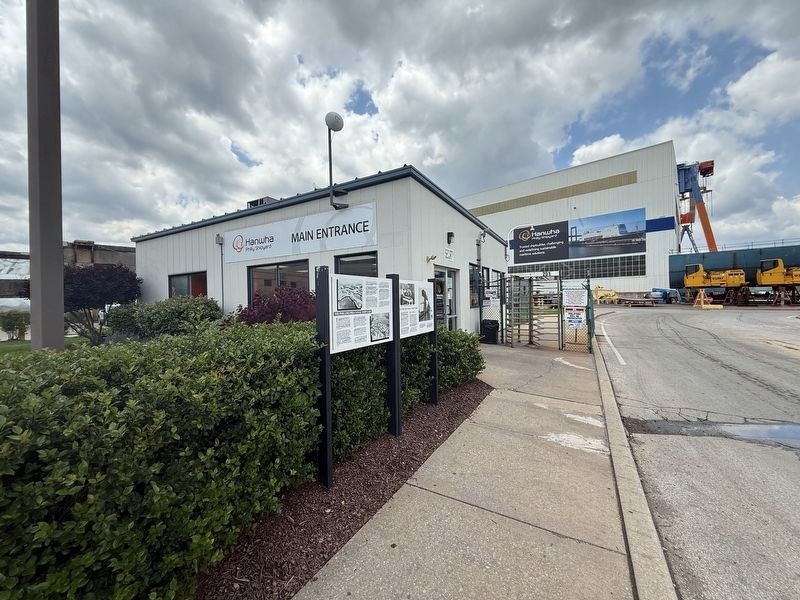
Other nearby markers. At least 8 other markers are within walking distance of this marker: The Shipyard During World War II (here, next to this marker); Naval Foundry and Propeller Center (approx. 0.4 miles away); In Memoriam (approx. 0.6 miles away); Rear Admiral George W. Melville (approx. 0.6 miles away); 16"/50 Caliber Mark 7 Gun Barrel Number 293 (approx. 0.7 miles away); World War II Submariners Memorial (approx. 0.8 miles away); To the lost at sea (approx. 0.8 miles away); U.S. Naval Aircraft Factory (approx. 0.9 miles away). Touch for a list and map of all markers in Philadelphia.
More about this marker. The marker has suffered significant weather damage.
Credits. This page was last revised on June 1, 2025. It was originally submitted on March 15, 2020, by Devry Becker Jones of Washington, District of Columbia. This page has been viewed 1,274 times since then and 138 times this year. Photos: 1. submitted on June 1, 2025, by Devry Becker Jones of Washington, District of Columbia. 2. submitted on March 15, 2020, by Devry Becker Jones of Washington, District of Columbia. 3. submitted on June 1, 2025, by Devry Becker Jones of Washington, District of Columbia.
