Big Indian in Ulster County, New York — The American Northeast (Mid-Atlantic)
History of Big Indian and Oliverea

Photographed by Cosmos Mariner, July 3, 2019
1. History of Big Indian and Oliverea Marker
The Legend of Big Indian
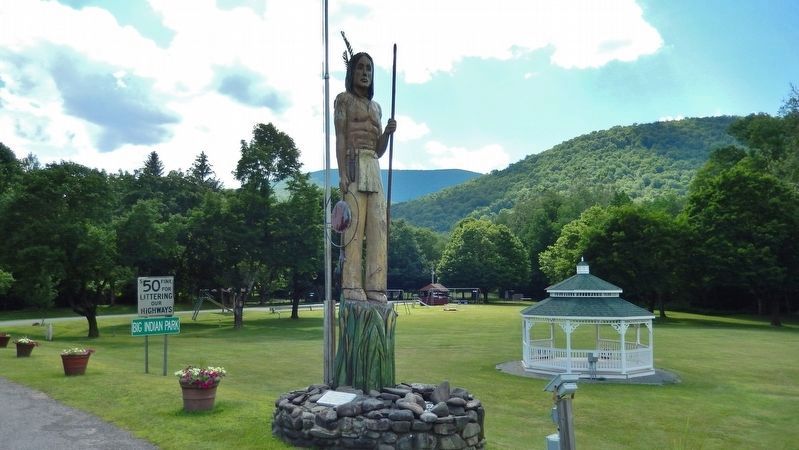
The hamlet of Big Indian takes its name from an 18th century Native American named "Winnisook," who was said to be over seven feet in height, strong, well-built, and fearless. Much of the legend surrounding Winnisook's activities in Ulster County were undoubtedly embellished over the years by local guides and lodging owners seeking to attract visitors to the area with an enticing, romantic tale. However, one fact is certain: the first reference to "Big Indian" as a location was recorded in surveys dating from 1786.
Winnisook, a member of the local tribe called the Munsees of the Lenape Nation, lived in the Marbletown area of Ulster County. There Winnisook fell in love with one Gertrude Molyneaux, the daughter of an early Huguenot settler in the area. However, Gertrude had been betrothed to a Dutch settler by the name of Joseph Bundy, a man said to be of questionable character.
After a brief, unhappy marriage to Bundy, Winnisook succeeded in getting Gertrude to elope with him back to his village and thereafter fathered several children with her.
Several years after this very public humiliation
this page online
In response a posse was formed, including Bundy, to track down the raiding party. Allegedly, Bundy and company caught up with Winnisook in the area now named Big Indian. It was here that Bundy succeeded in finally getting his revenge by firing the bullet that killed Winnisook.
There are many versions of Winnisook's death, one more romantic than the next, including stories of a huge oak tree that stood at the crossroads with Winnisook's enormous outline carved into the bark. One version of the legend is likely true; that upon Winnisook's death Gertrude moved her family to the area we now call "Big Indian" to be near Winnisook's grave. Evidence of this can be found in old land title records that carry Gertrude Molyneaux's family name on land in the Lost Clove valley of Big Indian.
Thanks to Gary Gailes for his telling of the legend.
The site of Aley's General Store, recently known as Morra's Market, is believed by many to have been a stop on the Underground

Photographed by Cosmos Mariner, July 3, 2019
2. History of Big Indian and Oliverea Marker Kiosk
Logging, lumber milling, and furniture making were early industries of this region. All that lumber was needed to build and furnish many fine and fancy inns, boarding houses, and summer resorts for hundreds of thousands of visitors who fled the sweltering city each year. Some still stand today.
Founded in 1886, Oliverea’s famous Winnisook Club sits at the base of Slide Mountain, 2,660 feet above sea level. In 1887 a lodge was built on the private club’s 1,600 acres, and eventually 14 private homes were added, with ownership passing down through the original owners’ families.
Winnisook Lake, which empties into the headwaters of the Esopus Creek and the Neversink River, was dammed to form a five-acre lake for recreation. It is the highest lake in the Catskills. Many historical celebrities have visited the club, including Secretary of State William Jennings Bryan and famous naturalist John Burroughs.
Jake Moon built the original building that was once Rudy's Big Indian

3. Marker detail: 375 Million Years Ago
Panther Mountain Impact Footprint
Panther Mountain Impact Footprint
A meteor hit Panther Mountain in Oliverea, creating a 7-mile-wide crater. Or did it? In the 1970s, geologist Yngvar lsachsen, intrigued by the curiously curved question mark shape of the Esopus Creek, began to study the area and discovered fractures in the rocky streambed and other microscopic evidence of a meteor strike. According to this theory, the meteor would have been about 1/2 mile across and the explosion equal to 11 trillion tons of TNT. The shattered rock allowed water to flow more freely, influencing the shape of the Esopus hundreds of millions of years later. Abnormally weak gravity in the area is also thought to be the result of the impact, perhaps making your hike to the top of Panther Mountain just a little bit easier!
Topics. This historical marker is listed in these topic lists: Abolition & Underground RR • Indigenous Peoples and Communities • Industry & Commerce • Settlements & Settlers. A significant historical year for this entry is 1786.
Location. 42° 6.18′ N, 74° 26.756′ W. Marker is in Big Indian, New York, in Ulster County. It can be reached from New York State Route 28 0.1 miles west of Oliverea Road, on the left when traveling west. Marker is mounted in an interpretive kiosk at the east end of the parking lot in Big Indian Park. Touch for map. Marker is at or near this postal address: 8280

4. Marker detail: Aley's General Store

Regionally, this marker is in Upstate New York and in the Hudson Valley. It is also in the American Northeast, in the Mid-Atlantic, and on the Eastern Seaboard. Globally, it is in the North Atlantic Region, North America, the Western Hemisphere, the Western World, and the Anglosphere. Historically, it finds itself in what was once New Netherland and also one of the original Thirteen Colonies.
Other nearby markers. At least 8 other markers are within 4 miles of this marker, measured as the crow flies: Belleayre Mountain Ski Center (approx. 2.7 miles away); History of Pine Hill and Highmount (approx. 2.7 miles away); Pine Hill Honor Roll (approx. 2.7 miles away); Elm Street Stone Arch Bridge (approx. 2.7 miles away); The History of Shandaken, Bushnellsville & Allaben (approx. 3 miles away); Town of Shandaken Historic Sites (approx. 3 miles away); The Shandaken Tunnel and the N.Y.C. Water Supply System (approx. 3 miles away); Ulster County (approx. 4 miles away).

5. Marker detail: Risely Mill & Cruickshank Mill
(left) Risely Mill in 1908
(right) Steam powered Cruickshank Mill of Big Indian Wood Products Ltd. around 1930
(right) Steam powered Cruickshank Mill of Big Indian Wood Products Ltd. around 1930

6. Marker detail: Rohaly's Budapest Rest, Full Moon Resort, Cold Spring Lodge
Rohaly's Budapest Rest (right), is being rescued from the ravages of time, and the smaller building on the left is now a Baptist camp along Route 28. The Valley View (top left) is now the Full Moon Resort, and the Cold Spring Farm (bottom left) is now the Cold Spring Lodge.

7. Marker detail: William Jennings Bryan & John Burroughs

8. Marker detail: Jake Moon Restaurant & Jake Moon
Photographed by Cosmos Mariner, July 3, 2019
9. Winnisook "Big Indian" Statue near park entrance
Photographed by Cosmos Mariner, July 3, 2019
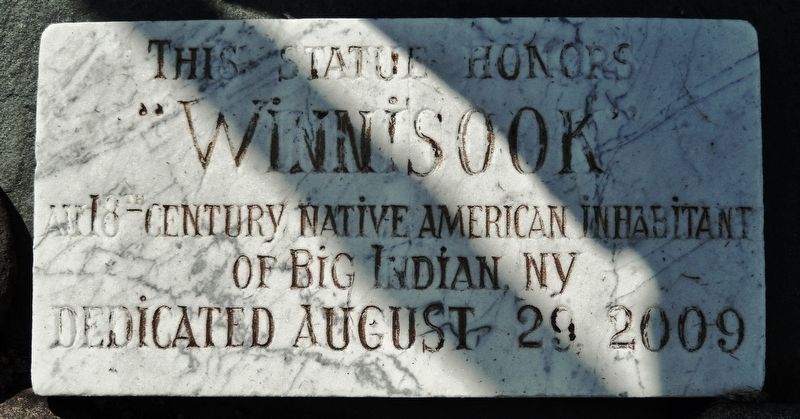
10. Winnisook Statue Marker
Winnisook
An 18th-century Native American inhabitant
of Big Indian, NY
Dedicated August 29, 2009
Credits. This page was last revised on July 14, 2025. It was originally submitted on March 29, 2020, by Cosmos Mariner of Cape Canaveral, Florida. This page has been viewed 6,208 times since then and 369 times this year. Photos: 1, 2, 3, 4, 5, 6. submitted on March 29, 2020, by Cosmos Mariner of Cape Canaveral, Florida. 7, 8, 9, 10. submitted on March 30, 2020, by Cosmos Mariner of Cape Canaveral, Florida.
