Pencader Hundred near Glasgow in New Castle County, Delaware — The American Northeast (Mid-Atlantic)
Poplar Hall
Photographed by Bill Pfingsten, April 24, 2016
1. Poplar Hall Marker
Inscription.
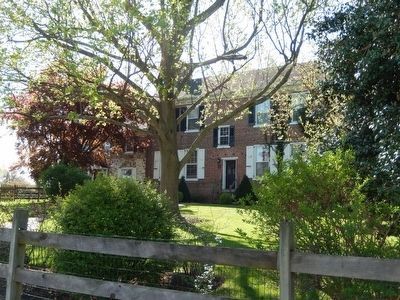
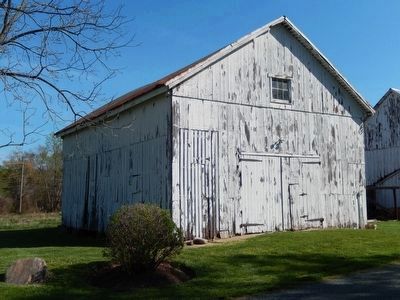
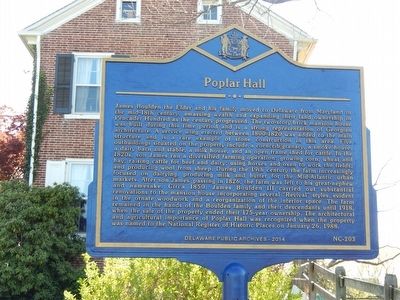
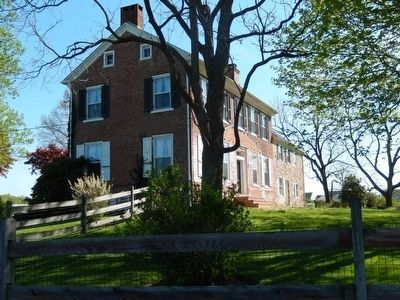
Poplar Hall. . James Boulden the Elder and his family moved to Delaware from Maryland in the mid-18th century, amassing wealth and expanding their land ownership in Pencader Hundred as the century progressed. The two-story brick mansion house was built during this time period and is a strong representation of Georgian architecture. A service wing erected between 1800-1820 was added to the main structure and is a rare example of stone construction in this area. Five outbuildings situated on the property include a corncrib/granary, a smoke house, a dairy barn and stable, a milk house, and an open frame shed for cattle. In the 1820s, son James ran a diversified farming operation: growing corn, wheat and hay; raising cattle for beef and dairy; using houses and oxen to work the fields; and producing wool from sheep. During the 19th century the farm increasingly focused on dairying, producing milk and butter for the Mid-Atlantic urban markets. After son James' passing in 1826, the farm was left to his great-nephew and namesake. Circa 1850, James Boulden III carried out substantial renovations to the mansion house incorporating several "Revival" styles, evident in the ornate woodwork and a reorganization of the interior space. The farm remained in the hands of the Boulden family and their descendants until 1918, when the sale of the property ended their 175-year ownership. The architectural and agricultural importance of Poplar Hall was recognized when the property was named to the National Register of Historic Places on January 26, 1988.
James Boulden the Elder and his family moved to Delaware from Maryland in the mid-18th century, amassing wealth and expanding their land ownership in Pencader Hundred as the century progressed. The two-story brick mansion house was built during this time period and is a strong representation of Georgian architecture. A service wing erected between 1800-1820 was added to the main structure and is a rare example of stone construction in this area. Five outbuildings situated on the property include a corncrib/granary, a smoke house, a dairy barn and stable, a milk house, and an open frame shed for cattle. In the 1820s, son James ran a diversified farming operation: growing corn, wheat and hay; raising cattle for beef and dairy; using houses and oxen to work the fields; and producing wool from sheep. During the 19th century the farm increasingly focused on dairying, producing milk and butter for the Mid-Atlantic urban markets. After son James' passing in 1826, the farm was left to his great-nephew and namesake. Circa 1850, James Boulden III carried out substantial renovations to the mansion house incorporating several "Revival"
Click or scan to see this page online
styles, evident in the ornate woodwork and a reorganization of the interior space. The farm remained in the hands of the Boulden family and their descendants until 1918, when the sale of the property ended their 175-year ownership. The architectural and agricultural importance of Poplar Hall was recognized when the property was named to the National Register of Historic Places on January 26, 1988.
Erected 2014 by Delaware Public Archives. (Marker Number NC-203.)
Location. 39° 33.356′ N, 75° 46.47′ W. Marker is near Glasgow, Delaware, in New Castle County. It is in Pencader Hundred. It is on Denny Road, on the left when traveling west. Touch for map. Marker is at or near this postal address: 3152 Denny Road, Newark DE 19702, United States of America. Touch for directions.

Regionally, this marker is in Greater Wilmington and in Greater Philadelphia.
Photographed by Bill Pfingsten, April 24, 2016
2. Poplar Hall
It is also in the American Mid-Atlantic, on the Delmarva Peninsula, and on the Eastern Seaboard. Globally, it is in the North Atlantic Region, North America, the Western Hemisphere, the Western World, and the Anglosphere. Historically, it finds itself in what was once New Netherland and also one of the original Thirteen Colonies.
Form (Submitted on April 24, 2025, by Larry Gertner of New York, New York.)
Photographed by Bill Pfingsten, April 24, 2016
4. Corn crib
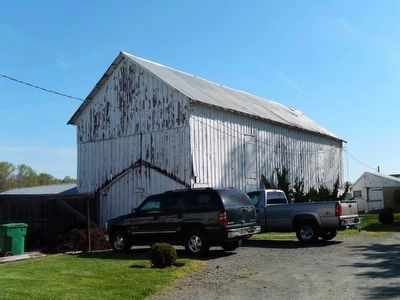
Photographed by Bill Pfingsten, April 24, 2016
5. Barn
Credits. This page was last revised on May 20, 2026. It was originally submitted on April 25, 2016, by Bill Pfingsten of Bel Air, Maryland. This page has been viewed 1,064 times since then and 35 times this year. Last updated on April 7, 2020, by Carl Gordon Moore Jr. of North East, Maryland. Photos:1, 2, 3, 4, 5. submitted on April 25, 2016, by Bill Pfingsten of Bel Air, Maryland.