Vermilion’s Lighthouse
A History
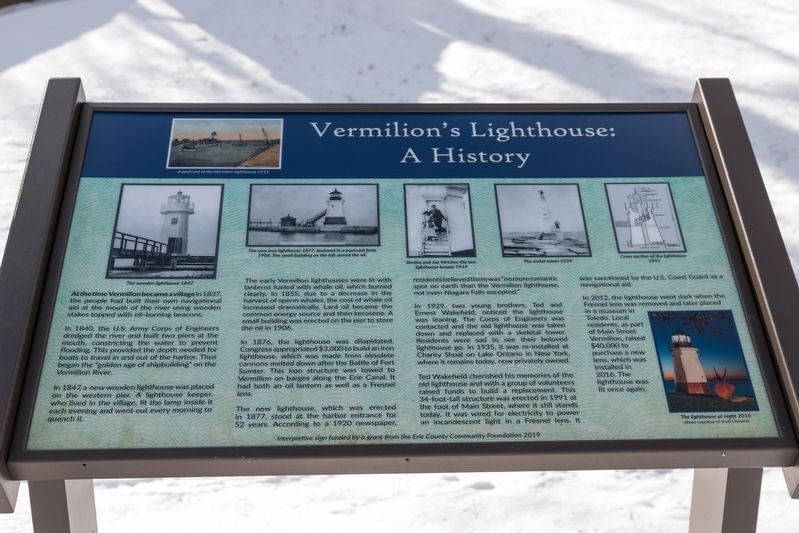
At the time Vermilion became a village in 1837, the people had built their own navigational aid at the mouth of the river using wooden stakes topped with oil-burning beacons.
In 1840, the U.S. Army Corps of Engineers dredged the river and built two piers at the mouth, constricting the water to prevent flooding. This provided the depth needed for boats to travel in and out of the harbor. Thus began the “golden age of shipbuilding” on the Vermilion River.
In 1847, a new wooden lighthouse was placed on the western pier. A lighthouse keeper, who lived in the village, lit the lamp inside it each evening and went out every morning to quench it.
The early Vermilion lighthouses were lit with lanterns fueled with whale oil, which burned clearly. In 1855, due to a decrease in the harvest of sperm whales, the cost of whale oil increased dramatically. Lard oil became the common energy source and then kerosene. A small building was erected on the pier to store the oil in 1906.
In 1876, the lighthouse was dilapidated. Congress appropriated $3,000 to build an iron lighthouse, which was made
this page online
The new lighthouse, which was erected in 1877, stood at the harbor entrance for 52 years. According to a 1920 newspaper, residents believed there was “no more romantic spot on earth than the Vermilion lighthouse, not even Niagara Falls excepted.”
In 1929, two young brothers, Ted and Ernest Wakefield, noticed the lighthouse was leaning. The Corps of Engineers was contacted and the old lighthouse was taken down and replaced with a skeletal tower. Residents were sad to see their beloved lighthouse go. In 1935, it was re-installed at Charity Shoal on Lake Ontario in New York, where it remains today, now privately owned.
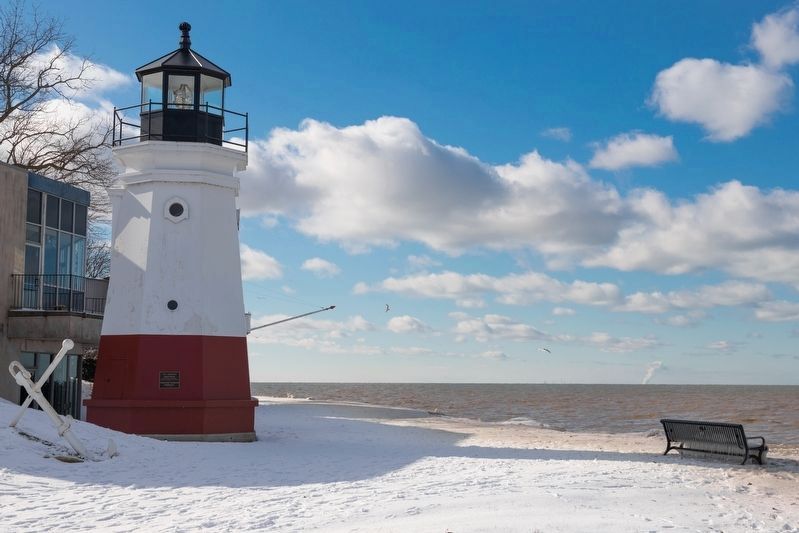
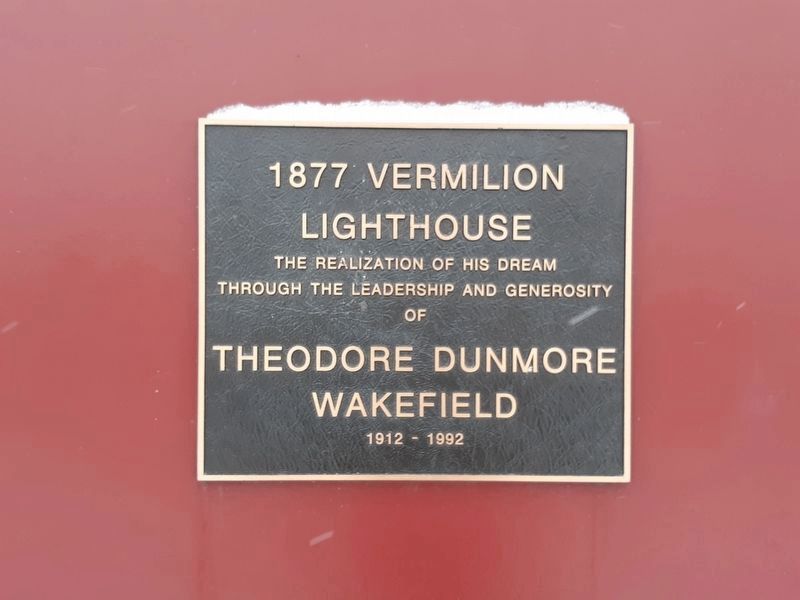
Ted Wakefield cherished his memories of the old lighthouse and with a group of volunteers raised funds to build a replacement. This 34-foot-tall structure was erected in 1991 at the foot of Main Street, where it still stands today. It was wired for electricity to power an incandescent
In 2012, the lighthouse went dark when the
Fresnel lens was removed and later placed
in a museum in
Toledo. Local
residents, as part
of Main Street
Vermilion, raised
$40,000 to
purchase a new
lens, which was
installed in
2016. The
lighthouse was
lit once again.
Erected 2019 by the Erie County Community Foundation.
Topics and series. This historical marker is listed in these topic lists: Communications • Waterways & Vessels. In addition, it is included in the Lighthouses series list. A significant historical year for this entry is 1837.
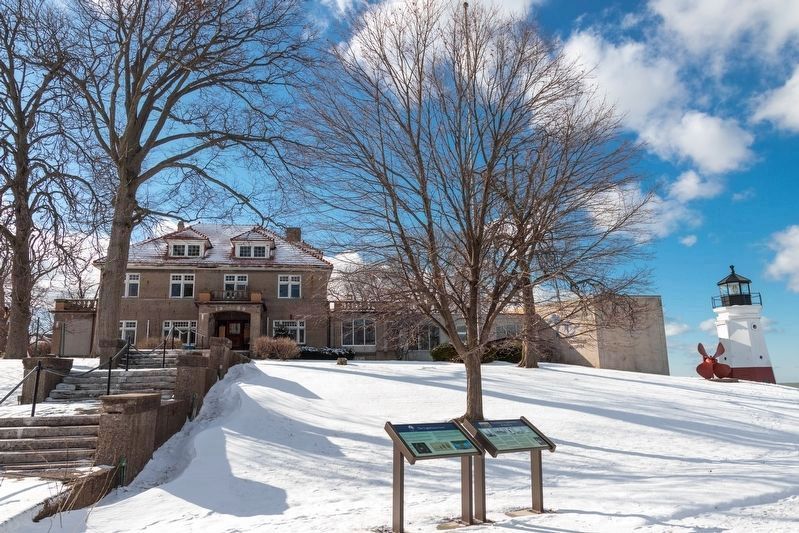
Location. 41° 25.481′ N, 82° 21.974′ W. Marker is in Vermilion, Ohio, in Erie County. It is on Main Street north of Huron Street, on the left when traveling north. It is at the foot of Main Street in Harbor View Park near the Vermilion lighthouse. Touch for map. Marker is at or near this postal address: 480 Main St, Vermilion OH 44089, United States of America. Touch for directions.
Regionally, this marker is on Ohio’s Lake Erie Shore and in the Western Reserve. It is also in the
Other nearby markers. At least 8 other markers are within walking distance of this marker: The Lighthouse Lens (here, next to this marker); Frederick William Wakefield / Harbor View (a few steps from this marker); Holland-Bond Veterans of Foreign Wars Post 7576 Veterans Memorial (within shouting distance of this marker); Simon Kenton (approx. 0.2 miles away); The Days of Steel Boats (approx. 0.2 miles away); Days of Wooden Ships (approx. 0.2 miles away); A Brief History... (approx. 0.2 miles away); The Kishman Fish Company (approx. 0.2 miles away). Touch for a list and map of all markers in Vermilion.
More about this marker. This interpretive panel has seven illustrations. On the dark blue heading is a reproduction of a postcard captioned “A postcard of the Vermilion lighthouse 1911.”
Also see . . .
1. Vermilion Lighthouse. Excerpt:
Once the ironworkers in Buffalo had completed the casting of the lighthouse and ensured that all parts fit together correctly, the pieces of the lighthouse were loaded onto barges in the nearby Erie Canal. Hauled by mules, the barges [headed east and] reached Oswego, New York, in two weeks. From there, the lighthouse was transferred to the lighthouse tender Haze, a steam-powered propeller vessel, which departed Oswego on September 1, 1877 and headed west for the Welland Canal, where a series of twenty-seven locks raised the boat to the water level of Port(Submitted on April 11, 2020.)Colborne and onto Lake Erie. One must wonder why this circuitous route was taken when Buffalo, where the tower was cast, sits right on Lake Erie.Photographed by Craig Doda, November 28, 20245. Vermilion’s Lighthouse MarkerThe museum was demolished in 2021.

2. Inland Seas Maritime Museum. Note: The museum has moved to Toledo. It was housed here from 1953 to 2013. Most of what is described at this link is now in Toledo. (Submitted on April 11, 2020, by J. J. Prats of Powell, Ohio.)
Credits. This page was last revised on December 28, 2024. It was originally submitted on April 11, 2020, by J. J. Prats of Powell, Ohio. This page has been viewed 521 times since then and 35 times this year. Photos: 1. submitted on April 11, 2020, by J. J. Prats of Powell, Ohio. 2. submitted on April 10, 2020, by J. J. Prats of Powell, Ohio. 3. submitted on April 7, 2020, by J. J. Prats of Powell, Ohio. 4. submitted on January 26, 2021, by Craig Doda of Napoleon, Ohio. 5. submitted on December 3, 2024, by Craig Doda of Napoleon, Ohio.
