Financial District in Manhattan in New York County, New York — The American Northeast (Mid-Atlantic)
St. Paul’s Chapel
Exploring Downtown
Photographed by Bill Coughlin, June 24, 2009
1. St. Paul’s Chapel Marker
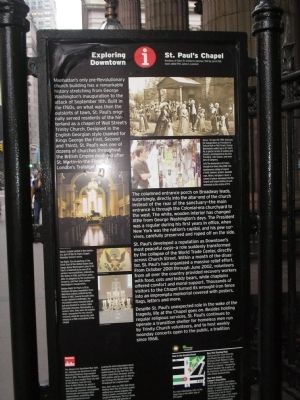
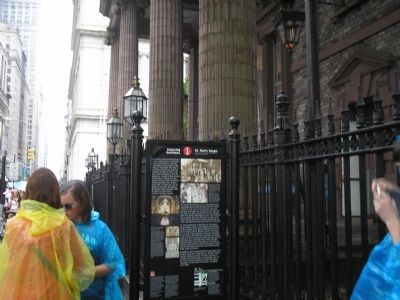
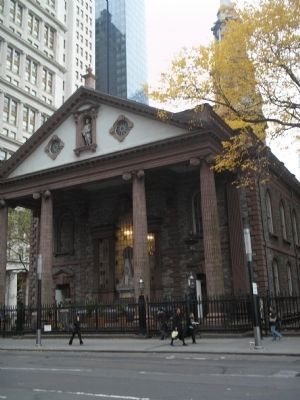
Manhattan’s only pre-Revolutionary church building has a remarkable history stretching from George Washington’s inauguration to the attack of September 11th. Built in the 1760s, on what was then the outskirts of town, St. Paul’s originally served residents of the hinterland as a chapel of Wall Street’s Trinity Church. Designed in the English Georgian style (named for King George the First, Second and Third), St. Paul’s was one of dozens of churches throughout the British Empire modeled after St. Martin-in-the-Fields in London’s Trafalgar Square.
The columned entrance porch on Broadway leads, surprisingly, directly into the altar-end of the church instead of the rear of the sanctuary – the main entrance is through the Colonial-era churchyard to the west. The white, wooden interior has changed little from George Washington’s days. The President was a regular during his first years in office, when New York was the nation’s capital, and his pew survives, carefully preserved and roped off on the side.
St. Paul’s developed a reputation as Downtown’s most peaceful oasis – a role suddenly transformed by the collapse of the World
this page online
Despite St. Paul’s unexpected role in the wake of the tragedy, life at the Chapel goes on. Besides holding regular religious services, St. Paul’s continues to operate a transition shelter for homeless men run by Trinity Church volunteers, and to host weekly noonday concerts open to the public, a tradition since 1968.
Erected by The Alliance for Downtown New York, Inc.
Topics. This historical marker is listed in these topic lists: Colonial Era • Religion & Religious Structures. A significant historical year for this entry is 2001.
Location. Marker has been permanently removed. It was located near 40° 42.678′ N, 74° 0.532′ W. Marker was in Manhattan, New York, in New York County. It was
Photographed by Bill Coughlin, June 24, 2009
2. Marker on Broadway
We have been informed that this marker is no longer there and will not be replaced. This page is an archival view of what was.
Regionally, this marker was in New York City. It was also in the American Northeast, in the Mid-Atlantic, and on the Eastern Seaboard. Globally, it was in the North Atlantic Region, North America, the Western Hemisphere, the Western World, and the Anglosphere. Historically, it found itself in what was once New Netherland and also one of the original Thirteen Colonies.

Other nearby markers. At least 8 other markers are within walking distance of this location: October 19, 1977 (here, next to this marker); Dr. William James MacNeven (here, next to this marker); October 3, 1979 (here, next to this marker); a different marker also named St. Paul's Chapel (a few steps from this marker); August 15, 1984 (a few steps from this marker); Richard Montgomery (a few steps from this
Photographed by Bill Coughlin, June 25, 2009
3. Marker at St. Paul’s Chapel
New York Freedom Trail website entry
Click for more information.
Click for more information.
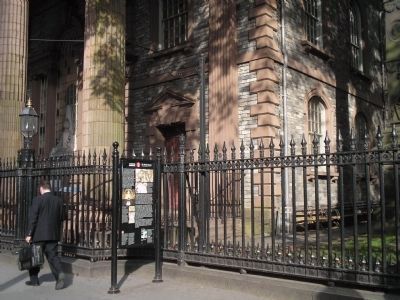
More about this marker. The top right of the marker features a picture of George Washington in front of St. Paul’s Chapel. It has a caption of “On April 30, 1789, following his inauguration as President at Federal Hall on Wall Street, George Washington walked up to St. Paul’s for a special service in solemn procession, accompanied by his Vice President, John Adams, and members of Congress.” Below this is a photograph of “The memorial on St. Paul’s wrought-iron fence, May 2002. The spontaneous collage of signed t-shirts, banners, posters, baseball caps, letters, and paper cranes – a symbol of peace – developed into the largest and longest-lasting of such memorials to the victims of 9-11.” The left of the marker contains a photograph of “A piano recital in the sanctuary, part of the St. Paul’s Chapel Noonday series.” Below this is a picture of the painting from the church, with the caption “The oil painting of the Great Seal of the United States
Photographed by Bill Coughlin, November 5, 2008
4. St. Paul’s Chapel
St. Paul’s Chapel is the oldest public building in continuous use in Manhattan.
Regarding St. Paul’s Chapel. The building is listed in the “American Institute of Architecture (AIA) Guide to New York City, Fifth Edition”.
Related markers. Click here for a list of markers that are related to this marker. Take a tour of the markers in lower Manhattan erected by the Alliance for Downtown New York, Inc.
Also see . . . The 1766 St. Paul's Chapel -- Broadway and Fulton Street.
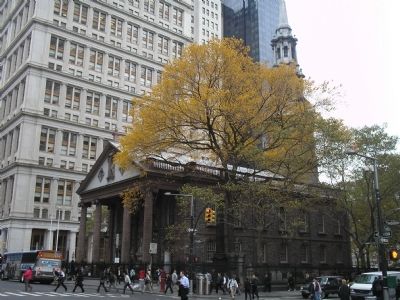
Photographed by Bill Coughlin, November 5, 2008
5. St. Paul’s Chapel with Marker
Marker can be seen in the photo in front of St. Paul’s Chapel
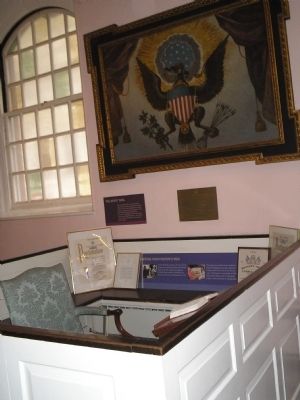
Photographed by Bill Coughlin, November 5, 2008
6. George Washington's Pew in St. Paul’s Chapel
George Washington prayed at St. Paul’s after his inauguration as the first president of the United States in 1789. He continued to worship at St. Paul’s Chapel until the capital of the U.S. moved from New York to Philadelphia in 1790.
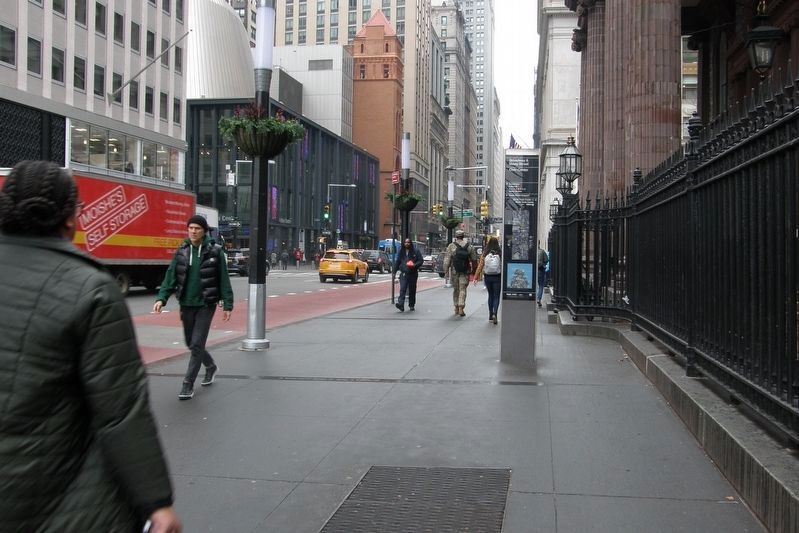
Photographed by Larry Gertner, February 5, 2019
7. St. Paul’s Chapel Marker, former location
The marker is one of several replaced by directional, rather than informational, steel columns.

Photographed by Jack DePalma, October 1, 2025
8. St. Paul’s Chapel in New York City
Credits. This page was last revised on October 5, 2025. It was originally submitted on June 24, 2009, by Bill Coughlin of Woodland Park, New Jersey. This page has been viewed 2,301 times since then and 109 times this year. Last updated on April 12, 2020, by Larry Gertner of New York, New York. Photos: 1, 2, 3, 4, 5, 6. submitted on June 24, 2009, by Bill Coughlin of Woodland Park, New Jersey. 7. submitted on February 5, 2019, by Larry Gertner of New York, New York. 8. submitted on October 4, 2025, by Jack DePalma of Brooklyn,NY, New York. • Bill Pfingsten was the editor who published this page.
