Near Richmond in Chesterfield County, Virginia — The American South (Mid-Atlantic)
Fort Stevens
Butler’s Campaign Ends
| — | Bermuda Hundred Campaign | — |
Photographed by Bill Coughlin, April 21, 2007
1. Fort Stevens Marker
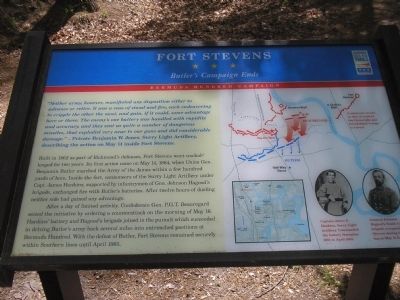
“Neither army, however, manifested any disposition either to advance or retire. It was a case of stand and fire, each endeavoring to cripple the other the most, and gain, if it could, some advantage here or there. The enemy’s one battery was handled with rapidity and accuracy, and they sent us quite a number of dangerous missiles, that exploded very near to our guns and did considerable damage.” - Private Benjamin W. Jones, Surry Light Artillery, describing the action on May 14 inside Fort Stevens.
Built in 1862 as part of Richmond’s defenses, Fort Stevens went unchallenged for two years. Its first action came on May 14, 1864, when Union Gen. Benjamin Butler marched the Army of the James within a few hundred yards of here. Inside the fort, cannoneers of the Surry Light Artillery under Capt. James Hankins, supported by infantrymen of Gen. Johnson Hagood’s brigade, exchanged fire with Butler’s batteries. After twelve hours of dueling neither side had gained any advantage.
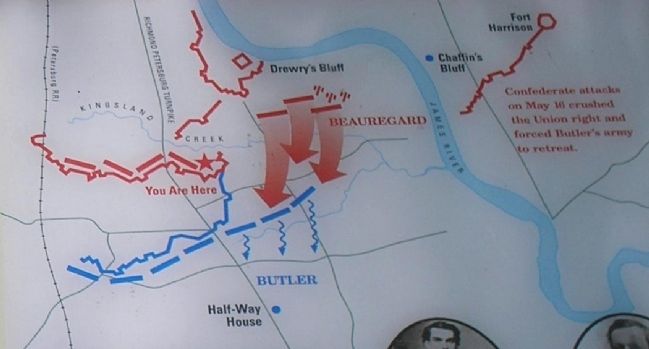
After a day of limited activity, Confederate Gen. P.G.T. Beauregard seized the initiative by ordering a counterattack on the morning of May 16. Hankins’ battery
this page online
Erected by Virginia Civil War Trails.
Topics and series. This historical marker is listed in these topic lists: Forts and Castles • War, US Civil. In addition, it is included in the Virginia Civil War Trails series list. A significant historical year for this entry is 1862.
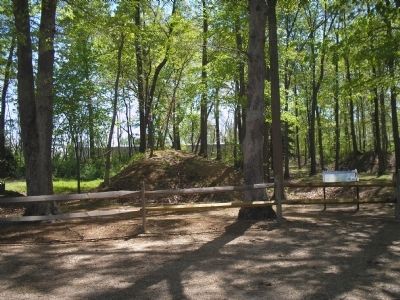
Location. 37° 24.225′ N, 77° 25.759′ W. Marker is near Richmond, Virginia, in Chesterfield County. It is at the intersection of Pams Avenue and Norcliff Avenue, on the left when traveling north on Pams Avenue. Marker is in Fort Stevens Historical Park, located at the corner of Pams and Norcliff Avenues. Touch for map. Marker is at or near this postal address: 2451 Norcliff Rd, Richmond VA 23237, United States of America. Touch for directions.

Regionally, this marker is in the Piedmont and in Central Virginia. It is also in the American South, specifically in the Upper South, and on the Eastern Seaboard. Globally,
Photographed by Bill Coughlin, April 21, 2007
2. Marker in Fort Stevens Historical Park
Other nearby markers. At least 8 other markers are within walking distance of this marker: The Second Battle of Drewry's Bluff - May 16, 1864 (a few steps from this marker); The Army of the James Advance on Richmond (a few steps from this marker); The Bermuda Campaign (a few steps from this marker); First Virginia Infantry Regiment (within shouting distance of this marker); a different marker also named Fort Stevens (within shouting distance of this marker); Drewry’s Bluff Defences (approx. 0.3 miles away); Drewry’s Bluff Battlefield (approx. half a mile away); Bellwood Elk Herd (approx. ¾ mile away). Touch for a list and map of all markers in Richmond.
Other markers no longer nearby. Battle of Drewry’s Bluff (was approx. ¼ mile away but has been confirmed missing); Second Battle of Drewry's Bluff (was approx.
Photographed by Bill Coughlin, April 21, 2007
3. Fort Stevens Fortifications
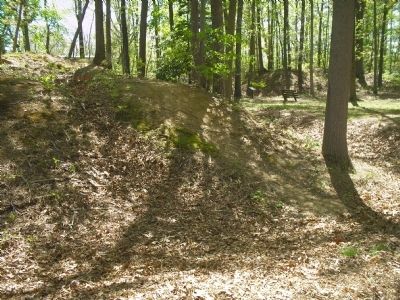
The well preserved remains of Fort Stevens still exist at the site of the marker. These earthworks were successfully defended against Gen. Butler's army on May 14, 1864.
More about this marker. Photographs of two Confederate officers appear at the bottom right of the marker. They have captions of “Captain James D. Hankins, Surry Light Artillery. Commanded the battery November 1862 to April 1865” and “General Johnson Hagood’s South Carolina brigade occupied Fort Stevens during the fighting on May 14 & 16.” The top of the marker features a battle map of the May 16 counterattack.
Also see . . . Central Virginia, Richmond and Area. CivilWarTraveler website. (Submitted on December 31, 2008, by Bill Coughlin of Woodland Park, New Jersey.)
Photographed by Bill Coughlin, April 21, 2007
4. Fort Stevens Battle Map from Marker
Credits. This page was last revised on September 23, 2021. It was originally submitted on December 31, 2008, by Bill Coughlin of Woodland Park, New Jersey. This page has been viewed 2,150 times since then and 66 times this year. Photos: 1, 2, 3, 4. submitted on December 31, 2008, by Bill Coughlin of Woodland Park, New Jersey.
