Near Richmond in Chesterfield County, Virginia — The American South (Mid-Atlantic)
Fort Stevens
Photographed by Bill Coughlin, April 21, 2007
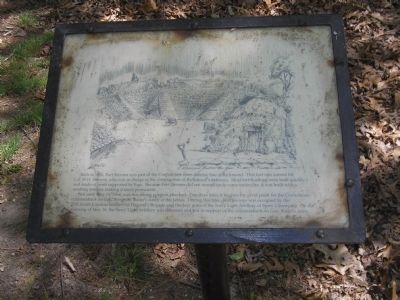
1. Fort Stevens Marker
Built in 1862, Fort Stevens was part of the Confederate inter-defense line of Richmond. This fort was named for Col. W.H. Stevens, who was in charge of the construction of Richmond’s defenses. Most fortifications were built quickly and made of earth supported by logs. Because Fort Stevens did not immediately come under fire, it was built with a sandbag interior, making it more permanent.
Not until May 14, 1864, was this strong position attacked. Two days later, it became the pivot point for the Confederate counterattack on Gen. Benjamin Butler’s Army of the James. During this time, Fort Stevens was occupied by the 27th South Carolina Infantry of Hagood’s Brigade and the four guns of the Surry Light Artillery of Surry County, Va. On the morning of May 16, the Surry Light Artillery was removed and put in support of the counterattack on Gen. Butler’s army.
Erected by Chesterfield County.
Topics. This historical marker is listed in these topic lists: Forts and Castles • War, US Civil. A significant historical date for this entry is May 14, 1862.
Location. 37° 24.205′ N, 77° 25.774′ W. Marker is near Richmond, Virginia, in Chesterfield
this page online

Regionally, this marker is in the Piedmont and in Central Virginia. It is also in the American South, specifically in the Upper South, and on the Eastern Seaboard. Globally, it is in the North Atlantic Region, North America, the Western Hemisphere, the Western World, and the Anglosphere. Historically, it finds itself in what was once the territory of the Mississippian Culture, one of the original Thirteen Colonies, one of the Confederate States of America, and the Antebellum South.
Other nearby markers. At least 8 other markers are within walking distance of this marker: The Bermuda Campaign (within shouting distance of this marker); The Army of the James Advance on Richmond (within shouting distance of this marker); The Second Battle of Drewry's Bluff - May 16, 1864 (within
Photographed by Bill Coughlin, April 21, 2007
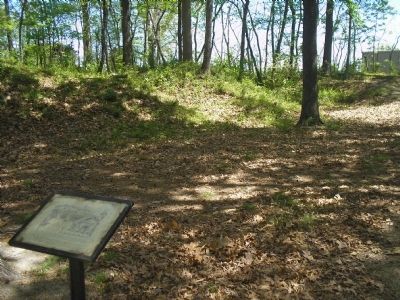
2. Marker at Fort Stevens Historical Park
Other markers no longer nearby. Battle of Drewry’s Bluff (was approx. ¼ mile away but has been confirmed missing); Second Battle of Drewry's Bluff (was approx. half a mile away but has been confirmed missing).
More about this marker. The top of the marker features a picture of the interior of Fort Stevens with Confederate soldiers manning the cannons.
Also see . . .
1. The Bermuda Hundred Campaign. Essential Civil War Curriculum website entry (Submitted on January 12, 2024, by Larry Gertner of New York, New York.)
2. Civil War Sites. Chesterfield Parks and Recreation website entry (Submitted on January 12, 2024, by Larry Gertner of New York, New York.)
Photographed by Bill Coughlin, April 21, 2007
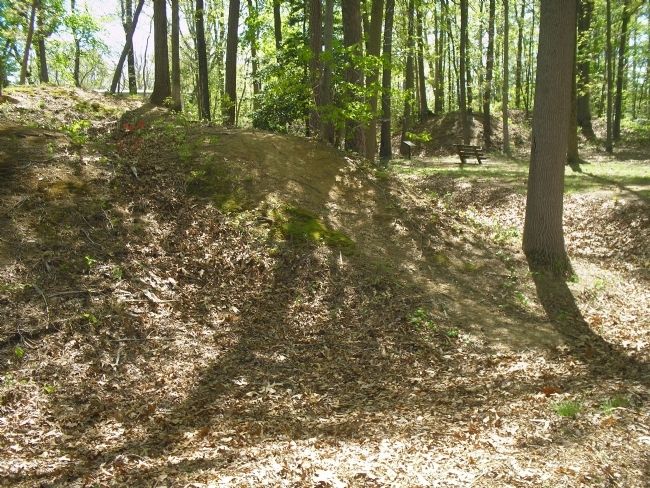
3. Inside Fort Stevens
The well-preserved fortifications of Fort Stevens can be seen in this photo. The marker appears in the background.
Credits. This page was last revised on January 12, 2024. It was originally submitted on December 31, 2008, by Bill Coughlin of Woodland Park, New Jersey. This page has been viewed 2,123 times since then and 115 times this year. Photos: 1, 2, 3. submitted on December 31, 2008, by Bill Coughlin of Woodland Park, New Jersey.
