Cumberland Township near Round Top in Adams County, Pennsylvania — The American Northeast (Mid-Atlantic)
Historic Breastworks
July 2, 1863 - Second Day
Photographed by Craig Swain, July 24, 2008
1. Historic Breastworks Marker
"Rude shelters were thrown up of the loose rocks that covered the ground."
Col. Joshua L. Chamberlain, U.S.A.
Commander, 20th Maine Volunteers
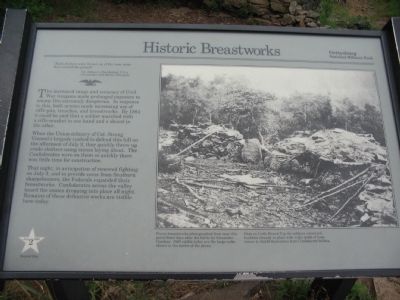
The increased range and accuracy of Civil War weapons made prolonged exposure to enemy fire extremely dangerous. In response to this, both armies made increasing use of rifle-pits, trenches, and breastworks. By 1864 it could be said that a soldier marched with a rifle-musket in one hand and a shovel in the other.
When the Union infantry of Col. Strong Vincent's brigade rushed to defend this hill on the afternoon of July 2, they quickly threw up crude shelters using stones laying about. The Confederates were on them so quickly there was little time for construction.
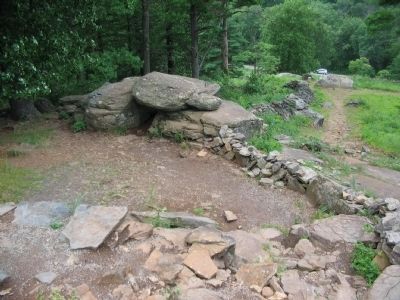
That night, in anticipation of renewed fighting on July 3, and to provide cover from Southern sharpshooters, the Federals expanded their breastworks. Confederates across the valley heard the stones dropping into place all night. Remains of these defensive works are visible here today.
Erected by Gettysburg National Military Park.
Topics. This historical marker is listed in this topic list: War, US Civil. A significant historical date for this entry is July 2, 1883.
Location. Marker
this page online
We have been informed that this marker is no longer there and will not be replaced. This page is an archival view of what was.
Regionally, this marker was in South-Central Pennsylvania. It was also in the American Northeast, in the Mid-Atlantic, in Appalachia, and specifically in Northern Appalachia. Globally, it was in North America, the Western Hemisphere, the Western World, and the Anglosphere. Historically, it found itself in what was once the Haudenosaunee (Iroquois) Confederacy and also one of the original Thirteen Colonies.

Other nearby markers. At least 8 other markers are within walking distance of this location: A different marker also
Photographed by Brandon Fletcher, June 25, 2009
2. Historic Breastworks Marker
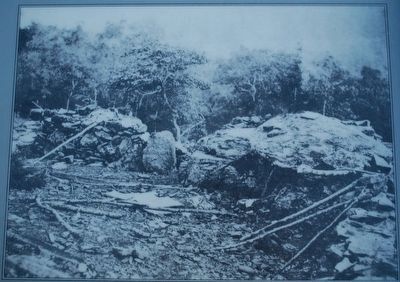
More about this marker. On the right side of the marker is a wartime photograph of the works. Union breastworks photographed from near this point three days after the battle by Alexander Gardner. Still visible today are the large rocks shown in the center of the photo.
Here on Little Round Top the soldiers connected boulders already in place with walls made of loose stones to shield themselves from Confederate bullets.
Photographed by Craig Swain, July 24, 2008
3. Historic Breastworks Marker
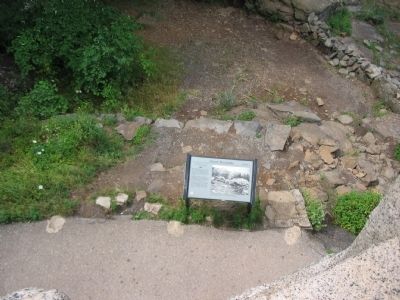
The marker stands at the base of the 12th and 44th New York Infantry Monument.
Photographed by Craig Swain, July 24, 2008
4. Section of Breastworks
The boulders in the center match some of those seen in the wartime photograph.
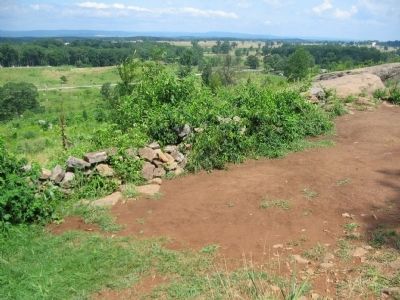
Photographed by Craig Swain, July 24, 2008
5. More Breastworks
Little Round Top is laced with rock breastworks erected by the Federal defenders. It is a testament to those early preservationists in the later parts of the 19th century that these stand today as reminders of the battle.
Credits. This page was last revised on October 21, 2024. It was originally submitted on January 1, 2009, by Craig Swain of Leesburg, Virginia. This page has been viewed 2,038 times since then and 56 times this year. Photos: 1. submitted on January 1, 2009, by Craig Swain of Leesburg, Virginia. 2. submitted on August 29, 2015, by Brandon Fletcher of Chattanooga, Tennessee. 3, 4, 5. submitted on January 1, 2009, by Craig Swain of Leesburg, Virginia.
