Flagstaff in Coconino County, Arizona — The American Mountains (Southwest)
Lowell Observatory
National Historic Landmark
Photographed by Cosmos Mariner, May 31, 2015
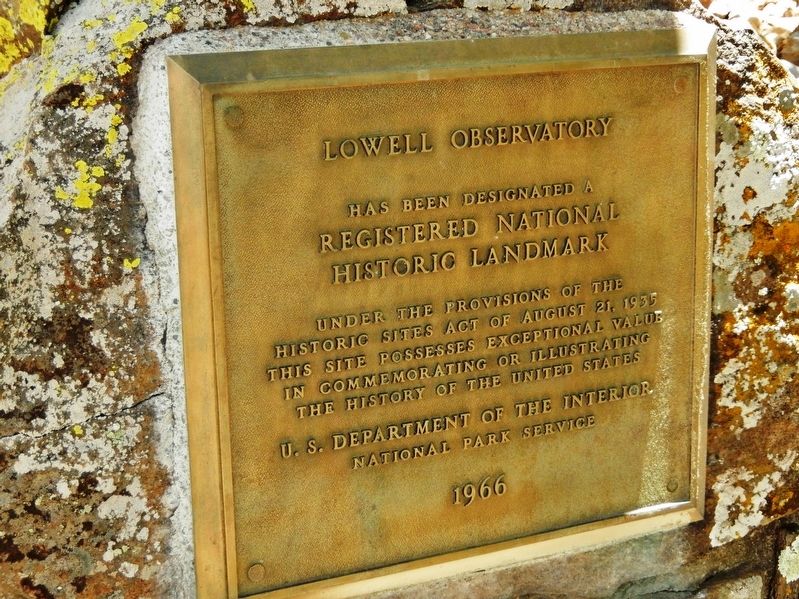
1. Lowell Observatory Marker
has been designated a
Registered National
Historic Landmark
Under the provisions of the
Historic Sites Act of August 21, 1935
this site possesses exceptional value
in commemorating or illustrating
the History of The United States
U.S. Department of the Interior
National Park Service
1966
Erected by National Park Service, U.S. Department of the Interior.
Topics and series. This historical marker is listed in these topic lists: Air & Space • Education • Exploration • Science & Medicine. In addition, it is included in the National Historic Landmarks series list.
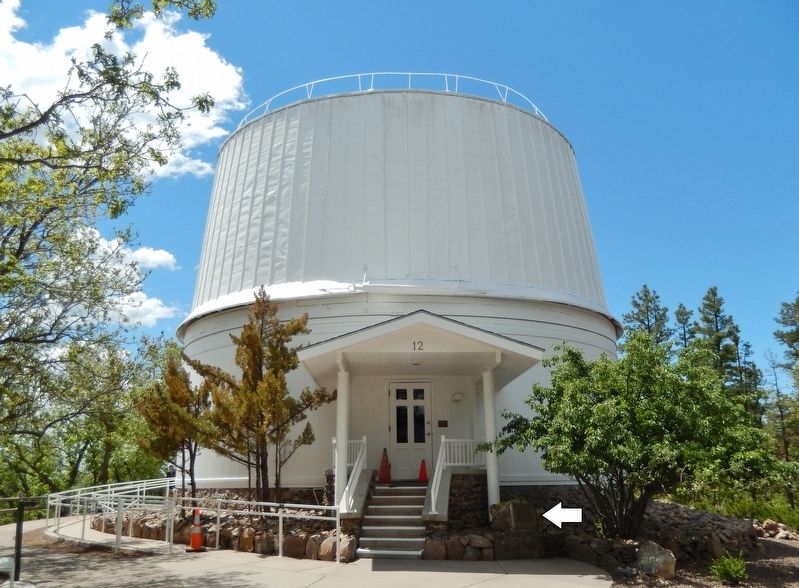
Location. 35° 12.143′ N, 111° 39.843′ W. Marker is in Flagstaff, Arizona, in Coconino County. It can be reached from West Mars Hill Road 0.6 miles west of West Santa Fe Avenue. Marker is located on the Lowell Observatory campus. It is mounted beside the steps, just to the right of the Clark Telescope Dome entrance. Touch for map. Marker is at or near this postal address: 1400 West Mars Hill Road, Flagstaff AZ 86001, United States of America. Touch for directions.

Regionally, this marker
this page online
Other nearby markers. At least 8 other markers are within walking distance of this marker: Clark Dome Weather Station (a few steps from this marker); The San Francisco Peaks (a few steps from this marker); Soda Acid Fire Extinguisher / Stone Water Tank (within shouting distance of this marker); U. S. Astronomer Percival Lowell, Specialist Of Mars, And Anamizu (within shouting distance of this marker); The Sundial (within shouting distance of this marker); 42-Inch Reflecting Telescope (within shouting distance of this marker); Henry Lee Giclas (about 500 feet away, measured in a direct line); The Lawrence Lowell Telescope (about 800 feet away). Touch for a list and map of all markers in Flagstaff.
Regarding Lowell Observatory. National Register of Historic Places #66000172.
Related markers.
Photographed by Cosmos Mariner, May 31, 2015
2. Lowell Observatory Marker
Also see . . .
1. Lowell Observatory: Where Pluto Was Discovered. Space.com website entry:
The observatory was founded by astronomer Percival Lowell. Lowell became famous after saying he saw canals on Mars through a telescope. This was later refuted with close-up images of the Red Planet, but Lowell's astronomical legacy persists in the form of the observatory. Lowell Observatory, founded in 1894, is perhaps best known for the discovery of Pluto, but that is not nearly the facility's only contribution to astronomy. (Submitted on May 7, 2020, by Cosmos Mariner of Cape Canaveral, Florida.)
2. Clark 125th Anniversary. Sky and Telescope website entry:
In 1895, Lowell Observatory founder Percival Lowell commissioned the Alvan Clark & Sons Firm of Cambridgeport, Massachusetts to build a state-of-the-art 24-inch refracting telescope. Percival Lowell initially used the telescope search for intelligent life on Mars. (Submitted on May 7, 2020, by Cosmos Mariner of Cape Canaveral, Florida.)
3. Lowell Observatory. Wikipedia

Photographed by Adam Margolis, May 25, 2024
3. Lowell Observatory Marker
Lowell Observatory is among the oldest observatories in the United States. In 2011, the Observatory was named one of "The World's 100 Most Important Places" by TIME. The main facility, located on Mars Hill just west of downtown Flagstaff, houses the original 24-inch Clark Refracting Telescope, which is now used for public education. (Submitted on May 7, 2020, by Cosmos Mariner of Cape Canaveral, Florida.)
Photographed by Cosmos Mariner, May 31, 2015
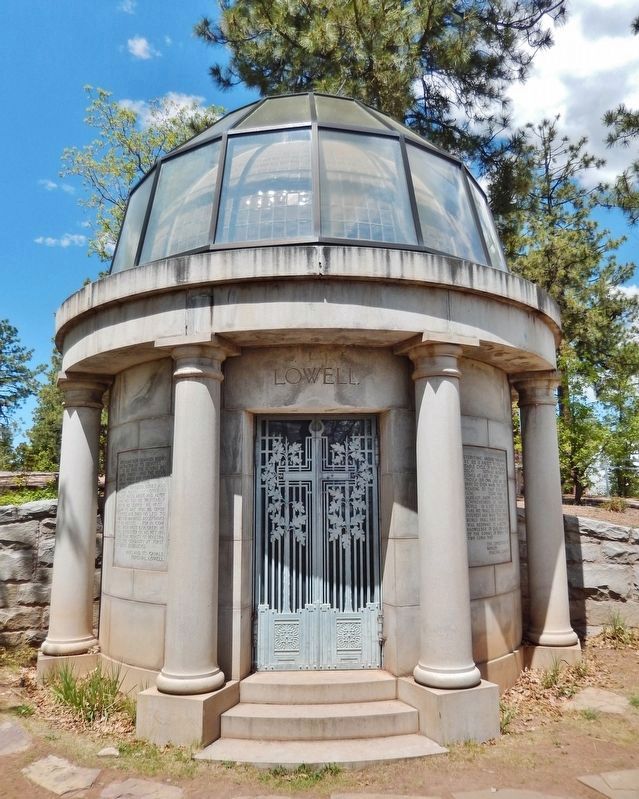
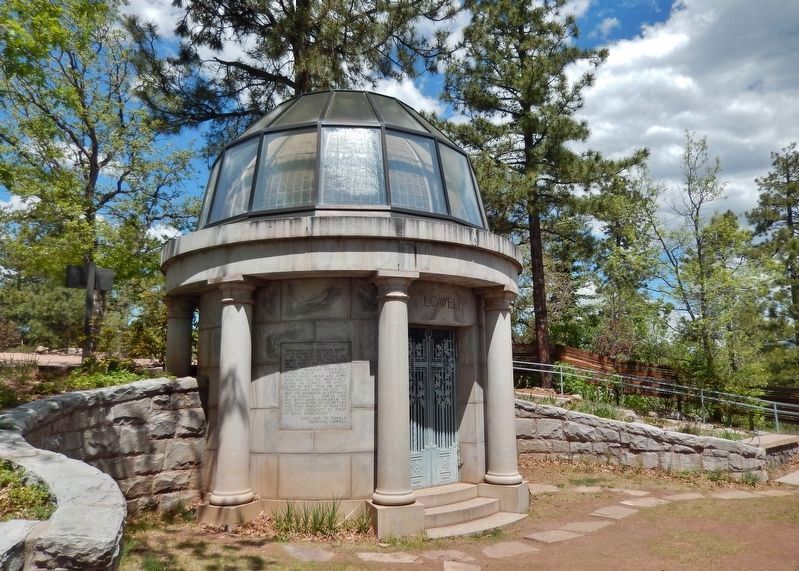
4. Percival Lowell Mausoleum
Photographed by Cosmos Mariner, May 31, 2015
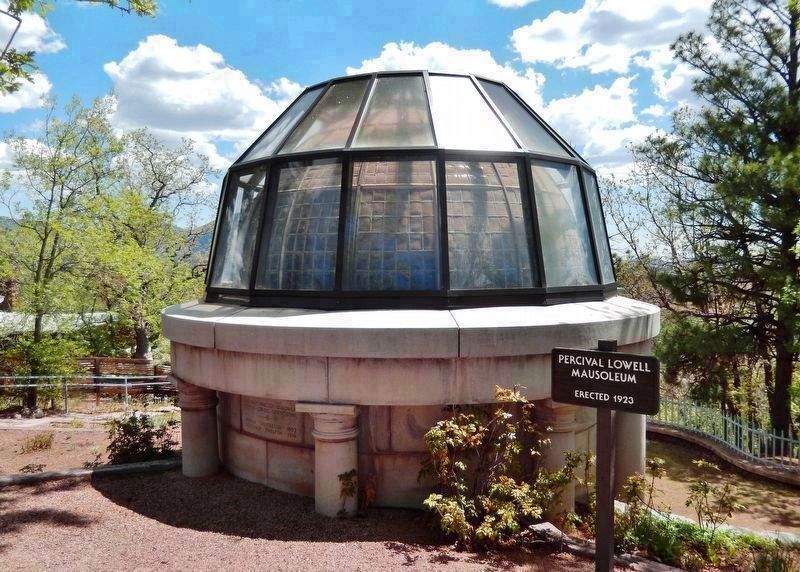
5. Percival Lowell Mausoleum (west side)
Founder • Director • Endower
of the Lowell Observatory
• • •
March Thirteenth 1855
November Twelfth 1916
Photographed by Cosmos Mariner, May 31, 2015
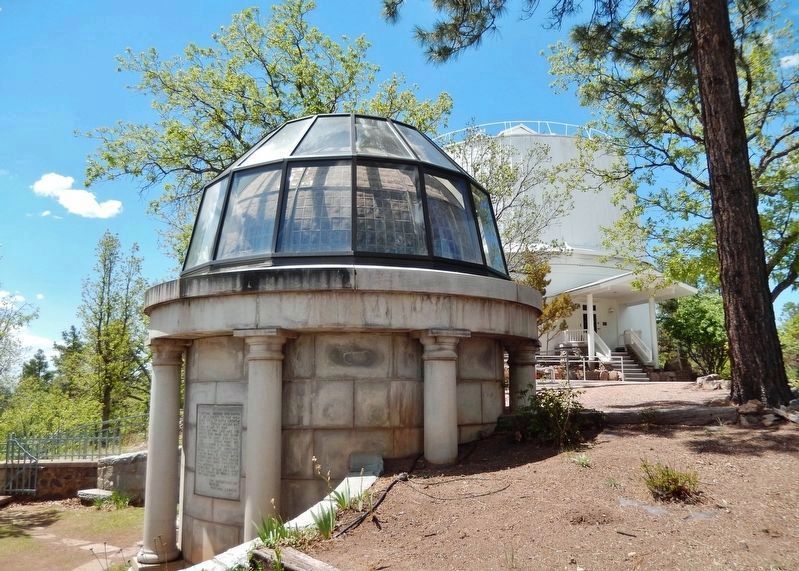
6. Percival Lowell Mausoleum (south side)
(tablet inscription:) Astronomy now demands bodily abstraction of its devotee… to see into the beyond requires purity… and the securing it makes him perforce a hermit from his kind… he must abandon cities and forego plains… only in places raised above and aloof from men can he profitably persue his search. He must learn to wait upon his opportunities and then no less to wait for mankind’s acceptance of his results... for in common with most explorers he will encounter on his return that final penalty of penetration the certainty at first of being disbelieved…
—Mars and Its Canals
Percival Lowell
—Mars and Its Canals
Percival Lowell
Photographed by Cosmos Mariner, May 31, 2015
7. Percival Lowell Mausoleum (north side)
(tablet inscription:) Everything around this Earth we see is subject to one inevitable cycle of birth growth decay… nothing begins but comes at last to end… though our own lives are too busy to even mark the slow nearing to that eventual goal… today what we already know is helping to comprehension of another world. In a not distant future we shall be repaid with interest and what that other world shall have taught us will redound to a better knowledge of our own and of the cosmos of which the two form part…
—The Evolution of Worlds
Percival Lowell
—The Evolution of Worlds
Percival Lowell

Photographed by Cosmos Mariner, May 31, 2015
8. Clark Telescope
Inside the dome, the Clark Telescope is one of the structures listed in the Observatory’s Registered National Historic Landmark designation.

Photographed by Adam Margolis, May 25, 2024
9. Lowell Observatory Interior
Credits. This page was last revised on October 11, 2025. It was originally submitted on May 6, 2020, by Cosmos Mariner of Cape Canaveral, Florida. This page has been viewed 802 times since then and 44 times this year. Photos: 1, 2. submitted on May 7, 2020, by Cosmos Mariner of Cape Canaveral, Florida. 3. submitted on December 18, 2024, by Adam Margolis of Mission Viejo, California. 4, 5. submitted on May 7, 2020, by Cosmos Mariner of Cape Canaveral, Florida. 6, 7. submitted on May 8, 2020, by Cosmos Mariner of Cape Canaveral, Florida. 8. submitted on May 7, 2020, by Cosmos Mariner of Cape Canaveral, Florida. 9. submitted on December 18, 2024, by Adam Margolis of Mission Viejo, California.
