Lehi in Utah County, Utah — The American Mountains (Southwest)
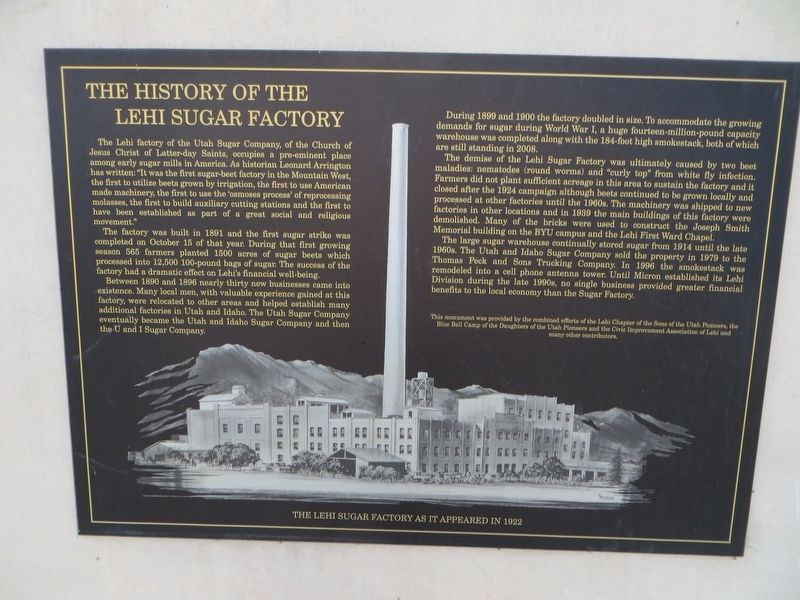
The History of the Lehi Sugar Factory
Photographed by Bill Kirchner, October 2, 2018
1. The History of the Lehi Sugar Factory Marker
The factory was built in 1891 and the first sugar strike was completed on October 15 of that year. During that first growing season 565 farmers planted 1500 acres of sugar beets which processed into 12,500 100-pound bags of sugar. The success of the factory had a dramatic effect on Lehi‘s financial well-being.
Between 1890 and 1896 nearly thirty new businesses came into existence. Many local men, with valuable experience gained at this factory, were relocated to other areas and helped establish many additional factories in Utah and Idaho. The Utah Sugar Company
this page online
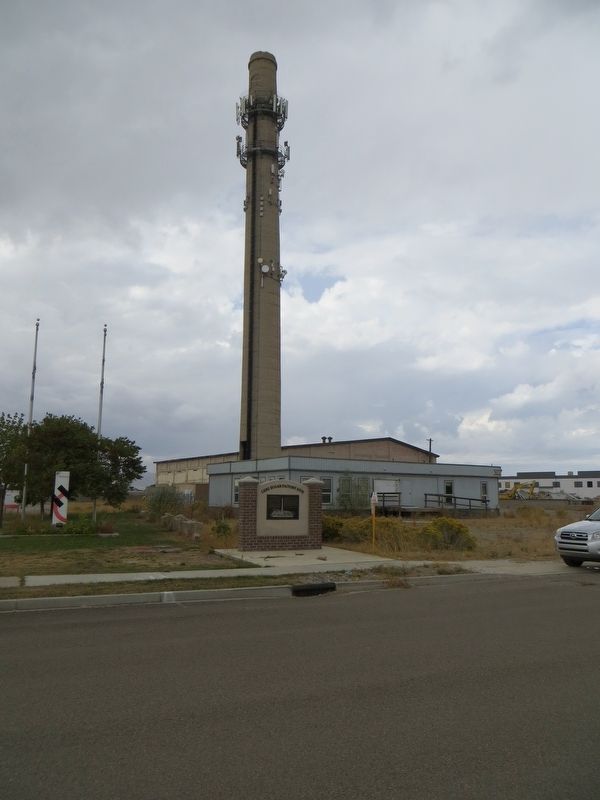
During 1899 and 1900 the factory doubled in size. To accommodate the growing demands for sugar during World War I, a huge fourteen-million-pound capacity warehouse was completed along with the 184-foot high smokestack, both of which are still standing in 2008.
The demise of the Lehi Sugar Factory was ultimately caused by two beet maladies: nematodes (round worms) and “curly top” from white fly infection. Farmers did not plan sufficient acreage in this area to sustain the factory and it closed after the 1924 campaign although beets continued to be grown locally and processed at other factories until the 1960s. The machinery was shipped to new factories in other locations and in 1939 the main buildings of this factory were demolished. Many of the bricks were used to construct the Joseph Smith Memorial Building on the BYU Campus and the Lehi First Ward Chapel.
The large sugar warehouse continually stored sugar from 1914 until the late 1960s. The Utah and Idaho Sugar Company sold the property in 1979 to the Thomas Peck and Sons Trucking
Photographed by Bill Kirchner, October 2, 2018
2. The History of the Lehi Sugar Factory Marker
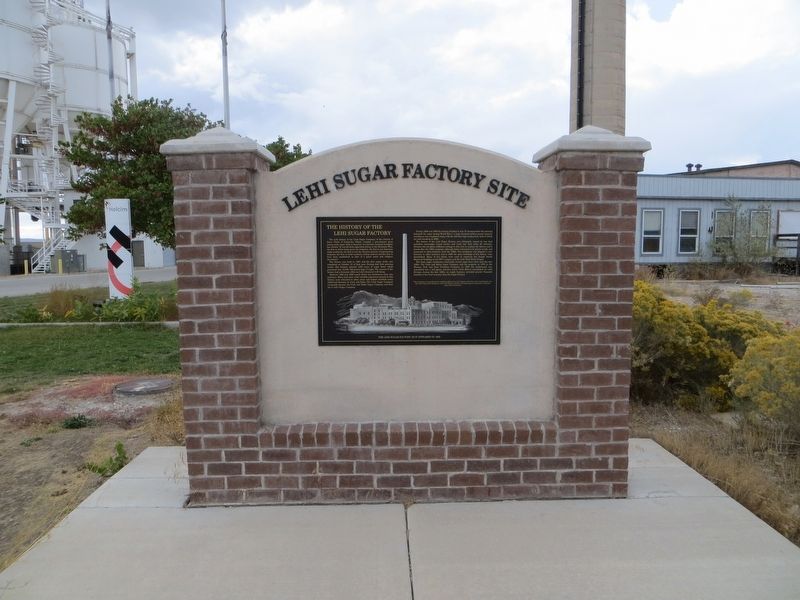
Erected by Lehi Chapter of the Sons of Utah Pioneers, the Blur Bell Camp of the Daughters of the Utah Pioneers and the Civic Improvement Association of Lehi and many other contributors.
Topics and series. This historical marker is listed in these topic lists: Agriculture • Industry & Commerce. In addition, it is included in the Daughters of Utah Pioneers, and the Sons of Utah Pioneers series lists. A significant historical date for this entry is October 15, 1891.
Location. 40° 22.687′ N, 111° 49.989′ W. Marker is in Lehi, Utah, in Utah County. It is at the intersection of Mill Pond Road and Pioneer Crossing, on the right when traveling south on Mill Pond Road. Touch for map. Marker is in this post office area: Lehi UT 84043, United States of America. Touch for directions.

Regionally, this marker is in the Wasatch Front and in Greater Provo. It is also in the American Mountain West and on the
Photographed by Bill Kirchner, October 2, 2018
3. The History of the Lehi Sugar Factory Marker
Other nearby markers. At least 8 other markers are within 2 miles of this marker, measured as the crow flies: Home of Pioneer Joseph Kirkham, Built Circa 1885 (approx. 0.8 miles away); Memorial Building (approx. 1.1 miles away); Lehi Memorial Building (approx. 1.1 miles away); John Austin Cabin (approx. 1.1 miles away); Merrihew/Dalley Building (approx. 1.1 miles away); Lehi City (approx. 1.2 miles away); Lehi Meeting House (approx. 1.2 miles away); Bishop David Evans (approx. 1.2 miles away). Touch for a list and map of all markers in Lehi.
Credits. This page was last revised on May 14, 2020. It was originally submitted on May 14, 2020, by Bill Kirchner of Tucson, Arizona. This page has been viewed 1,755 times since then and 158 times this year. Photos: 1, 2, 3. submitted on May 14, 2020, by Bill Kirchner of Tucson, Arizona.
