Cape Henlopen State Park near Lewes in Sussex County, Delaware — The American Northeast (Mid-Atlantic)
Proof Steel
How do you test a 16-inch gun?
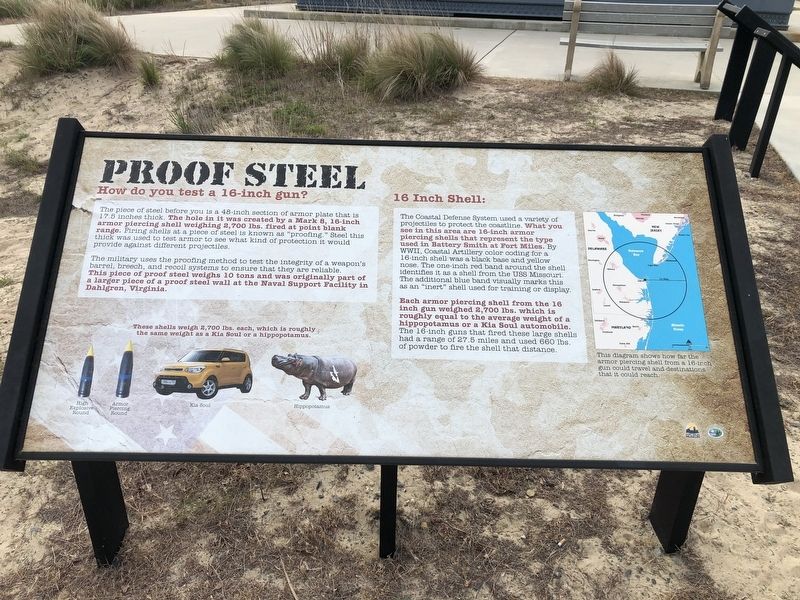
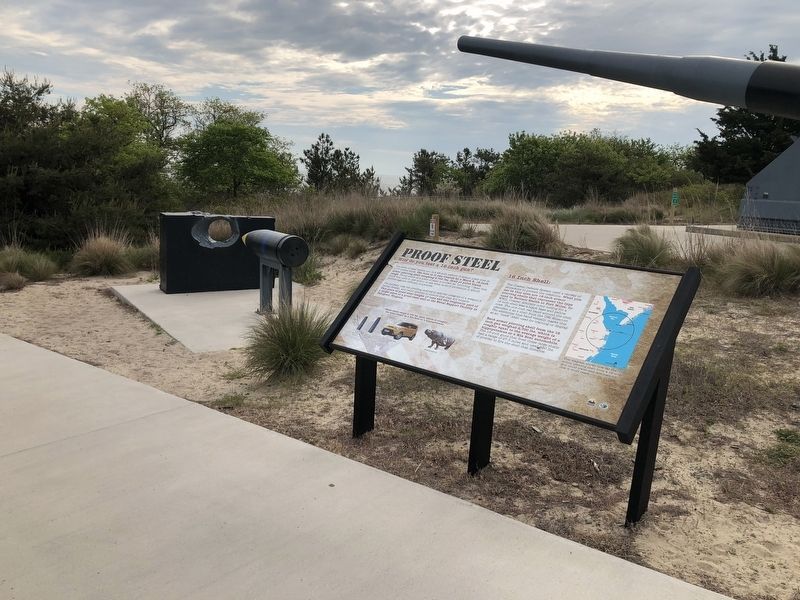
The piece of steel before you is a 48-inch section of armor plate that is 17.5 inches thick. The hole in it was created by a Mark 8, 16-inch armor piercing shell weighing 2,700 lbs. fired at point blank range. Firing shells at a piece of steel is known as "proofing." Steel this thick was used to test armor to see what kind of protection it would provide against different projectiles.
The military uses the proofing method to test the integrity of a weapon's barrel, breech, and recoil systems to ensure that they are reliable. This piece of proof steel weighs 10 tons and was originally part of a larger piece of a proof steel wall at the Naval Support Facility in Dahlgren, Virginia.
16 Inch Shell:
The Coastal Defense System used a variety of projectiles to protect the coastline. What you see in this area are 16-inch armor piercing shells that represent the type used in Battery Smith at Fort Miles. By WWII, Coastal Artillery color coding for a 16-inch shell was a black base and yellow nose. The one-inch red band around the shell identifies it as a shell from the USS Missouri. The additional blue band visually marks
this page online
Each armor piercing shell from the 16 inch gun weighed 2,700 lbs. which is roughly equal to the average weight of a hippopotamus or a Kia Soul automobile. The 16-inch guns that fired these large shells had a range of 27.5 miles and used 660 lbs. of powder to fire the shell that distance.
[Captions:]
These shells weigh 2,700 lbs. each, which is roughly the same weight as a Kia Soul or a hippopotamus.
This diagram shows how far the armour piercing shell from a 16-inch gun could travel and destinations that it could reach.
Erected by Fort Miles Museum, Delaware Department of Natural Resources and Environmental Control.
Topics. This historical marker is listed in these topic lists: Air & Space • Forts and Castles • War, World II • Waterways & Vessels.
Location. 38° 46.657′ N, 75° 5.274′ W. Marker is near Lewes, Delaware, in Sussex County. It is in Cape Henlopen State Park. It can be reached from Dune Road half a mile west of Campground Road, on the left when traveling east. Touch for map. Marker is

Regionally, this marker is on Delaware’s Beaches. It is also in the American Mid-Atlantic, on the Delmarva Peninsula, and on the Eastern Seaboard. Globally, it is in the North Atlantic Region, North America, the Western Hemisphere, the Western World, and the Anglosphere. Historically, it finds itself in what was once New Netherland, one of the original Thirteen Colonies, and the Antebellum South.
Other nearby markers. At least 8 other markers are within walking distance of this marker: 16-inch Gun (here, next to this marker); 8-inch Gun (within shouting distance of this marker); 6-inch Gun (within shouting distance of this marker); 155mm Gun (within shouting distance of this marker); Fort Miles Artillery Park (about 400 feet away, measured in a direct line); The Great Dune (about 400 feet away); The Cape Henlopen Lighthouse (about 400 feet away); Aircraft Warning System (about 400 feet away). Touch for a list and map of all markers in Lewes.
Credits. This page was last revised on September 18, 2023. It was originally submitted on May 17, 2020, by Devry Becker Jones of Washington, District of Columbia. This page has been viewed 524 times since then and 52 times this year. Photos: 1, 2. submitted on May 17, 2020, by Devry Becker Jones of Washington, District of Columbia.
