
Elkridge in Howard County, Maryland — The American Northeast (Mid-Atlantic)
Elkridge Landing
Growth and Prosperity, 1800-1900
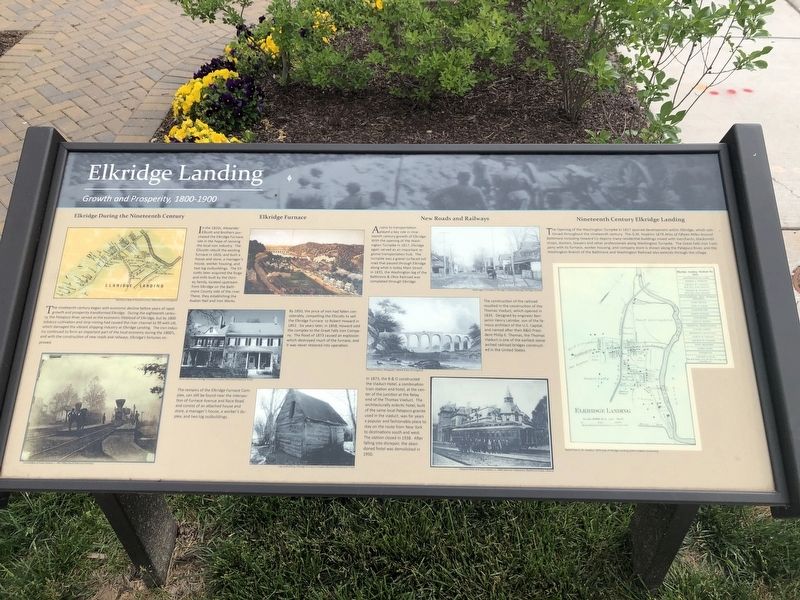
Photographed by Devry Becker Jones (CC0), May 27, 2020
1. Elkridge Landing Marker
Inscription.
Elkridge Landing. Growth and Prosperity, 1800-1900.
Elkridge During the Nineteenth Century. The nineteenth century began with economic decline before years of rapid growth and prosperity transformed Elkridge. During the eighteenth century, the Patapsco River served as the economic lifeblood of Elkridge, but by 1800 tobacco cultivation and strip mining had caused the river channel to fill with silk, which damaged the vibrant shipping industry at Elkridge Landing. The iron industry continued to form an important part of the local economy during the 1800's, and with the construction of new roads and railways, Elkridge's fortunes improved.,
Elkridge Furnace. In the 1820s, Alexander Ellicott and Brothers purchased the Elkridge Furnace site in the hope of reviving the local iron industry. The Ellicotts rebuilt the existing furnace in 1826, and built a house and store, a manager's house, worker housing, and two log outbuildings. The Ellicotts later acquired the forge and mills built by the Dorsey family, located upstream from Elkridge on the Baltimore County side of the river. There, they established the Avalon Nail and Iron Works., By 1850, the price of iron had fallen considerably, compelling the Ellicotts to sell the Elkridge Furnace to Robert Howard in 1852. Six years later, in 1858, Howard sold the complex to the Great Falls Iron Company. The flood of 1873 caused an explosion which destroyed much of the furnace, and it was never restored into operation., The remains of the Elkridge Furnace Complex, can still be found near the intersection of Furnace Avenue and Race Road, and consist of an attached house and store, a manager's house, a worker's duplex, and two log outbuildings.,
New Roads and Railways. Access to transportation played a key role in nineteenth century growth of of Elkridge. With the opening of the Washington Turnpike in 1817, Elkridge again served as an important regional transportation hub. The turnpike was a gravel surfaced toll road that passed through Elkridge along what is today Main Street. In 1835, the Washington leg of the Baltimore and Ohio Railroad was completed through Elkridge., The construction of the railroad resulted in the construction of the Thomas Viaduct, which opened in 1835. Designed by engineer Benjamin Henry Latrobe, son of famous architect of the U.S. Capital, and named after then B&O President Philip E. Thomas, the Thomas Viaduct is one of the earliest stone arched railroad bridges constructed in the United States., In 1873, the B and O constructed the Viaduct Hotel, a combination train station and hotel, at the center of the junction at the Relay end of the Thomas Viaduct. The architecturally eclectic hotel, built of the same local Patapsco granite used in the viaduct, was for years a popular and fashionable place to stay on the route from New York to destinations south and west. The station closed in 1938. After falling into disrepair, the abandoned hotel was demolished in 1950.,
Nineteenth Century Elkridge Landing. The Opening of the Washington Turnpike in 1817 spurred development within Elkridge, which continued throughout the nineteenth century. The G.M. Hopkins 1878 Atlas of Fifteen Miles Around Baltimore Including Howard Co depicts many residential buildings mixed with merchants, blacksmith shops, doctors, lawyers and other professionals along Washington Turnpike. The Great Falls Iron Company with its furnace, worker housing, and company store is shown along the Patapsco River, and the Washington Branch of the Baltimore and Washington Railroad also extends through the village.
Elkridge During the Nineteenth Century
The nineteenth century began with economic decline before years of rapid growth and prosperity transformed Elkridge. During the eighteenth century, the Patapsco River served as the economic lifeblood of Elkridge, but by 1800 tobacco cultivation and strip mining had caused the river channel to fill with silk, which damaged the vibrant shipping industry at Elkridge Landing. The iron industry continued to form an important part of the local economy during the 1800's, and with the construction of new roads and railways, Elkridge's fortunes improved.
Elkridge Furnace
In the 1820s, Alexander Ellicott and Brothers purchased the Elkridge Furnace site in the hope of reviving the local iron industry. The Ellicotts rebuilt the existing furnace in 1826, and built a house and store, a manager's house, worker housing, and two log outbuildings. The Ellicotts later acquired the forge and mills built by the Dorsey family, located upstream from Elkridge on the Baltimore County side of the river. There, they established the Avalon Nail and Iron Works.
By 1850, the price of iron had fallen considerably, compelling the Ellicotts to sell the Elkridge Furnace to Robert Howard in 1852. Six years later, in 1858, Howard sold the complex to the Great Falls
Click or scan to see this page online
Iron Company. The flood of 1873 caused an explosion which destroyed much of the furnace, and it was never restored into operation.
The remains of the Elkridge Furnace Complex, can still be found near the intersection of Furnace Avenue and Race Road, and consist of an attached house and store, a manager's house, a worker's duplex, and two log outbuildings.
New Roads and Railways
Access to transportation played a key role in nineteenth century growth of of Elkridge. With the opening of the Washington Turnpike in 1817, Elkridge again served as an important regional transportation hub. The turnpike was a gravel surfaced toll road that passed through Elkridge along what is today Main Street. In 1835, the Washington leg of the Baltimore & Ohio Railroad was completed through Elkridge.
The construction of the railroad resulted in the construction of the Thomas Viaduct, which opened in 1835. Designed by engineer Benjamin Henry Latrobe, son of famous architect of the U.S. Capital, and named after then B&O President Philip E. Thomas, the Thomas Viaduct is one of the earliest stone arched railroad bridges constructed in the United States.
In 1873, the B & O constructed the Viaduct Hotel, a combination train station and hotel, at the center of the junction at the Relay end of the Thomas Viaduct. The architecturally eclectic
Photographed by Devry Becker Jones (CC0), May 27, 2020
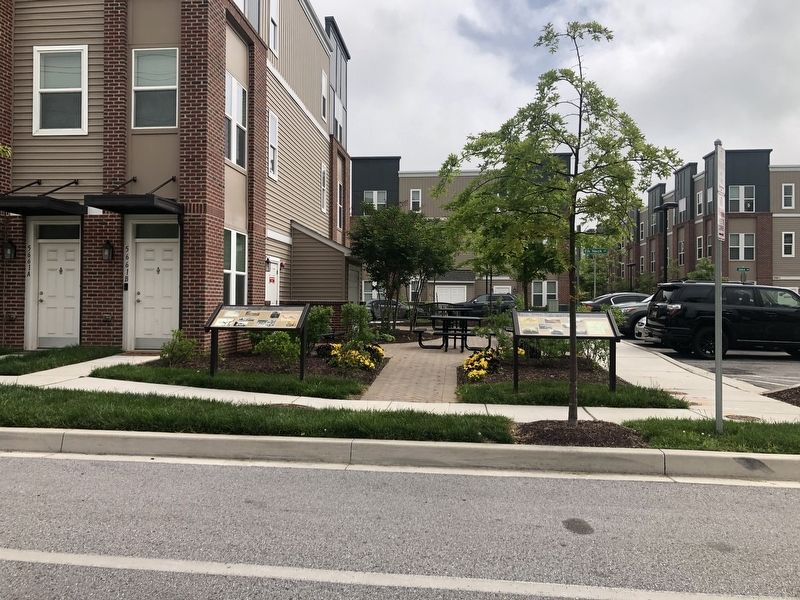
2. Elkridge Landing Marker
hotel, built of the same local Patapsco granite used in the viaduct, was for years a popular and fashionable place to stay on the route from New York to destinations south and west. The station closed in 1938. After falling into disrepair, the abandoned hotel was demolished in 1950.
Nineteenth Century Elkridge Landing
The Opening of the Washington Turnpike in 1817 spurred development within Elkridge, which continued throughout the nineteenth century. The G.M. Hopkins 1878 Atlas of Fifteen Miles Around Baltimore Including Howard Co depicts many residential buildings mixed with merchants, blacksmith shops, doctors, lawyers and other professionals along Washington Turnpike. The Great Falls Iron Company with its furnace, worker housing, and company store is shown along the Patapsco River, and the Washington Branch of the Baltimore and Washington Railroad also extends through the village.
Location. 39° 12.876′ N, 76° 42.37′ W. Marker is in Elkridge, Maryland, in Howard County. It
is at the intersection of Furnace Avenue and Riverwatch Avenue, on the right when traveling north on Furnace Avenue. Touch for map. Marker is at or near this postal address: 5655 Furnace Ave, Elkridge MD 21075, United States of America. Touch for directions.

Regionally, this marker is in Central Maryland. It is also in the American Mid-Atlantic. Globally, it is in the North Atlantic Region, North America, the Western Hemisphere, the Western World, and the Anglosphere. Historically, it finds itself in what was once one of the original Thirteen Colonies and also the Antebellum South.
Another marker is no longer nearby. Elkridge Furnace Inn (was about 600 feet away but has been replaced with another marker now near it).
Credits. This page was last revised on May 27, 2020. It was originally submitted on May 27, 2020, by Devry Becker Jones of Washington, District of Columbia. This page has been viewed 776 times since then and 36 times this year. Photos:1, 2. submitted on May 27, 2020, by Devry Becker Jones of Washington, District of Columbia.
