Near Richmond in Chesterfield County, Virginia — The American South (Mid-Atlantic)
Drewry’s Bluff
Richmond Battlefield
| — | Richmond Nat’l Battlefield Pk – 1862/64 | — |
Photographed by Bill Coughlin, April 24, 2007
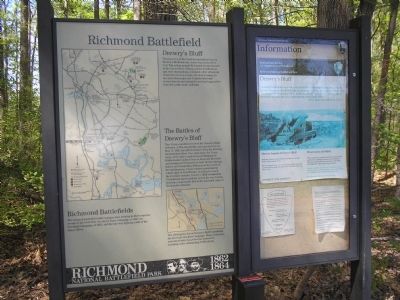
1. Drewry’s Bluff Marker
The Battles of Drewry’s Bluff
Two Union expeditions tested the Drewry’s Bluff defenses. A five-ship flotilla came up the river on May 15, 1862, but stiff resistance from the fort here blocked that effort. Two years later, the Union Army of the James under General Benjamin F. Butler landed south of here at Bermuda Hundred and threatened Richmond by land. Severe infantry battles all through May 1864 proved the worth of the fortifications. Union infantry penetrated to within sight of Fort Drewry, but failed to reach the riverside redoubt. Drewry’s Bluff remained in Confederate hands until the end of the war, having stood as a dependable link in the extended chain of Richmond’s defenses.
[Right Marker]: Drewry’s Bluff
“Nothing could have been more beautiful than the neatness and precision of the movement with which Rodgers placed the Galena, as if at target-practice, directly under the enemy’s fire. In the words of [one] officer …. ‘It was one of the most masterly pieces of seamanship of the whole war.’”
this page online
Erected by Richmond National Battlefield Park - National Park Service.
Topics. This historical marker is listed in this topic list: War, US Civil. A significant historical month for this entry is May 1864.
Location. This marker has been replaced by another marker nearby. 37° 25.273′ N, 77° 25.471′ W. Marker is near Richmond, Virginia, in Chesterfield County. It can be reached from Fort Darling Road, on the left when traveling east. Marker is located in the Drewry’s Bluff/Fort Darling unit of Richmond National Battlefield Park. Touch for map. Marker is at or near this postal address: 7710 Fort Darling Rd, Richmond VA 23237, United States of America. Touch for directions.

Regionally, this marker is in the Piedmont and in Central Virginia. It is also in the American South, specifically in the Upper South, and on the Eastern Seaboard. Globally, it is in the North Atlantic Region, North America, the Western Hemisphere, the Western World, and the Anglosphere. Historically, it finds itself in what was once the territory of the Mississippian Culture, one of the original Thirteen Colonies, one
Photographed by Bill Coughlin, April 24, 2007
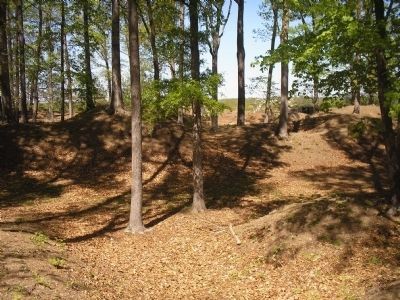
2. Inside Fort Darling (Drewry’s Bluff)
The fortifications on the cliffs overlooking the James River, still remain at this site.
Other nearby markers. At least 8 other markers are within walking distance of this location: Drewry’s Bluff Trail (here, next to this marker); Covered Way (about 600 feet away, measured in a direct line); A Permanent Post (about 600 feet away); Fort Darling (about 600 feet away); Camp Beall (about 600 feet away); "A Very Neat Chapel" (about 700 feet away); a different marker also named Drewry's Bluff (about 700 feet away); The First Marine Medal of Honor (about 700 feet away). Touch for a list and map of all markers in Richmond.
Another marker is no longer nearby. Bombproof and Well (was about 600 feet away but has been replaced with another marker now near it).
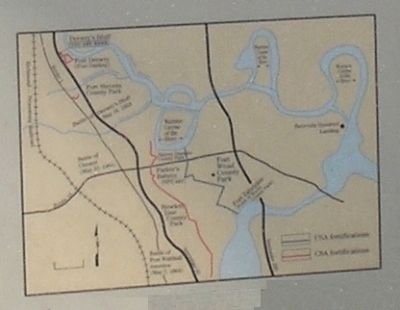
More about this marker. The left side of the marker features a map of Richmond National Battlefield Park, with the location of Drewry’s Bluff indicated. The bottom right of the marker contains a battle map of the fighting at Drewry’s Bluff. The right marker features a picture of a cannon at Drewry’s Bluff overlooking the James River.
Regarding Drewry’s Bluff. This marker was replaced by a new

Photographed by Bill Coughlin, April 24, 2007
3. Artillery Drewry’s Bluff
Cannon placed here at Drewry’s Bluff guarded the James River approach to Richmond.
Also see . . .
1. Drewry’s Bluff. Richmond National Battlefield website. (Submitted on January 5, 2009, by Bill Coughlin of Woodland Park, New Jersey.)
2. Drewry’s Bluff. CWSAC Battle Summaries. (Submitted on January 5, 2009, by Bill Coughlin of Woodland Park, New Jersey.)
3. Battle of Drewry’s Bluff, 15 May 1862. American Civil War website. (Submitted on January 5, 2009, by Bill Coughlin of Woodland Park, New Jersey.)
Photographed by Bill Coughlin, April 24, 2007
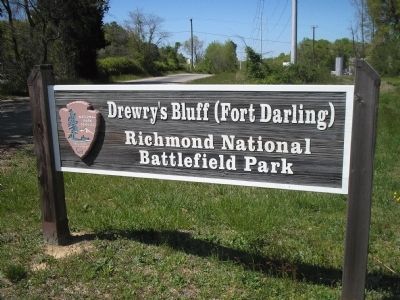
4. Richmond National Battlefield Park
Marker is located in the Drewry’s Bluff/Fort Darling unit of Richmond National Battlefield Park.
Photographed by Bill Coughlin, April 24, 2007
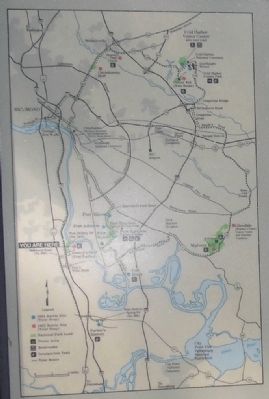
5. Richmond Battlefields
The national battlefield park contains sites relating to three separate events of the Civil War: the Seven Days Campaign of 1862, the Overland Campaign of 1864, and the late-war fighting north of the James River.
Photographed by Bill Coughlin, April 24, 2007
6. Drewry’s Bluff Battle Map from Marker
The 1864 battles below Drewry’s Bluff constituted the Bermuda Hundred Campaign. Many of the sites associated with that period are preserved, including some outstanding fortifications.
Credits. This page was last revised on June 16, 2016. It was originally submitted on January 5, 2009, by Bill Coughlin of Woodland Park, New Jersey. This page has been viewed 1,677 times since then and 27 times this year. Photos: 1, 2, 3, 4, 5, 6. submitted on January 5, 2009, by Bill Coughlin of Woodland Park, New Jersey.
