
Norbeck near Rockville in Montgomery County, Maryland — The American Northeast (Mid-Atlantic)
Norbeck Rosenwald School
Photographed by Jerry Klinger, July 26, 2019
1. Norbeck Rosenwald School Marker
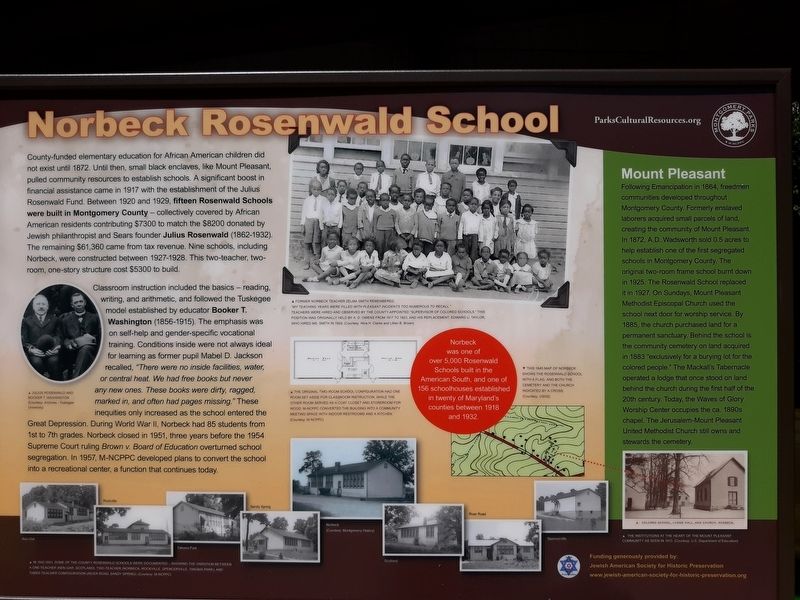
County-funded elementary education for African American children did not exist until 1872. Until then, small black enclaves, like Mount Pleasant, pulled community resources to establish schools. A significant boost in financial assistance came in 1917 with the establishment of the Julius Rosenwald Fund. Between 1920 and 1929, fifteen Rosenwald Schools were built in Montgomery County – collectively covered by African American residents contributing $7300 to match the $8200 donated by Jewish philanthropist and Sears founder Julius Rosenwald (1862-1932). The remaining $61,360 came from tax revenue. Nine schools, including Norbeck, were constructed between 1927-1928. This two-teacher, two-room, one-story structure cost $5300 to build.
Classroom instruction included the basics — reading, writing, and arithmetic, and followed the Tuskegee model established by educator Booker T. Washington (1856-1915). The emphasis was on self-help and gender-specific vocational training. Conditions inside were not always ideal for learning as former pupil Mabel D. Jackson recalled, "There were no inside facilities, water, or central heat. We had free books but never any new ones. These books were dirty, ragged, marked in, and often had pages missing."
this page online
Norbeck was one of over 5,000 Rosenwald Schools built in the American South, and one of 156 schoolhouses established in twenty of Maryland's counties between 1918 and 1932.
Mount Pleasant
Following Emancipation in 1864, freedmen communities developed throughout Montgomery County. Formerly enslaved laborers acquired small parcels of land, creating the community of Mount Pleasant. In 1872, A.D. Wadsworth sold 0.5 acres to help establish one of the first segregated schools in Montgomery County. The original two-room frame school burnt down in 1925. The Rosenwald School replaced it in 1927. On Sundays, Mount Pleasant Methodist Episcopal Church used the school next door for worship service. By 1885, the church purchased land for a permanent sanctuary Behind
Photographed by Jerry Klinger
2. Norbeck Rosenwald School Marker
[Captions:]
Former Norbeck teacher Zelma Smith remembered, "My teaching years were filled with pleasant incidents too numerous to recall." Teachers were hired and observed by the county-appointed "Supervisor of Colored Schools." This position was originally held by A. D. Owens from 1917 to 1923, and his replacement, Edward U. Taylor, who hired Ms. Smith in 1929.
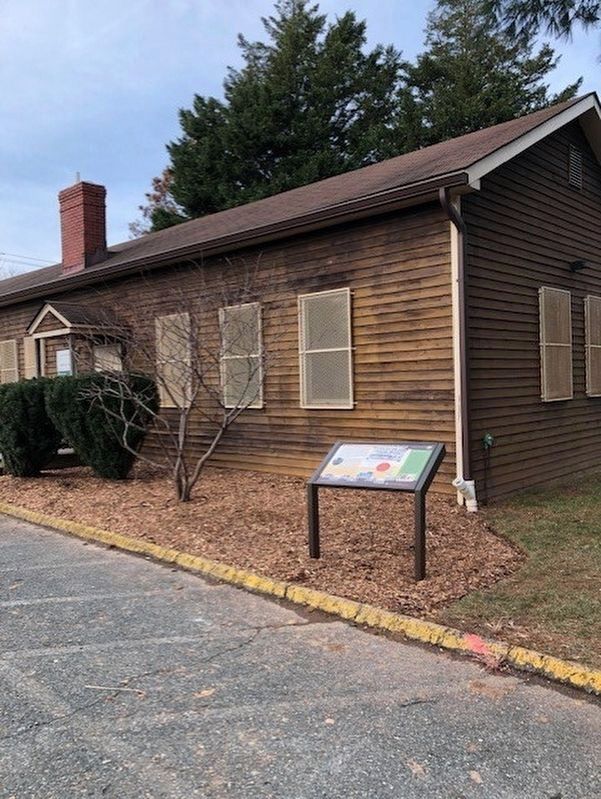
The original two-room school configuration had one room set aside for classroom instruction, while the other room served as a coat closet and storeroom for wood.M-NCPPC converted the building into a community meeting space with indoor restrooms and a kitchen.
This 1945 map of Norbeck shows the Rosenwald School with a flag, and both the cemetery and the church indicated by a cross.
In 1942-1943, some of the county Rosenwald Schools were documented — showing the variation between a one-teacher (Ken-Gar, Scotland), two-teacher (Norbeck, Rockville, Spencerville, Takoma Park), and three-teacher configuration (River Road, Sandy Spring).
The institutions at the heart of the Mount Pleasant community as seen in 1913.
Erected by Montgomery
Topics and series. This historical marker is listed in these topic lists: African Americans • Civil Rights • Education • Settlements & Settlers. In addition, it is included in the Maryland, Montgomery Parks, and the Rosenwald Schools series lists. A significant historical year for this entry is 1872.
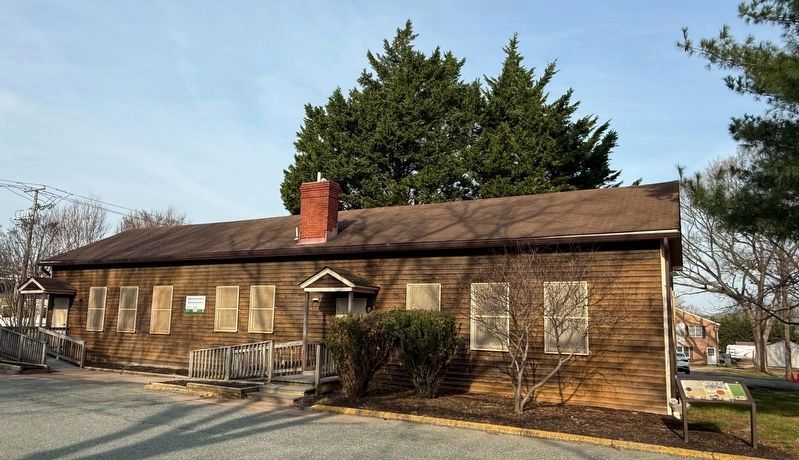
Location. 39° 6.611′ N, 77° 4.879′ W. Marker is near Rockville, Maryland, in Montgomery County. It is in Norbeck. It can be reached from Muncaster Mill Road (Maryland Route 115) west of Norbeck Road, on the right when traveling west. Adjacent to the Norbeck Senior Center. The Center was the school house. Touch for map. Marker is at or near this postal address: 4021 Muncaster Mill Rd, Rockville MD 20853, United States of America. Touch for directions.

Regionally, this marker is in the Washington Metropolitan Area. It is also in the American Mid-Atlantic. Globally, it is in North America, the Western Hemisphere, the Western World, and the Anglosphere. Historically, it finds itself in what was once one of the original Thirteen Colonies and also the Antebellum South.
Other nearby markers. At least 8 other markers are within 3 miles of this marker, measured as the crow flies: Hamere Berhan Kedus Yohannes EOTC, USA (within shouting distance of this marker); Higgins Tavern (approx. 1.6 miles away); Old Glory (approx. 2 miles away); Matthew Henson (approx. 2.4 miles away); a different marker also named Matthew Henson (approx. 2.7 miles away); Autre - St. Mary’s Plantation (approx. 2.8 miles away); Conduit Track Switch and Crossover (approx. 2.8 miles away); Needwood (approx. 3 miles away).
Additional keywords. Julius Rosenwald, Rosenwald School, Rosenwald Foundation, Black Education, Rockville, Maryland, Jewish American, Booker T. Washington, Tuskegee University
Credits. This page was last revised on March 26, 2026. It was originally submitted on June 13, 2020, by Jerry Klinger of Boynton Beach, Florida. This page has been viewed 1,264 times since then and 128 times this year. Photos: 1, 2. submitted on June 13, 2020, by Jerry Klinger of Boynton Beach, Florida. 3. submitted on March 26, 2026, by Devry Becker Jones of Washington, District of Columbia. • Bill Pfingsten was the editor who published this page.
