Near Lemay in St. Louis County, Missouri — The American Midwest (Upper Plains)
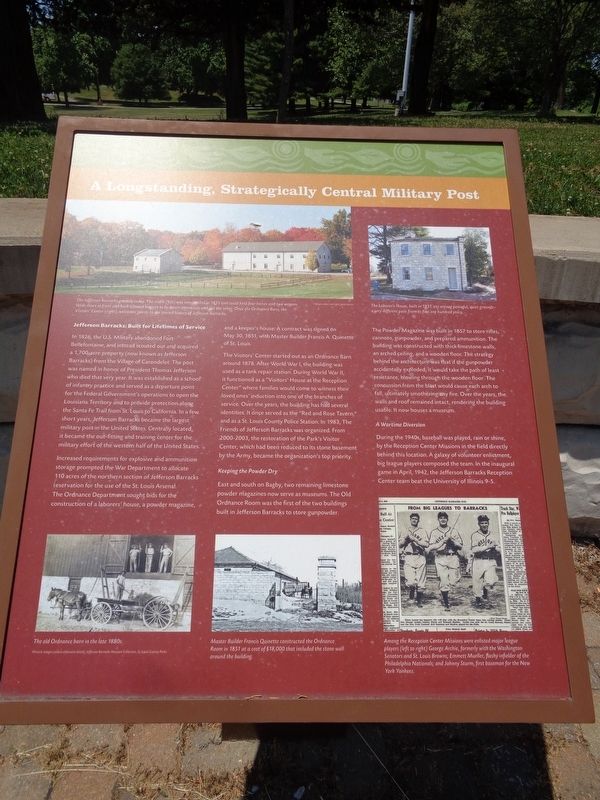
A Longstanding, Strategically Central Military Post
Photographed by Jason Voigt, June 14, 2020
1. A Longstanding, Strategically Central Military Post Marker
Jefferson Barracks: Built for Lifetimes of Service
In 1826, the U.S. Military abandoned Fort Bellefontaine, and instead scouted out and acquired a 1,700-acre property (now known as Jefferson Barracks) from the Village of Carondelet. The post was named in honor of President Thomas Jefferson who died that very year. It was established as a school of infantry practice and served as a departure point for the Federal Government's operations to open the Louisiana Territory and to provide protection along the Santa Fe Trail from St. Louis to California. In a few short years, Jefferson Barracks became the largest military post in the United States. Centrally located, it became the out-fitting and training center for the military effort of the western half of the United States.
Increased requirements for explosive and ammunition storage prompted the War Department to allocate 110 acres of the northern section of Jefferson Barracks reservation for the use of the St. Louis Arsenal. The Ordnance Department sought bids for the construction of a laborers' house, a powder magazine, and a keeper's house. A contract was signed on
this page online
The Visitors' Center started out as an Ordnance Barn around 1878. After World War I, the building was used as a tank repair station. During World War II, it functioned as a "Visitors' House at the Reception Center" where families would come to witness their loved ones' induction into one of the branches of service. Over the years, the building has had several identities. It once served as the "Red and Rose Tavern," and as a St. Louis County Police Station. In 1983, The Friends of Jefferson Barracks was organized. From 2000-2003, the restoration of the Park's Visitor Center, which had been reduced to its stone basement by the Army, became the organization's top priority.
Keeping the Powder Dry
East and south on Bagby, two remaining limestone powder magazines now serve as museums. The Old Ordnance Room was the first of the two buildings built in Jefferson Barracks to store gunpowder.
The Powder Magazine was built in 1857 to store rifles, cannons, gunpowder, and prepared ammunition. The building was constructed with thick limestone walls, an arched ceiling,
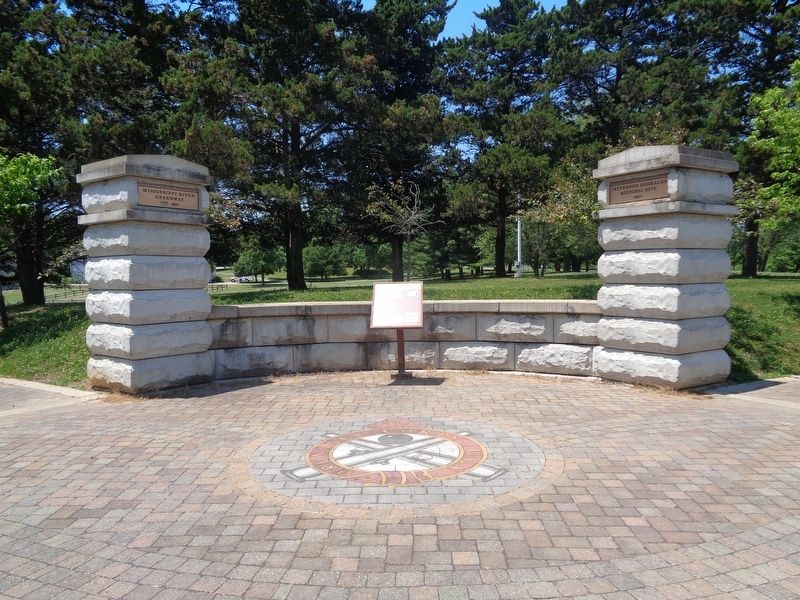
Photographed by Jason Voigt, June 14, 2020
2. A Longstanding, Strategically Central Military Post Marker
A Wartime Diversion
During the 1940s, baseball was played, rain or shine, by the Reception Center Missions in the field directly behind this location. A galaxy of volunteer enlistment, big league players composed the team. In the inaugural game in April, 1942, the Jefferson Barracks Reception Center beat the University of Illinois 9-5.
Erected by Saint Louis County Parks.
Topics. This historical marker is listed in these topic lists: Parks & Recreational Areas • Sports.
Location. This marker has been replaced by another marker nearby. It was located near 38° 31.18′ N, 90° 16.394′ W. Marker was near Lemay, Missouri, in St. Louis County. It was on Bagby Road south of Gark Road, on the right when traveling south. Marker was near the Missouri Military Memorial in Jefferson Barracks Park. It was also located on the Mississippi River Greenway bike path. Touch for map. Marker was at or near this postal address: 490 Bagby Rd, Saint Louis MO 63125, United States of America. Touch for directions.

Regionally, this marker was in Greater St. Louis. It was also in the American Midwest, in the Lewis & Clark Corridor, in the Corn Belt, and in the Great River Road Region. Globally, it was in North America, the Western Hemisphere, the Western World, and the Anglosphere. Historically, it found itself in what was once the Viceroyalty of New France, the territory of the Mississippian Culture, the Louisiana Purchase, and the Antebellum South.
Other nearby markers. At least 8 other markers are within walking distance of this location: Military Post History (here, next to this marker); The Missouri Military Memorial & Gold Star Pavilion (within shouting distance of this marker); Jefferson Barracks Historic Site - Old Ordnance Room (about 300 feet away, measured in a direct line); 173rd Airborne (about 400 feet away); Jefferson Barracks Historic Site - World War II Reception Center #1772 (about 400 feet away); Operation Desert Shield & Desert Storm (about 500 feet away); Missouri Military Memorial (about 600 feet away); Jefferson Barracks Historic Site - Visitors Center, Laborer House and Stable (about 600 feet away). Touch for a list and map of all markers in Lemay.
Another marker is no longer nearby. Jefferson Barracks - At the Confluence of American History (was about 600 feet away but has been replaced with another marker now near it).
Credits. This page was last revised on July 10, 2026. It was originally submitted on June 16, 2020, by Jason Voigt of Glen Carbon, Illinois. This page has been viewed 413 times since then and 37 times this year. Photos: 1, 2. submitted on June 16, 2020, by Jason Voigt of Glen Carbon, Illinois. • Devry Becker Jones was the editor who published this page.
