Near Leesburg in Loudoun County, Virginia — The American South (Mid-Atlantic)
Swann's Castle
Morven Park in the Civil War
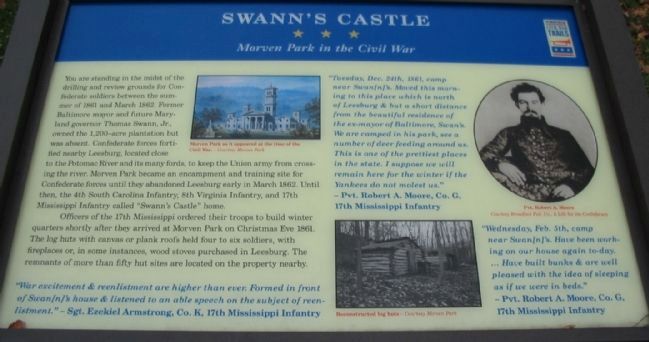
Photographed by Craig Swain, November 16, 2008
1. Swann's Castle Marker
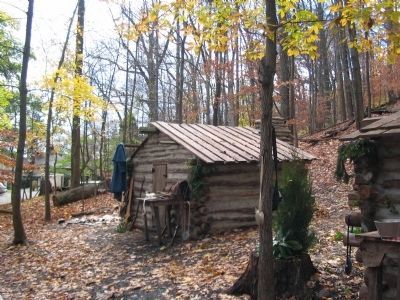
Officers of the 17th Mississippi ordered their troops to build winter quarters shortly after they arrived at Morven Park on Christmas Eve 1861. The log huts with canvas or plank roofs held four to six soldiers, with fireplaces or, in some instances, wood stoves purchased in Leesburg. The remnants of more than fifty hut sites are located on the property nearby.
"War excitement & reenlistment are higher than ever. Formed in front of Swan[n]'s house & listened to an able speech on the subject of reenlistment."
this page online
"Tuesday, Dec. 24th, 1861, camp near Swan[n]'s. Moved this morning to this place which is north of Leesburg & but a short distance from the beautiful residence of the ex-mayor of Baltimore, Swan's. We are camped in his park, see a number of deer feeding around us. This is one of the prettiest places in the state. I suppose we will remain here for the winter if the Yankees do not molest us." - Pvt. Robert A. Moore, Co. G, 17th Mississippi Infantry
"Wednesday, Feb. 5th, camp near Swan[n]'s. Have been working on our house again to-day. ...Have built bunks & are well pleased with the idea of sleeping as if we were in beds." - Pvt. Robert A. Moore, Co. G, 17th Mississippi Infantry
Erected 2008 by Virginia Civil War Trails.
Topics and series. This historical marker is listed in this topic list: War, US Civil. In addition, it is included in the Virginia Civil War Trails series list. A significant historical month for this entry is March 1862.
Location. Marker has been permanently removed. It was located near 39° 8.371′ N, 77° 34.345′ W. Marker was near Leesburg, Virginia, in Loudoun County.
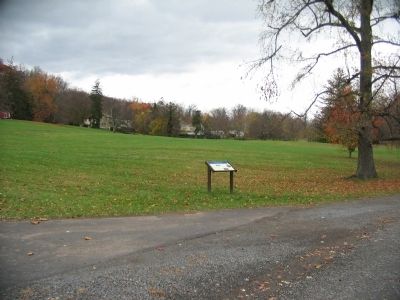
Photographed by Craig Swain, November 16, 2008
2. Swann's Castle Marker in Front of the Governor's Mansion
We have been informed that this marker is no longer there and will not be replaced. This page is an archival view of what was.
Regionally, this marker was in the Washington Metropolitan Area and in Northern Virginia. It was also in the American South, specifically in the Upper South, and in the Mid-Atlantic. Globally, it was in North America, the Western Hemisphere, the Western World, and the Anglosphere. Historically, it found itself in what was once the territory of the Mississippian Culture, one of the original Thirteen Colonies, one of the Confederate States of America, and the Antebellum South.

Other nearby markers. At least 8 other markers are within 2 miles of this location, measured as the crow flies: A Serious Business (approx. 0.2 miles away); The Farmhand House (approx. ¼ mile away); The Garden (approx. ¼ mile away); Early’s Washington Campaign (approx.
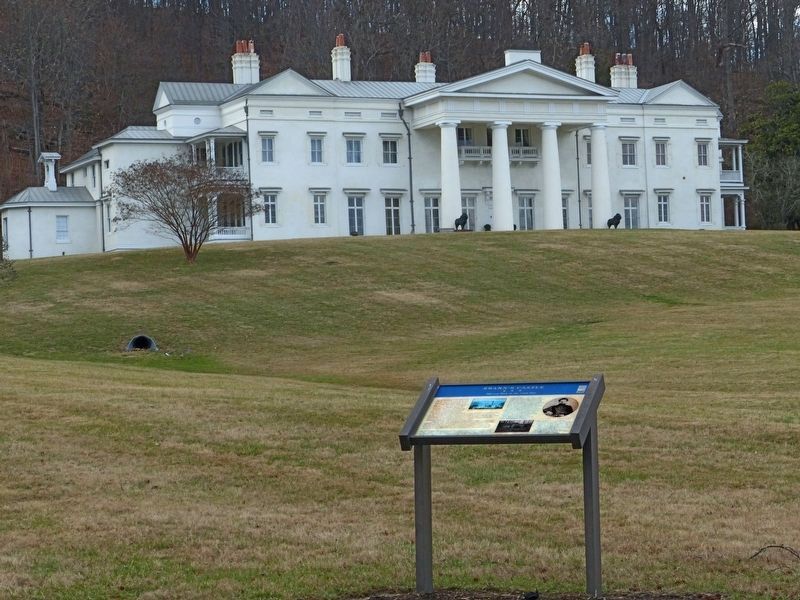
Photographed by Allen C. Browne, February 26, 2018
3. Swann's Castle Marker
Another marker is no longer nearby. 1862 Antietam Campaign (was approx. 1.2 miles away but has been permanently removed).
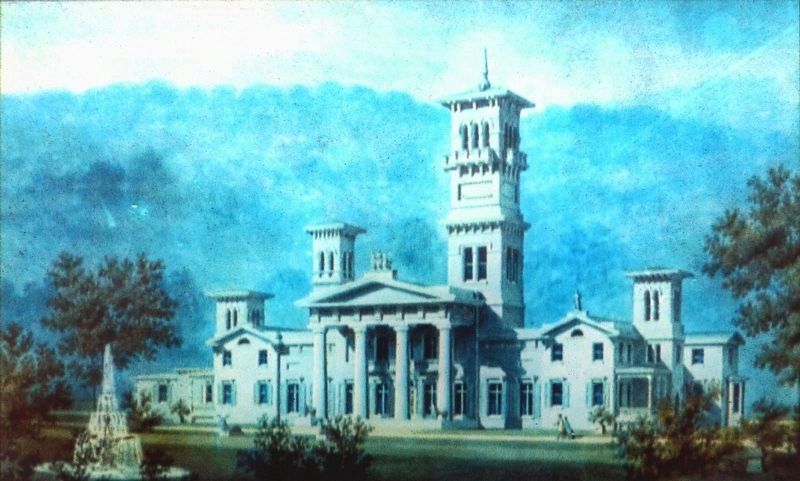
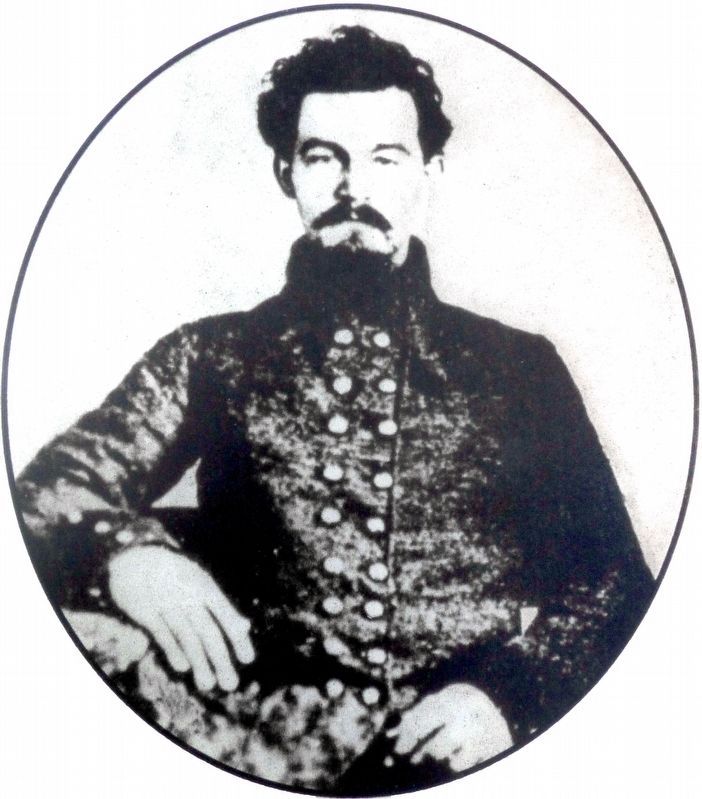
More about this marker. In the upper center is an illustration of Morven Park as it appeared at the time of the Civil War. On the right is a portrait of Pvt. Moore. In the lower center is a photograph of Reconstructed log huts.
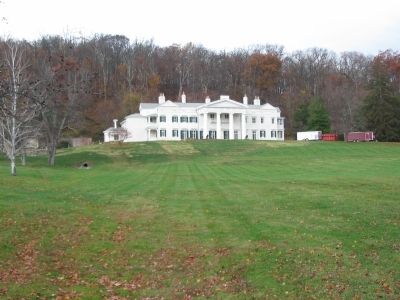
Photographed by Craig Swain, November 16, 2008
4. The Mansion as it Appears Today
Photographed by Craig Swain, November 16, 2008
5. One of the Recreated Cabins
On the hills around the grounds, several depressions are indications of the cabins built by the Confederates during their stay. Equipment around the cabin was part of a living history demonstration.
Photographed by Allen C. Browne, February 26, 2018
6. Morven Park as it appeared during the Civil War
Photographed by Allen C. Browne, February 26, 2018
7. Pvt. Robert A. Moore
Credits. This page was last revised on January 10, 2026. It was originally submitted on November 19, 2008. This page has been viewed 2,591 times since then and 69 times this year. Last updated on July 6, 2020, by Brandon Stahl of Fairfax, Virginia. Photos: 1, 2. submitted on November 19, 2008, by Craig Swain of Leesburg, Virginia. 3. submitted on May 8, 2018, by Allen C. Browne of Silver Spring, Maryland. 4, 5. submitted on November 19, 2008, by Craig Swain of Leesburg, Virginia. 6, 7. submitted on May 8, 2018, by Allen C. Browne of Silver Spring, Maryland. • J. Makali Bruton was the editor who published this page.
