Oberlin in Decatur County, Kansas — The American Midwest (Upper Plains)
Flight of the Cheyennes
Photographed by Cosmos Mariner, July 5, 2021
1. Flight of the Cheyennes Marker
Inscription.
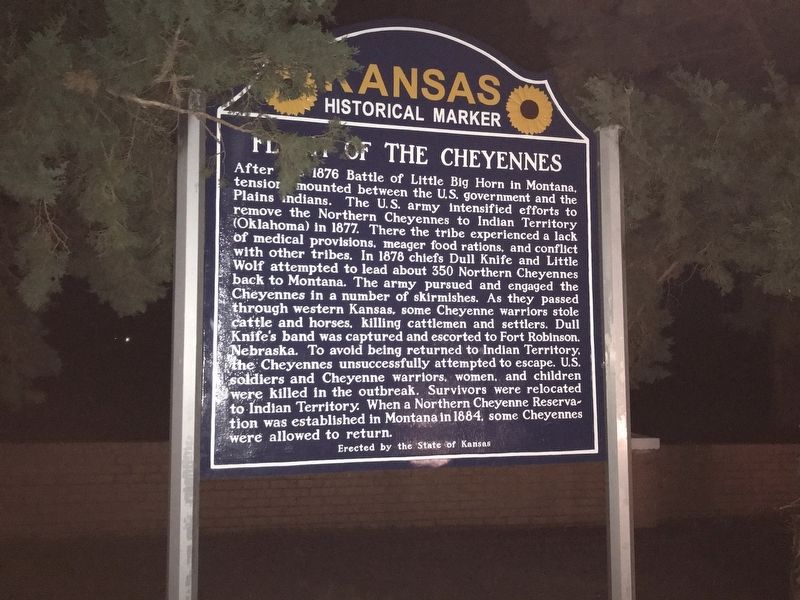
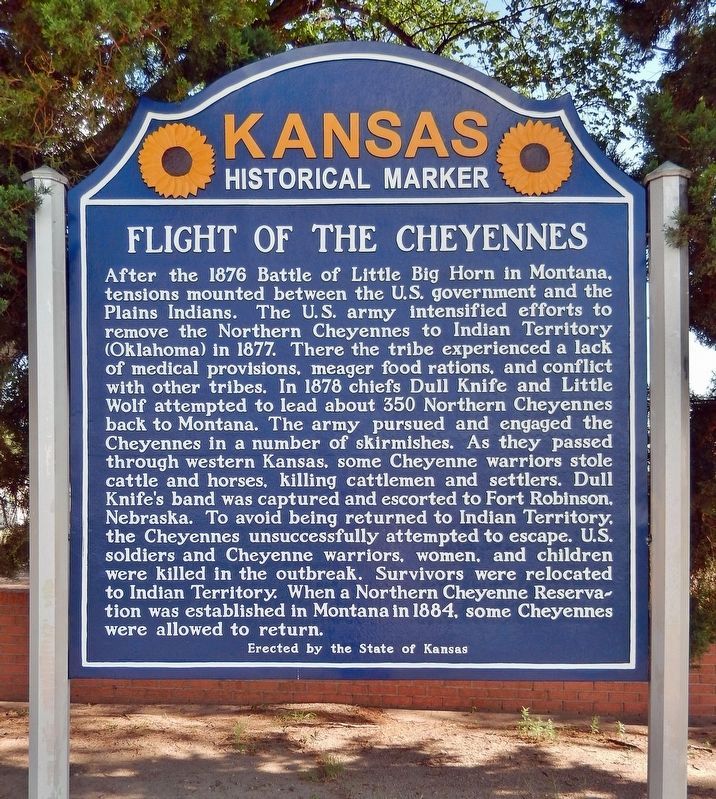
Flight of the Cheyennes. . After the 1876 Battle of Little Big Horn in Montana, tensions mounted between the U.S. government and the Plains Indians. The U.S. army intensified efforts to remove the Northern Cheyennes to Indian Territory (Oklahoma) in 1877. There the tribe experienced a lack of medical provisions, meager food rations, and conflict with other tribes. In 1878 chiefs Dull Knife and Little Wolf attempted to lead about 350 Northern Cheyennes back to Montana. The army pursued and engaged the Cheyennes in a number of skirmishes. As they passed through western Kansas, some Cheyenne warriors stole cattle and horses, killing cattlemen and settlers. Dull Knife's band was captured and escorted to Fort Robinson, Nebraska. To avoid being returned to Indian Territory, the Cheyennes unsuccessfully attempted to escape. U.S. soldiers and Cheyenne warriors, women, and children were killed in the outbreak. Survivors were relocated to Indian Territory. When a Northern Cheyenne Reservation was established in Montana in 1884, some Cheyennes were allowed to return.
After the 1876 Battle of Little Big Horn in Montana, tensions mounted between the U.S. government and the Plains Indians. The U.S. army intensified efforts to remove the Northern Cheyennes to Indian Territory (Oklahoma) in 1877. There the tribe experienced a lack of medical provisions, meager food rations, and conflict with other tribes. In 1878 chiefs Dull Knife and Little Wolf attempted to lead about 350 Northern Cheyennes back to Montana. The army pursued and engaged the Cheyennes in a number of skirmishes. As they passed through western Kansas, some Cheyenne warriors stole cattle and horses, killing cattlemen and settlers. Dull Knife's band was captured and escorted to Fort Robinson, Nebraska. To avoid being returned to Indian Territory, the Cheyennes unsuccessfully attempted to escape. U.S. soldiers and Cheyenne warriors, women, and children were killed in the outbreak. Survivors were relocated to Indian Territory. When a Northern Cheyenne Reservation was established in Montana in 1884, some Cheyennes were allowed to return.
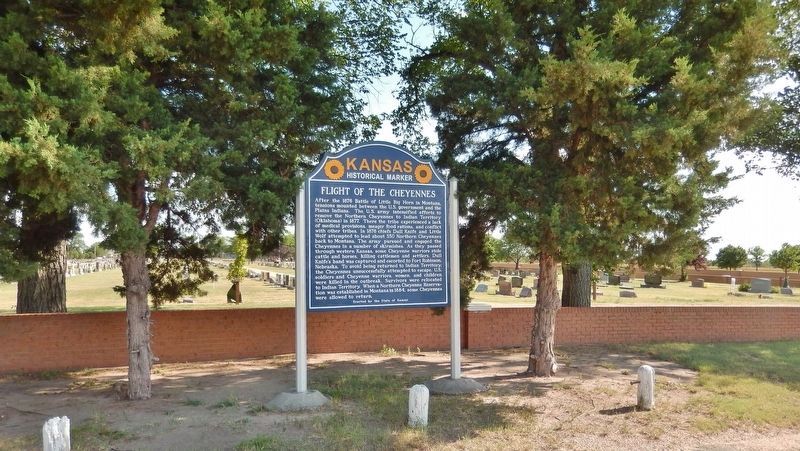
Location. 39° 49.672′ N, 100° 30.964′ W. Marker is in Oberlin, Kansas, in Decatur County. It is on East Frontier Parkway (U.S. 36) east of Martin Avenue, on the right when traveling east. Located at Oberlin Cemetery. Touch for map. Marker is at or near this postal address: 1245 E Frontier Pkwy, Oberlin KS 67749, United States of America. Touch for directions.

Regionally, this marker is in the American Midwest, in the Corn Belt, on the prairies, on the Great Plains, on the Southern Plains, and specifically on the High Plains. Globally, it is in North America, the Western Hemisphere, the Western World, and the Anglosphere. Historically, it finds itself in what was once the Louisiana Purchase.
Other nearby markers. At least 3 other markers are within 14 miles of this marker, measured as the crow flies: Tribute to the War Dead (about 500 feet away, measured in a direct line); Silent Glory (about 500 feet
Photographed by Duane and Tracy Marsteller, July 3, 2020
3. Flight of the Cheyennes Marker
Credits. This page was last revised on July 16, 2021. It was originally submitted on July 13, 2020, by Duane and Tracy Marsteller of Murfreesboro, Tennessee. This page has been viewed 654 times since then and 49 times this year. Photos:1, 2. submitted on July 16, 2021, by Cosmos Mariner of Cape Canaveral, Florida. 3. submitted on July 13, 2020, by Duane and Tracy Marsteller of Murfreesboro, Tennessee. • Devry Becker Jones was the editor who published this page.