Mackinac Island in Mackinac County, Michigan — The American Midwest (Great Lakes)
Sugar Loaf
Photographed by Cosmos Mariner, July 30, 2017
1. Sugar Loaf Marker
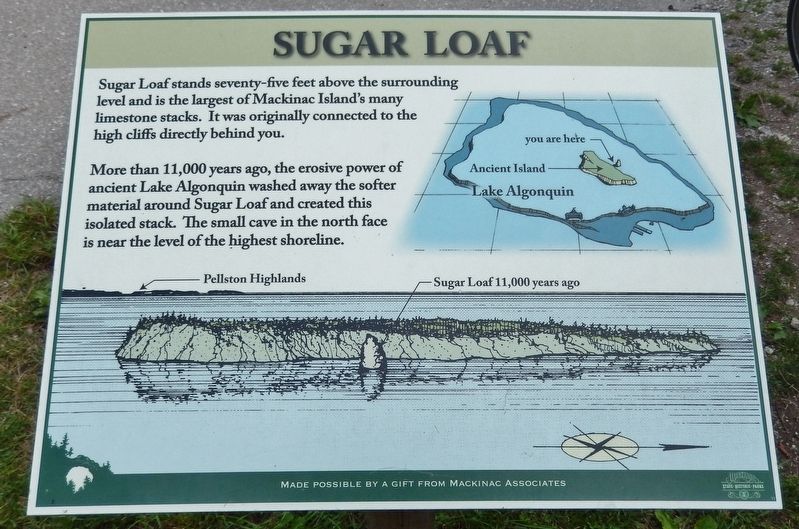
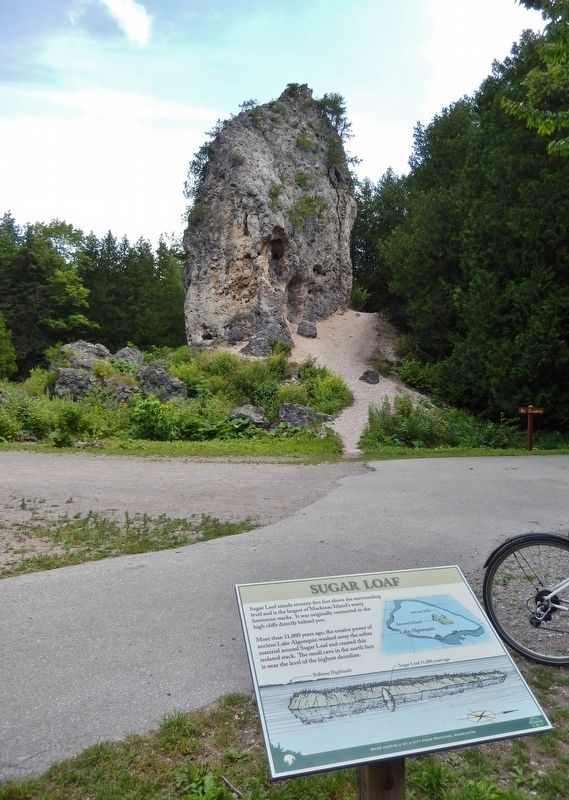
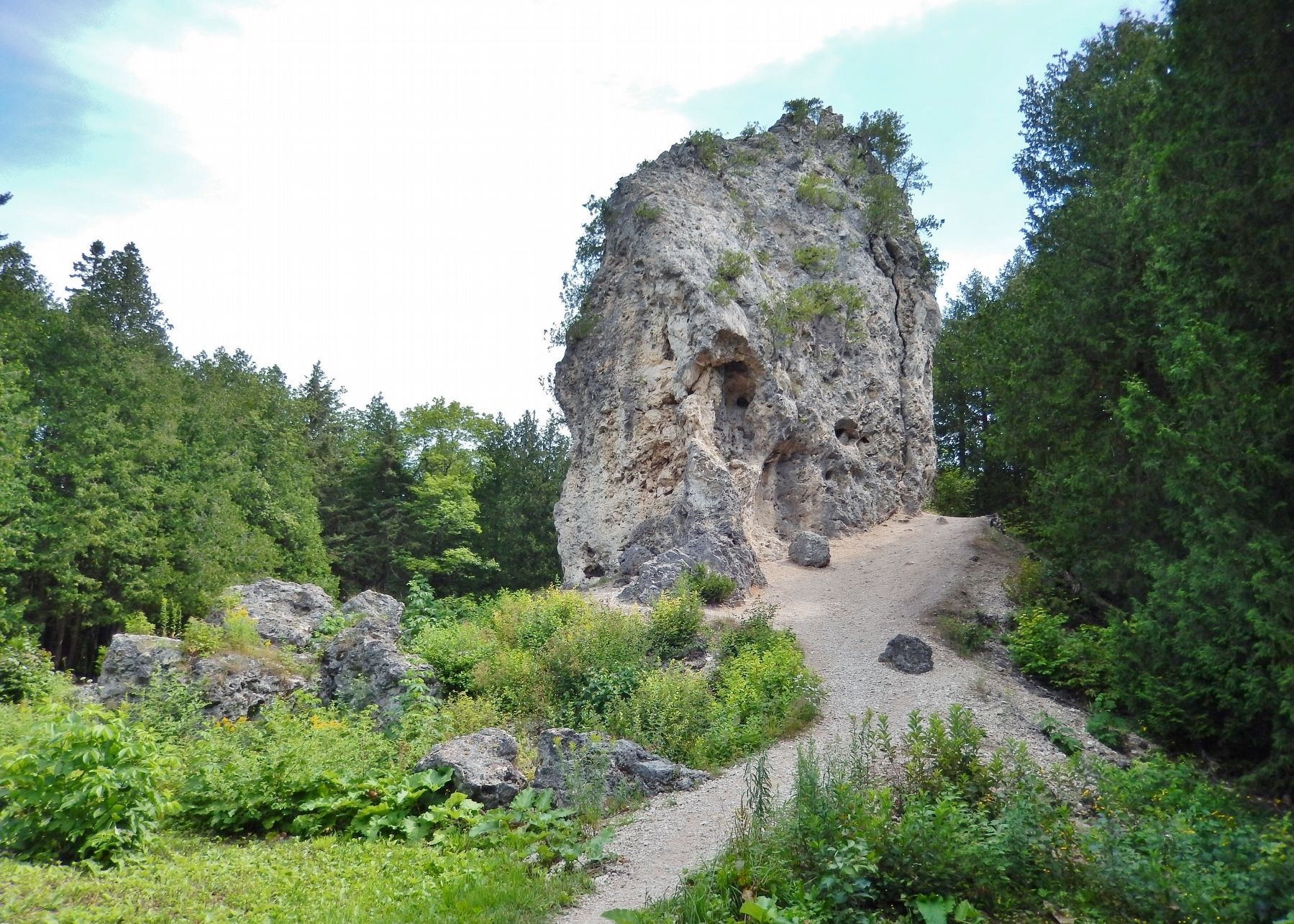
More than 11,000 years ago, the erosive power of ancient Lake Algonquin washed away the softer material around Sugar Loaf and created this isolated stack. The small cave in the north face is near the level of the highest shoreline.
(photo captions)
• Pellston Highlands
• Sugar Loaf 11,000 years ago.
Made possible by a gift from Mackinac Associates
Topics. This historical marker is listed in this topic list: Natural Features.
Location. 45° 51.694′ N, 84° 37.056′ W. Marker is on Mackinac Island, Michigan, in Mackinac County. It can be reached from Sugar Loaf Road ¾ mile west of Lake Shore Drive (State Highway 185). Sugar Loaf is about ¾ mile northwest of the Arch Rock trailhead on Lake Shore Drive, via Arch Rock Road to Rifle Range Road to Sugar Loaf Road. Access is via foot, bicycle or horseback. Touch for map. Marker is in this post office area: Mackinac Island MI 49757, United States
this page online

Regionally, this marker is on the Upper Peninsula and on the Straits of Mackinac. It is also in the American Midwest. Globally, it is in North America, in the Great North Woods, on the Great Lakes, in the Western Hemisphere, in the Western World, and in the Anglosphere. Historically, it finds itself in what was once the Viceroyalty of New France and also the Northwest Territory.
Other nearby markers. At least 8 other markers are within walking distance of this marker: Fort Holmes (approx. ¼ mile away); a different marker also named Fort Holmes (approx. ¼ mile away); Post Cemetery (approx. ¼ mile away); Home Of The Ancestors (approx. 0.3 miles away); Skull Cave (approx. 0.3 miles away); Resting Place of the Ancestors (approx. 0.3 miles away); Scout Barracks / Parade Ground (approx. 0.6 miles away); Greany Grove (approx. 0.6 miles away). Touch for a list and map of all markers in Mackinac Island.
Another marker is no longer nearby. Skull Cave (was approx. 0.3 miles away but has been permanently removed).
Also see . . . Sugar Loaf (Wikipedia). Sugar Loaf Rock appears
Photographed by Cosmos Mariner, July 30, 2017
2. Sugar Loaf Marker
Photographed by Cosmos Mariner, July 30, 2017
3. Sugar Loaf
Credits. This page was last revised on July 19, 2020. It was originally submitted on July 19, 2020, by Cosmos Mariner of Cape Canaveral, Florida. This page has been viewed 499 times since then and 40 times this year. Photos: 1, 2, 3. submitted on July 19, 2020, by Cosmos Mariner of Cape Canaveral, Florida.
