Yulee in Nassau County, Florida — The American South (South Atlantic)
Florida's First Cross-Peninsula Railroad
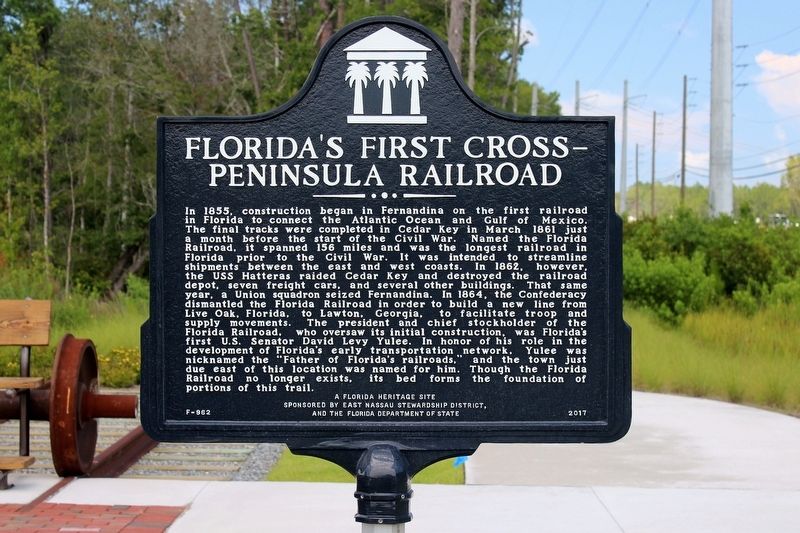
Photographed by Tim Fillmon, July 17, 2020
1. Florida's First Cross-Peninsula Railroad Marker
this page online
Erected 2017 by East Nassau Stewardship District and the Florida Department of State. (Marker Number F-962.)
Topics. This historical marker is listed in these topic lists: Railroads & Streetcars • War, US Civil. A significant historical year for this entry is 1855.
Location. 30° 37.445′ N, 81° 38.094′ W. Marker is in Yulee, Florida, in Nassau County. It is on Florida Route A1A/200 0.1 miles east of Wildlight Avenue, on the right when traveling west. Touch for map. Marker is in this post office area: Yulee FL 32097, United States of America. Touch for directions.

Regionally, this marker is in First Coast and in Greater Jacksonville. It is also in the American South and on the Eastern Seaboard. Globally, it is in the North Atlantic Region, North America, a Gulf of Mexico state, the Western Hemisphere, the Western World, and the Anglosphere. Historically, it finds itself in what was once New Spain, the territory of the Mississippian Culture, one of the Confederate States of America, and the Antebellum South.
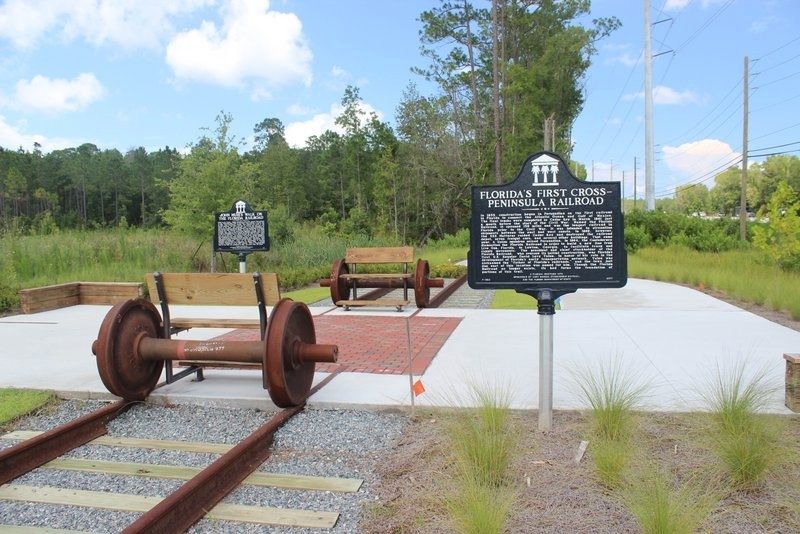
Photographed by Tim Fillmon, July 17, 2020
2. Florida's First Cross-Peninsula Railroad Marker
With companion marker in background.
Other nearby markers. At least 8 other markers are within 8 miles of this marker, measured as the crow flies: John Muir's Walk on the Florida Railroad (here, next to this marker); Bryant Academy (approx. 2.9 miles away); Italia (approx. 5 miles away); Home of Fernandina Beach (approx. 5.6 miles away); Florida Honors and Remembers our POW’s and MIA’s (approx. 5.7 miles away); Home of Amelia Island (approx. 5.7 miles away); The Battle of Waterman's Bluff (approx. 6.6 miles away); Jacksonville National Cemetery (approx. 7.3 miles away). Touch for a list and map of all markers in Yulee.
Credits. This page was last revised on July 22, 2020. It was originally submitted on July 22, 2020, by Tim Fillmon of Webster, Florida. This page has been viewed 1,018 times since then and 77 times this year. Photos: 1, 2. submitted on July 22, 2020, by Tim Fillmon of Webster, Florida.
