Hillsboro in Caroline County, Maryland — The American Northeast (Mid-Atlantic)
Frederick Douglass
"Tales of Horror"
Photographed by F. Robby, September 20, 2010
1. Frederick Douglass Marker
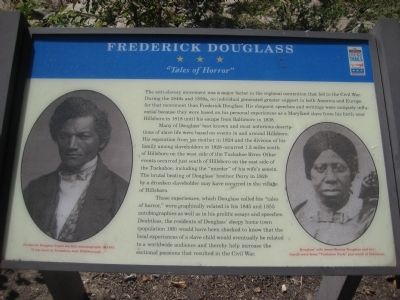
The anti-slavery movement was a major factor in the regional contention that led to the Civil War. During the 1840s and 1850s, no individual generated greater support in both America and Europe for that movement than Frederick Douglass. His eloquent speeches and writings were uniquely influential because they were based on his personal experiences as a Maryland slave from his birth near Hillsboro in 1818 until his escape from Baltimore in 1838.
Many of Douglass' best known and most notorious descriptions of slave life were based on events in and around Hillsboro. His separation from his mother in 1824 and the division of his family among slaveholders in 1828 occurred 1.5 miles south of Hillsboro on the west side of the Tuckahoe River. Other events occurred just south of Hillsboro on the east side of the Tuckahoe, including the "murder" of his wife's cousin. The brutal beating of Douglass' brother Perry in 1828 by a drunken slaveholder may have occurred in the village of Hillsboro.
These experiences, which Douglass called his "tales of horror," were graphically related in his 1845 and 1855 autobiographies as well
this page online
[Captions:]
Frederick Douglass began his first autobiography in 1845: "I was born in Tuckahoe, near Hillsborough…"
Douglass' wife Anne Murray Douglass and her family were from "Tuckahoe Neck" just south of Hillsboro.
Erected by Maryland Civil War Trails.
Topics and series. This historical marker is listed in these topic lists: African Americans • War, US Civil. In addition, it is included in the Maryland Civil War Trails series list. A significant historical year for this entry is 1818.
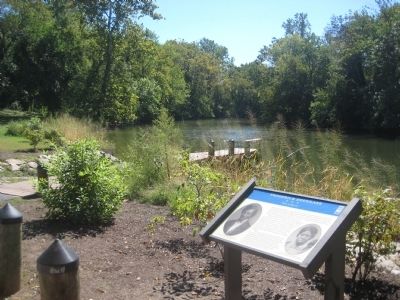
Location. This marker has been replaced by another marker nearby. It was located near 38° 55.023′ N, 75° 56.685′ W. Marker was in Hillsboro, Maryland, in Caroline County. It was on Main Street (Alternate Maryland Route 404) 0.4 miles west of Ridgely Road ( Route 480), on the left when traveling west. The marker stands next
Photographed by F. Robby, September 20, 2010
2. Frederick Douglass Marker

Regionally, this marker was on the Eastern Shore. It was also in the American Mid-Atlantic, on the Delmarva Peninsula, in the Tidewater, and on the Eastern Seaboard. Globally, it was in the North Atlantic Region, North America, the Western Hemisphere, the Western World, and the Anglosphere. Historically, it found itself in what was once one of the original Thirteen Colonies and also the Antebellum South.
Other nearby markers. At least 8 other markers are within 3 miles of this location, measured as the crow flies: A different marker also named Frederick Douglass (here, next to this marker); St. Paul’s Episcopal Church (approx. 0.2 miles away); Forging Freedom from Places of Bondage (approx. half a mile away); A Champion for Equality (approx. half a mile away); The Beloved Tuckahoe Home of Frederick Douglass (approx. half a mile away); Honoring an American Hero (approx. half a mile away); a different marker also named Frederick Douglass (approx. 2.3 miles away);
Photographed by F. Robby, September 20, 2010
3. Tuckahoe River
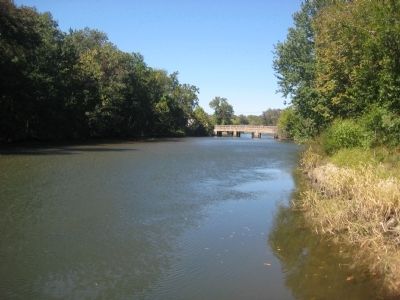
Looking west toward the Main Street bridge.
Related marker. Click here for another marker that is related to this marker. This marker has been replaced with the linked marker.
Credits. This page was last revised on October 5, 2024. It was originally submitted on September 6, 2013, by F. Robby of Baltimore, Maryland. This page has been viewed 1,180 times since then and 44 times this year. Last updated on August 7, 2020, by Carl Gordon Moore Jr. of North East, Maryland. Photos: 1, 2, 3. submitted on September 6, 2013, by F. Robby of Baltimore, Maryland. • Bill Pfingsten was the editor who published this page.
