
Cross Keys in Rockingham County, Virginia — The American South (Mid-Atlantic)
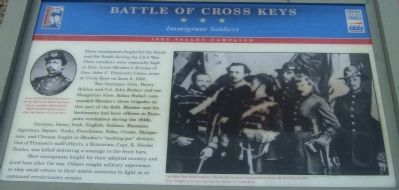
Battle of Cross Keys
Immigrant Soldiers
| — | 1862 Valley Campaign | — |
Photographed by Robert H. Moore, II, January 30, 2009
1. Battle of Cross Keys Marker
Two Germans (Gen. Henry Bohlen and Col. John Koltes) and one Hungarian (Gen. Julius Stahel) commanded Blenker’s three brigades on this part of the field. Blenker and his lieutenants had been officers in European revolutions during the 1840s.
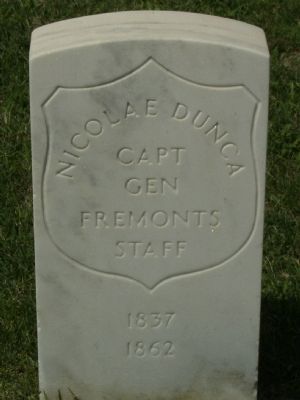
German, Swiss, Irish, English, Italians, Russians, Algerians, Sepoys, Turks, Frenchmen, Poles, Croats, Hungarians, and Chinese fought with Blenker’s “melting pot” division. One of Fremont’s staff officers, a Romanian, Capt. R. Nicolai Dunka, was killed delivering a message to the front here.
Most immigrants fought for their adopted country and lived here after the war. Others sought military experience so they could return to their native countries to fight in or command revolutionary armies.
Erected 2003 by Shenandoah Valley Battlefields Foundation & Virginia Civil War Trails.
Topics and series. This historical marker is listed in this topic list: War, US Civil.
this page online
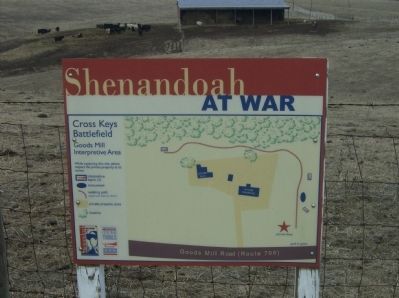
Location. This marker has been replaced by another marker nearby. It was located near 38° 21.204′ N, 78° 49.026′ W. Marker was in Cross Keys, Virginia, in Rockingham County. It could be reached from Goods Mill Road (Route 708), on the right when traveling south. This is one of three markers found at this site (Goods Mill Interpretive Area/Owen D. Graves Memorial Cross Keys Battlefield Wayside). Touch for map. Marker was in this post office area: Harrisonburg VA 22801, United States of America. Touch for directions.

Regionally, this marker was in Virginia’s Shenandoah Valley. It was also in the American South and specifically in the Upper South. Globally, it was in North America, the Western Hemisphere, the Western World, and the Anglosphere. Historically, it found itself in what was once the territory of the Mississippian Culture, one of the original Thirteen Colonies, one of the Confederate States of America, and the Antebellum South.
Other nearby markers. At least 8 other markers are within
Photographed by Bradley Owen, October 18, 2023
2. Markers At This Location
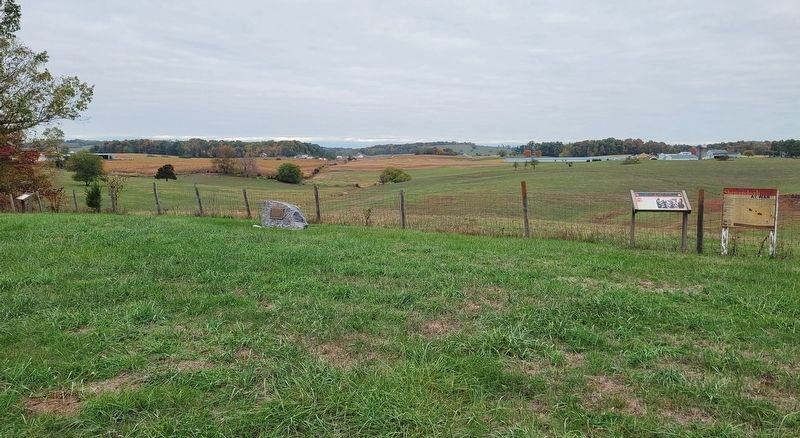
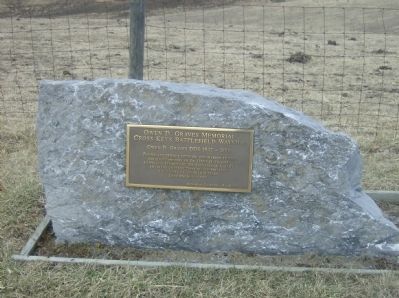
(Left to right): Trimble's Ravine, Graves Monument Boulder, Immigrant Soldiers and Trail Map.
Other markers no longer nearby. Battle of Cross Keys (was within shouting distance of this marker but has been replaced with another marker now near it); a different marker also named Battle of Cross Keys (was about 400 feet away, measured in a direct line but has been replaced with another marker now near it).
More about this marker. On the left is a portrait of Gen. Julius Stahel, who was awarded the Medal of Honor for heroism on another Shenandoah Valley battlefield two years after the Battle of Cross Keys. In the center right is a photograph of members of the 39th New York. The 39th New York Infantry (Garibaldi Guards) had members from all over the world. They fought near here during the Battle of Cross Keys.
Related marker.
Photographed by Robert H. Moore, II, January 30, 2009
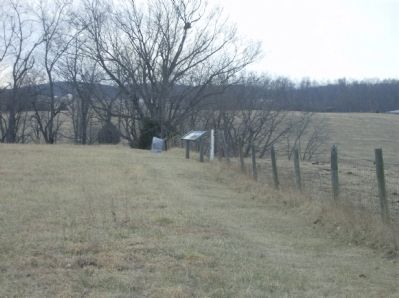
3. Battle of Cross Keys Marker
Photographed by Robert H. Moore, II, January 26, 2009
4. Grave of Capt. Nicolae Dunka, Staunton National Cemetery
Capt. Dunka's body was removed after the war from a nearby grave to the National Cemetery at Staunton, Virginia.
Photographed by Robert H. Moore, II, January 30, 2009
5. Marker showing map of trail to the different markers at the interpretive site
Photographed by Robert H. Moore, II, January 30, 2009
6. Owen D. Graves Monument Boulder
This is found at the site of the first marker on this trail.
Credits. This page was last revised on July 27, 2025. It was originally submitted on February 17, 2009, by Robert H. Moore, II of Winchester, Virginia. This page has been viewed 3,317 times since then and 38 times this year. Last updated on August 12, 2020, by Bradley Owen of Morgantown, West Virginia. Photos: 1. submitted on February 17, 2009, by Robert H. Moore, II of Winchester, Virginia. 2. submitted on October 18, 2023, by Bradley Owen of Morgantown, West Virginia. 3, 4, 5, 6. submitted on February 17, 2009, by Robert H. Moore, II of Winchester, Virginia. • Bernard Fisher was the editor who published this page.
