Lynnwood in Rockingham County, Virginia — The American South (Mid-Atlantic)
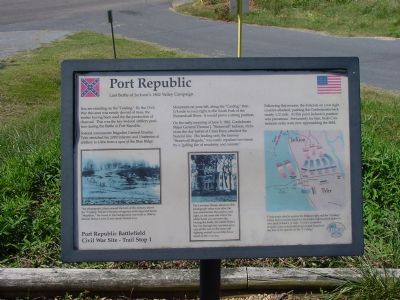
Port Republic
Last Battle of Jackson’s 1862 Valley Campaign
Photographed by J. J. Prats, September 25, 2007
1. Port Republic Marker
Port Republic Battlefield Civil War Site—Trail Stop 1
You are standing on the “Coaling.” By the Civil War this area was nearly devoid of trees, the timber having been used for the production of charcoal. This was the key Federal artillery position during the Battle of Port Republic.
Federal commander Brigadier General Erastus Tyler stretched his 3,000 infantry and 3 batteries of artillery in a line from a spur of the Blue Ridge Mountains on your left, along the “Coaling” then ¾ mile to your right, to the South Fork of the Shenandoah River. It would prove a strong position.
On the early morning of June 9, 1862, Confederate Major General Thomas J. “Stonewall” Jackson, victorious the day before at Cross Keys, attacked the Federal line. His leading unit, the famous “Stonewall Brigade,” was easily repulsed two times by a “galling fire of musketry and canister.”
Following this reverse, the Federals on your right counter-attacked, pushing the Confederates back nearly ½ mile. At this point Jackson’s position was precarious. Fortunately for him, Confederate units were now approaching the field.
Erected by APCWS
this page online
Topics. This historical marker is listed in this topic list: War, US Civil. A significant historical date for this entry is June 9, 1862.
Location. This marker has been replaced by another marker nearby. It was located near 38° 18.086′ N, 78° 46.027′ W. Marker was in Lynnwood, Virginia, in Rockingham County. It was at the intersection of Ore Bank Road (Virginia Route 708) and Mapleton Lane (County Route 967) on Ore Bank Road. It is just off U.S. 340 (East Side Highway). Touch for map. Marker was in this post office area: Port Republic VA 24471, United States of America. Touch for directions.

Regionally, this marker was in the Shenandoah Valley. It was also in the American South and specifically in the Upper South. Globally, it was in North America, the Western Hemisphere, the Western World, and the Anglosphere. Historically, it found itself in what was once the territory of the Mississippian Culture, one of the original Thirteen Colonies, one of the Confederate States of America, and the Antebellum South.
Other nearby markers. At least 8 other markers
Photographed by J. J. Prats, September 25, 2007
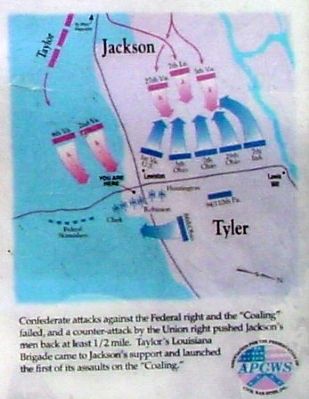
2. Closeup of Map on Marker
“Confederate attacks against the Federal right and the ‘Coaling’ failed, and a counter-attack by the Union right pushed Jackson’s men back at least ½ mile. Taylor’s Louisiana Brigade came to Jackson’s support and launched the first of its assaults on the ‘Coaling’.”
More about this marker. In addition to the map, marker reproduces two photographs with these captions, “This photograph, taken around the turn of the century, shows the ‘Coaling’ before it became overgrown with trees and brush. ‘Mapleton,’ the house in the background, was built in 1886 by Samuel Hance Lewis II and stands behind you.” And “The Lewiston House, shown in this photograph taken soon after the war, stood across the road to your right, on the same site where the white house you see now sits. During the battle, the initial Federal line ran through the Lewiston property all the way to the river, and fighting swirled around the
Photographed by J. J. Prats, September 25, 2007
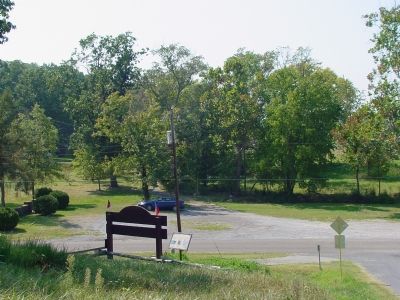
3. Port Republic Marker
Trail starts at this intersection, and this is Stop 1. Trail continues up hill to the left and behind the photographer to Stop 4.
Photographer’s note: Without a guide, the location of Trail Stops 2 and 3 are not immediately apparent.
Related marker. Click here for another marker that is related to this marker. This marker has been replaced by another at this location.
Photographed by Bernard Fisher, September 11, 2015
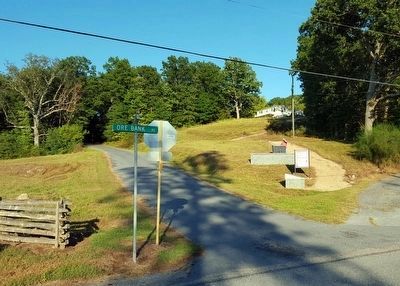
4. Port Republic Markers
Mapleton can be glimpsed in the gap in the tree line.
Photographed by J. J. Prats, September 15, 2019
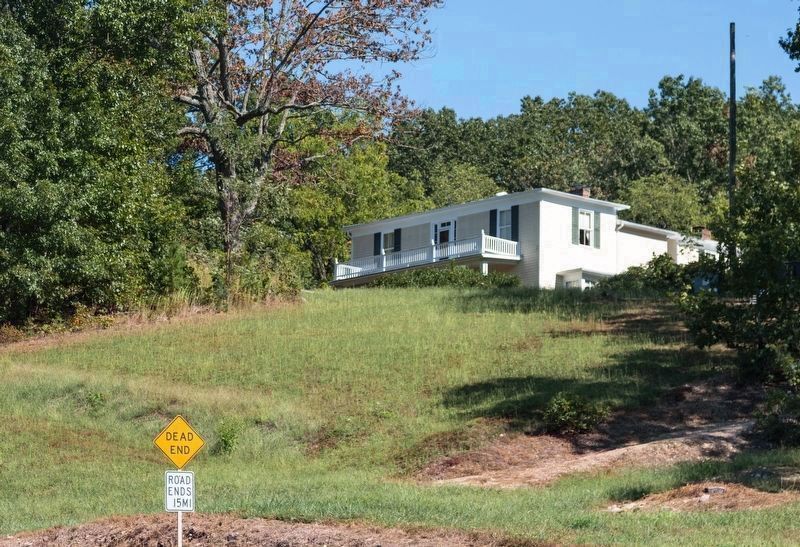
5. Mapleton
This view is from the Ore Bank Road. It is a private residence. No trespassing. The road up to the house, Mapleton Lane, is narrow and without guide rails, and offers no turnaround at the closed gate.
Photographed by J. J. Prats, September 25, 2007
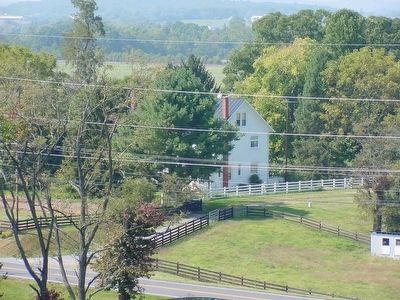
6. Replacement for the Lewiston House
This view is from the “Coaling.” East Side Highway (U.S. 340) is in the foreground. “During the battle, the initial Federal line ran through the Lewiston property all the way to the river, and fighting swirled around the house much of the morning.”
Photographed by Brandon Fletcher, June 27, 2009
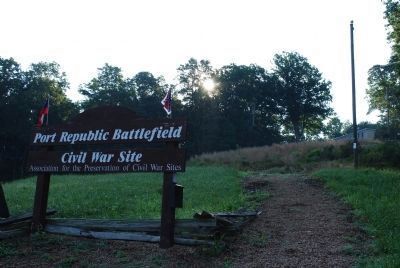
7. Port Republic Marker
Port Republic marker sits just to the front of this marker at the trail-head
Credits. This page was last revised on July 28, 2025. It was originally submitted on October 12, 2007, by J. J. Prats of Powell, Ohio. This page has been viewed 3,632 times since then and 32 times this year. Last updated on August 8, 2023. Photos: 1, 2, 3. submitted on October 12, 2007, by J. J. Prats of Powell, Ohio. 4. submitted on September 14, 2015, by Bernard Fisher of Richmond, Virginia. 5. submitted on September 22, 2019, by J. J. Prats of Powell, Ohio. 6. submitted on October 12, 2007, by J. J. Prats of Powell, Ohio. 7. submitted on July 22, 2015, by Brandon Fletcher of Chattanooga, Tennessee. • Bernard Fisher was the editor who published this page.
