Prune Capital of the World
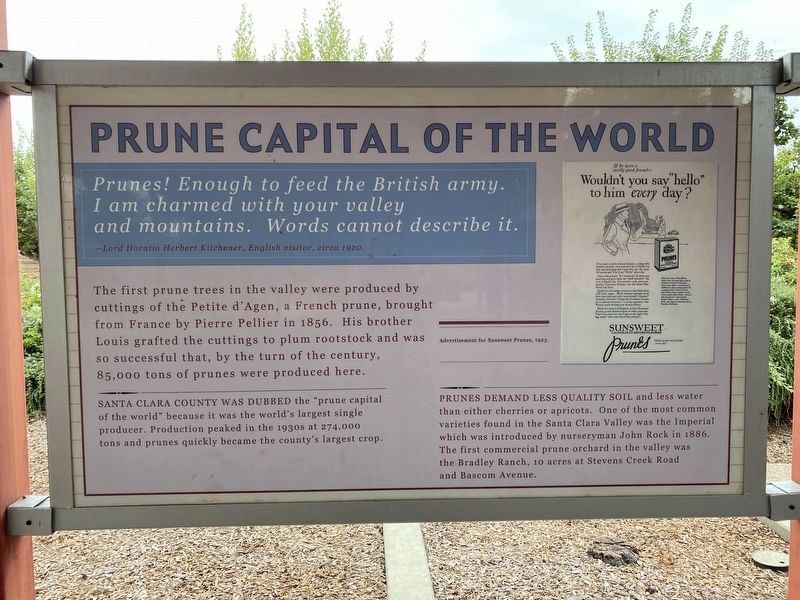
Prunes! Enough to feed the British army. I am charmed with your valley and mountains. Words cannot describe it.
-Lord Horatio Herbert Kitchener, English visitor, circa 1920.
The first prune trees in the valley were produced by cuttings of the Petite d'Agen, a French prune, brought from France by Pierre Pellier in 1856. His brother Louis grafted the cuttings to plum rootstock and was so successful that, by the turn of the century, 85,000 tons of prunes were produced here.
SANTA CLARA COUNTY WAS DUBBED the "prune capital of the world” because it was the world's largest single producer. Production peaked in the 1930s at 274,000 tons and prunes quickly became the county's largest crop.
PRUNES DEMAND LESS QUALITY SOIL and less water than either cherries or apricots. One of the most common varieties found in the Santa Clara Valley was the Imperial which was introduced by nurseryman John Rock in 1886. The first commercial prune orchard in the valley was the Bradley Ranch, 10 acres at Stevens Creek Road and Bascom Avenue.
Topics. This historical marker is listed in these topic lists: Agriculture
this page online
Location. 37° 21.378′ N, 122° 1.495′ W. Marker is in Sunnyvale, California, in Santa Clara County. It can be reached from East Remington Drive. Touch for map. Marker is at or near this postal address: 570 East Remington Drive, Sunnyvale CA 94087, United States of America. Touch for directions.

Regionally, this marker is in California’s San Francisco Bay Area, in Silicon Valley, and on the Coast Ranges. It is also on the American Pacific Coast. Globally, it is in North America, on the Ring of Fire, in the Pacific Rim, in the Western Hemisphere, in the Western World, and in the Anglosphere. Historically, it finds itself in what was once New Spain and also Mexico’s Alta California.
Other nearby markers. At least 8 other markers are within walking distance of this marker: Prune Heaven (here, next to this marker); Labor Day Prunes (here, next to this marker); Yugoslavian Orchardists of Sunnyvale (here, next to this marker); Heritage Park Museum (within shouting distance of this marker); Pippin Clay Glazed Tiles (within shouting distance of this
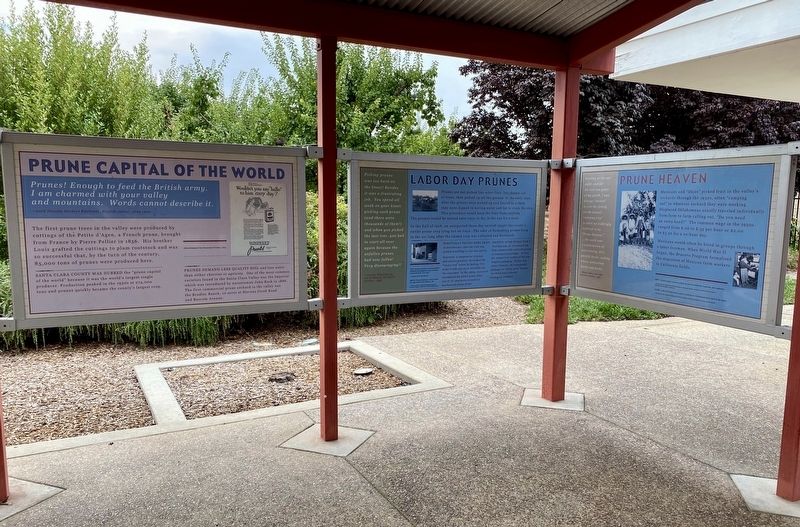
More about this marker. The marker is located outdoors under the roof of the orchard interpretive exhibit that is just to the south of the museum.
Credits. This page was last revised on August 27, 2020. It was originally submitted on August 27, 2020, by Andrew Ruppenstein of Lamorinda, California. This page has been viewed 1,627 times since then and 166 times this year. Photos: 1, 2, 3. submitted on August 27, 2020, by Andrew Ruppenstein of Lamorinda, California.
