Franklin in Pendleton County, West Virginia — The American South (Appalachia)
McCoy House
Union Headquarters
| — | 1862 Valley Campaign | — |
Photographed by Don Morfe, July 31, 2012
1. McCoy House Marker
Gen. Thomas J. "Stonewall" Jackson's unsuccessful attack on Union forces at Kernstown on March 23, 1862, alarmed Federal officials, who assigned additional troops to the Shenandoah Valley to guard against a Confederate assault on Washington, D.C. In May and June, Jackson's "foot cavalry" marched 350 miles; defeated three Union armies in engagements at McDowell (May 8), Front Royal (May 23), Winchester (May 25), Cross Keys (June 8), and Port Republic (June 9); inflicted twice the number of casualties it suffered; and tied down 60,000 Federal troops. The campaign made Jackson the Confederacy's foremost hero.
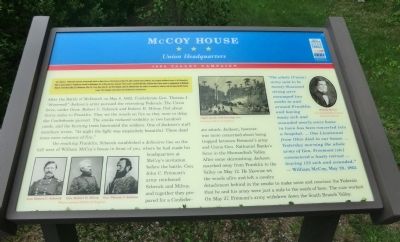
After the Battle of McDowell on May 8, 1862, Confederate Gen. Thomas J. “Stonewall” Jackson’s army pursued the retreating Federals. The Union force under Gens. Robert C. Schenck and Robert H. Milroy fled about thirty miles to Franklin. They set the woods on fire as they went to delay the Confederate pursuit. The smoke reduced visibility to two hundred yards, and burning trees fascinated the soldiers. One of Jackson’s staff members wrote, “At night the light was exquisitely beautiful. These dead trees were columns
this page online
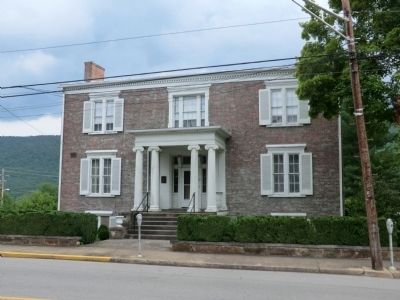
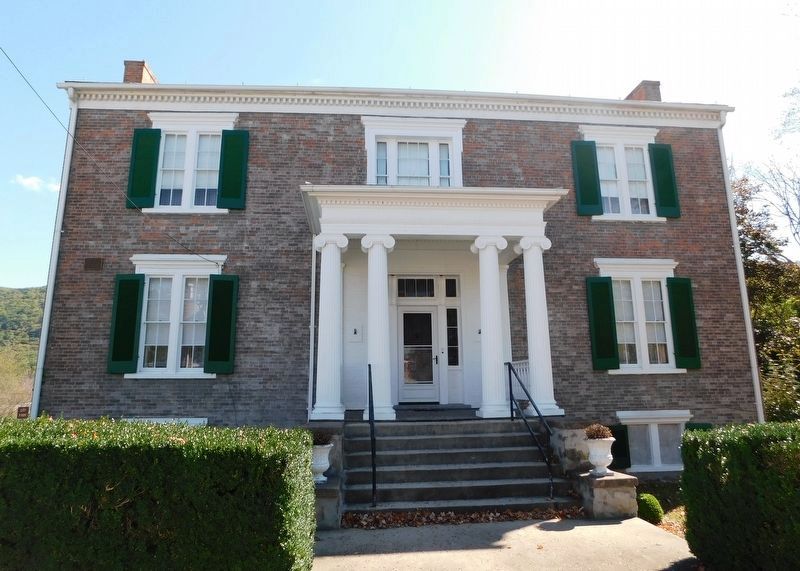
On reaching Franklin, Schenck established a defensive line on the hill west of William McCoy’s house in front of you, where he had made his headquarters at McCoy’s invitation before the battle. Gen. John C. Fremont’s army reinforced Schenck and Milroy, and together they prepared for a Confederate attack. Jackson, however was more concerned about being trapped between Fremont’s army and Union Gen. Nathaniel Banks’ force in the Shenandoah Valley. After some skirmishing, Jackson marched away from Franklin to the Valley on May 12. He likewise set the woods afire and left a cavalry detachment behind in the smoke to make noise and convince the Federals that he and his army were just a mile to the south of here. The ruse worked. On May 27, Fremont’s army withdrew down the South Branch Valley.
"The whole [Union] army said to be twenty thousand strong were encamped two weeks in and around Franklin and having many sick and wounded nearly every home in town has been converted into a hospital. …One Lieutenant from Ohio died in our house. … Yesterday morning the whole army of Gen. Freemont [sic] commenced a hasty retreat… leaving 125 sick and wounded."
- William McCoy, May 28, 1862
Erected by West
Photographed by Don Morfe, July 31, 2012
2. McCoy House Marker
Topics and series. This historical marker is listed in this topic list: War, US Civil. In addition, it is included in the West Virginia Civil War Trails series list. A significant historical month for this entry is March 1750.
Location. This marker has been replaced by another marker nearby. It was located near 38° 38.484′ N, 79° 19.878′ W. Marker was in Franklin, West Virginia, in Pendleton County. It was at the intersection of South Main Street and Chestnut Street on South Main Street. Touch for map. Marker was at or near this postal address: 101 South Main Street, Franklin WV 26807, United States of America. Touch for directions.

Regionally, this marker was in the Potomac Highlands. It was also in the American South, specifically in the Upper South, and in Appalachia. Globally, it was in North America, the Western Hemisphere, the Western World, and the Anglosphere. Historically, it found itself in what was once the territory of the Mississippian Culture.
Other nearby markers. At least 8 other markers are within 2 miles of this location, measured as the crow flies: Civil War Soldiers Monument (a few
Photographed by Bradley Owen, October 17, 2023
3. McCoy House Marker
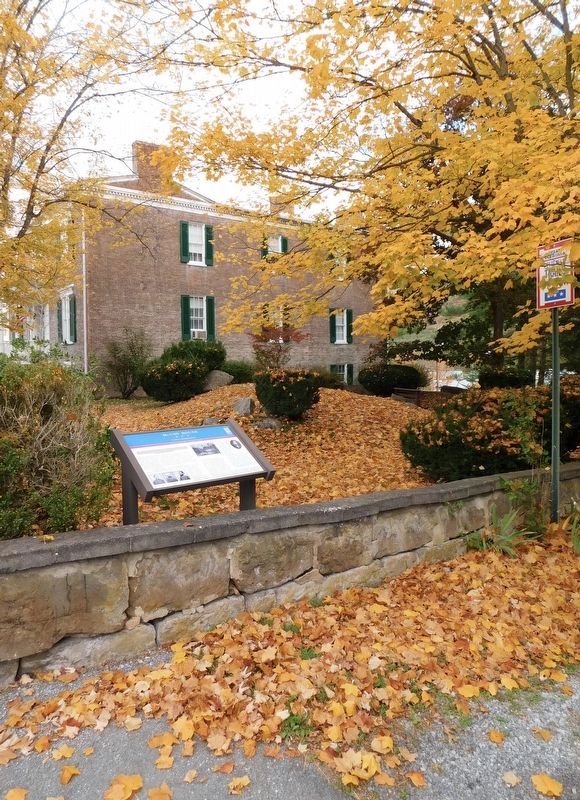
McCoy House is in the background.
Photographed by Bradley Owen, October 14, 2017
4. McCoy House
Credits. This page was last revised on August 9, 2026. It was originally submitted on August 23, 2012, by Don Morfe of Baltimore, Maryland. This page has been viewed 1,378 times since then and 50 times this year. Last updated on August 30, 2020, by Bradley Owen of Morgantown, West Virginia. Photos: 1, 2. submitted on August 23, 2012, by Don Morfe of Baltimore, Maryland. 3. submitted on October 17, 2023, by Bradley Owen of Morgantown, West Virginia. 4. submitted on January 28, 2021, by Bradley Owen of Morgantown, West Virginia. • Devry Becker Jones was the editor who published this page.
