Westend in Lynchburg, Virginia — The American South (Mid-Atlantic)
Civil War in Lynchburg
Prisoner-of-War Camp
Photographed by J. J. Prats, July 1, 2012
1. Civil War in Lynchburg Marker
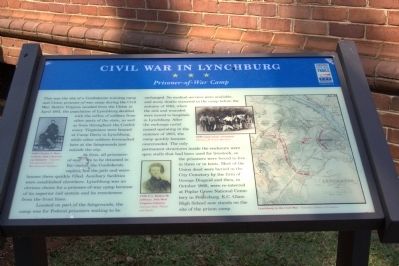
At first, all prisoners-of-war were to be detained in Richmond, the Confederate capital, but the jails and warehouses there quickly filled. Auxiliary facilities were established elsewhere. Lynchburg was an obvious choice for a prisoner-of-war camp because of its superior rail system and its remoteness from the front lines.
Located on part of the fairgrounds, the camp was for Federal prisoners waiting to be exchanged. No medical services were available, and many deaths occurred in the camp before the autumn of 1862, when the sick and wounded were moved to hospitals in Lynchburg. After the exchange cartel ceased operating in the summer of 1863, the camp quickly became overcrowded.
this page online
Erected by Civil War Trails.
Topics and series. This historical marker is listed in this topic list: War, US Civil. In addition, it is included in the Virginia Civil War Trails series list. A significant historical month for this entry is April 1861.
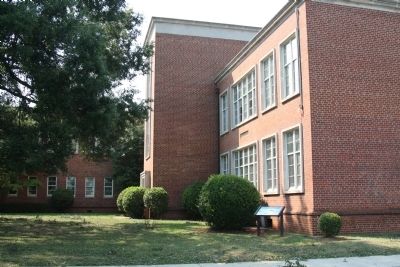
Location. 37° 24.418′ N, 79° 9.978′ W. Marker is in Lynchburg, Virginia. It is in Westend. It is on Memorial Avenue (Virginia Route 163) near Park Lane, on the right when traveling north. It is on the grounds of E. C. Glass High School visible from the street. Touch for map. Marker is in this post office area: Lynchburg VA 24501, United States of America. Touch for directions.

Regionally, this marker is in Central Virginia. It is also in the American South and specifically in the
Photographed by J. J. Prats, July 1, 2012
2. Civil War in Lynchburg Marker
Other nearby markers. At least 8 other markers are within walking distance of this marker: Lucille Chaffin Kent (about 300 feet away, measured in a direct line); Edward Christian Glass (1852-1931) (about 300 feet away); Memorial Avenue (approx. 0.2 miles away); Mustered and Disbanded 1861-1865 (approx. 0.2 miles away); Second Virginia Cavalry, C.S.A. (approx. ¼ mile away); Dr. Robert Withers Morgan (approx. 0.3 miles away); Georgia Weston Morgan (approx. 0.3 miles away); Horse Drawn Road Grader (approx. 0.4 miles away). Touch for a list and map of all markers in Lynchburg.
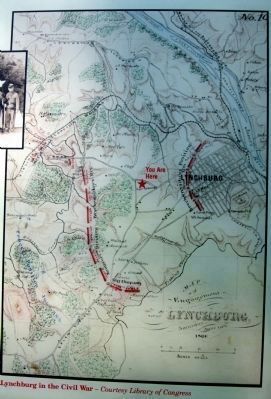
More about this marker. Marker has three photographs and to the right a map of the area during the Civil War. On the left is a photograph captioned “POW Chester A. Tourtellotte, 18th Connecticut Infantry — Courtesy The American Civil
3. Close-up of map on marker
Also see . . . Taylor Wilson Camp Heritage Group. Shows plans for a monument to the prisoners-of-war. (Submitted on August 12, 2012.)
Credits. This page was last revised on February 1, 2023. It was originally submitted on August 12, 2012. This page has been viewed 2,310 times since then and 164 times this year. Last updated on August 31, 2020, by Bradley Owen of Morgantown, West Virginia. Photos: 1, 2, 3. submitted on August 12, 2012, by J. J. Prats of Powell, Ohio. • J. Makali Bruton was the editor who published this page.
