Fort Hill in Lynchburg, Virginia — The American South (Mid-Atlantic)
Fort Early
The Confederate Center
| — | Battle of Lynchburg | — |
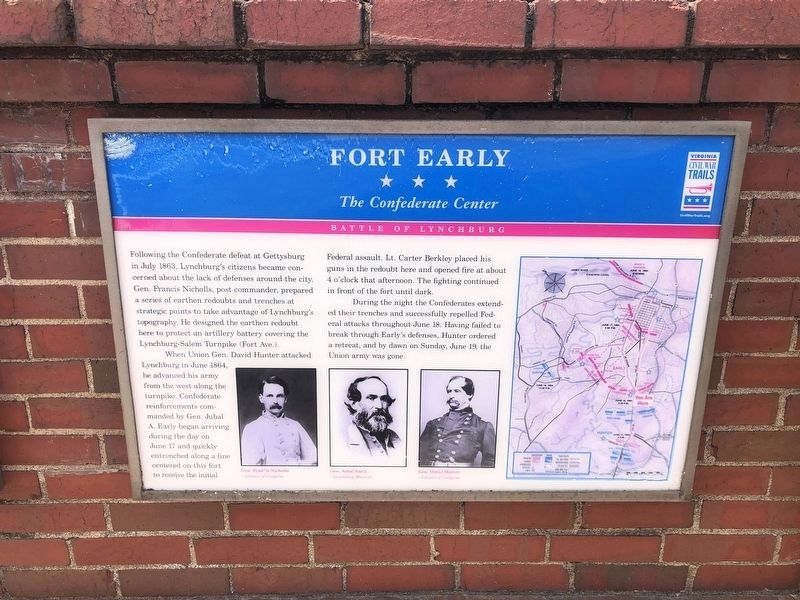
Following the Confederate defeat at Gettysburg in July 1863, Lynchburg’s citizens became concerned about the lack of defenses around the city. Gen. Francis Nicholls, post commander, prepared a series of earthen redoubts and trenches at strategic points to take advantage of Lynchburg’s topography. He designed the earthen redoubt here to protect an artillery battery covering the Lynchburg-Salem Turnpike (Fort Ave.).
When Union Gen. David Hunter attacked Lynchburg in June 1864, he advanced his army from the west along the turnpike. Confederate reinforcements commanded by Gen. Jubal A. Early began arriving during the day on June 17 and quickly entrenched along a line centered on this fort to receive the initial Federal assault. Lt. Carter Berkley placed his guns in the redoubt here and opened fire at about 4 o’clock that afternoon. The fighting continued in front of the fort until dark.
During the night the Confederates extended their trenches and successfully repelled Federal attacks throughout June 18. Having failed to break through Early’s defenses, Hunter ordered a retreat, and by dawn on Sunday, June 19, the Union army
this page online
Erected by Virginia Civil War Trails.
Topics and series. This historical marker is listed in this topic list: War, US Civil. In addition, it is included in the Virginia Civil War Trails series list. A significant historical month for this entry is June 1864.
Location. 37° 23.398′ N, 79° 10.372′ W. Marker is in Lynchburg, Virginia. It is in Fort Hill. It is at the intersection of Memorial Avenue and Fort Avenue (Business U.S. 460), on the right when traveling south on Memorial Avenue. Marker is mounted on the brick wall to the right of the Fort Early entrance. Touch for map. Marker is at or near this postal address: 3511 Memorial Ave, Lynchburg VA 24501, United States of America. Touch for directions.

Regionally, this marker is in Central Virginia. It is also in the American South and specifically in the Upper South. Globally, it is in North America, the Western Hemisphere, the Western World, and the Anglosphere. Historically, it finds itself in what was once the territory of the Mississippian Culture, one of the original Thirteen Colonies, one of the Confederate States of America, and the Antebellum South.
Other nearby markers. At
Photographed by Bill Coughlin, April 26, 2007
2. Fort Early Civil War Trails marker
This is a previous iteration of the marker. The language is identical although the formatting is slightly different from the current marker.
More about this marker. The marker displays portraits of Gens. Francis Nicholls, Jubal Early and David Hunter in the lower center. A map showing the unit dispositions during the battle over the present day road network is on the right side of the marker.
Regarding Fort Early. This is one in a series of Civil War Trails markers interpreting the Battle of Lynchburg (17-18 June 1864) and the city's role in the Civil War. Select the Civil War Virtual Tour by Marker link below to see other related markers.
Also see . . . Civil War Lynchburg Virtual Tour by Markers.
Photographed by Bill Coughlin, April 26, 2007
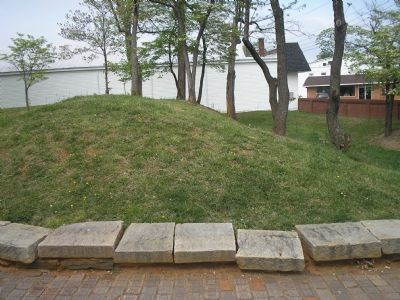
4. Fort Early earthworks
These earthworks are the remains of Fort Early, and saw action during the Battle of Lynchburg.
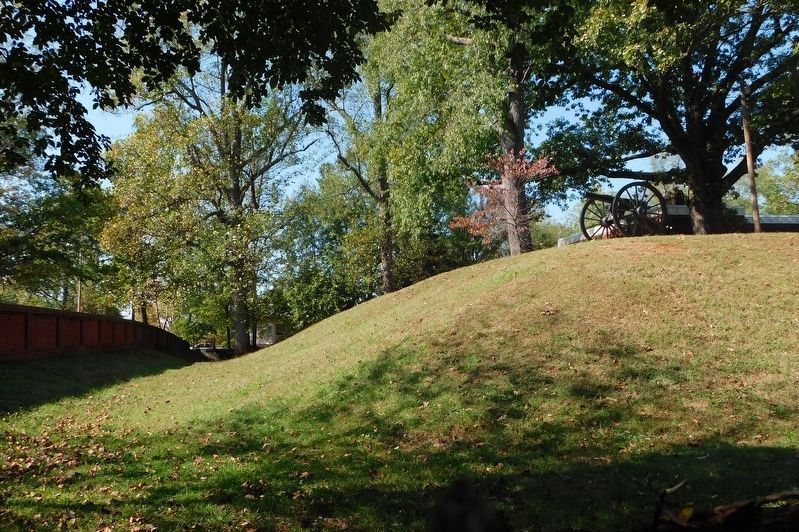
Photographed by Bradley Owen, October 15, 2017
5. Fort Early Earthworks
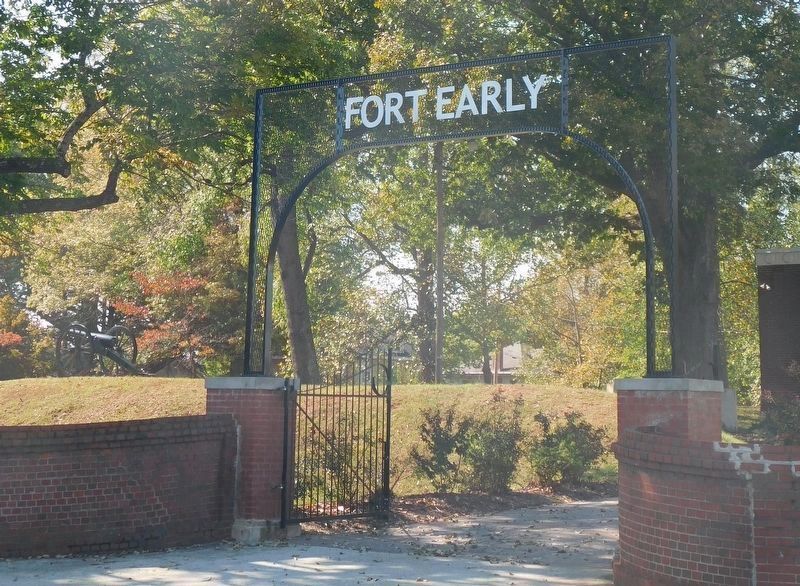
Photographed by Bradley Owen, October 15, 2017
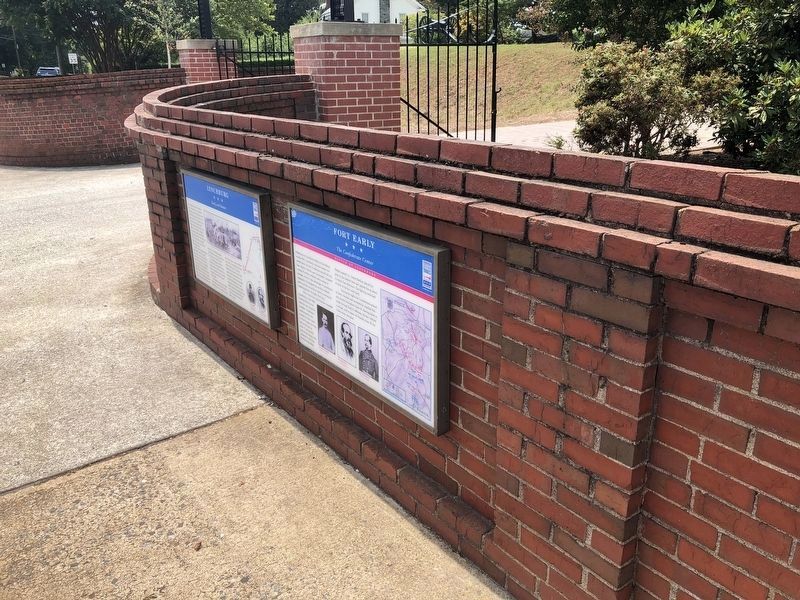
6. Memorial Arch At The Entrance To Fort Early
Credits. This page was last revised on October 14, 2025. It was originally submitted on December 2, 2007. This page has been viewed 3,098 times since then and 62 times this year. Last updated on August 31, 2020, by Bradley Owen of Morgantown, West Virginia. Photos: 1. submitted on August 16, 2021, by Devry Becker Jones of Washington, District of Columbia. 2. submitted on December 2, 2007, by Bill Coughlin of Woodland Park, New Jersey. 3. submitted on August 16, 2021, by Devry Becker Jones of Washington, District of Columbia. 4. submitted on December 2, 2007, by Bill Coughlin of Woodland Park, New Jersey. 5. submitted on March 17, 2021, by Bradley Owen of Morgantown, West Virginia. 6. submitted on March 21, 2021, by Bradley Owen of Morgantown, West Virginia. • J. Makali Bruton was the editor who published this page.
