
Near Miles City in Custer County, Montana — The American West (Mountains)
Powder River
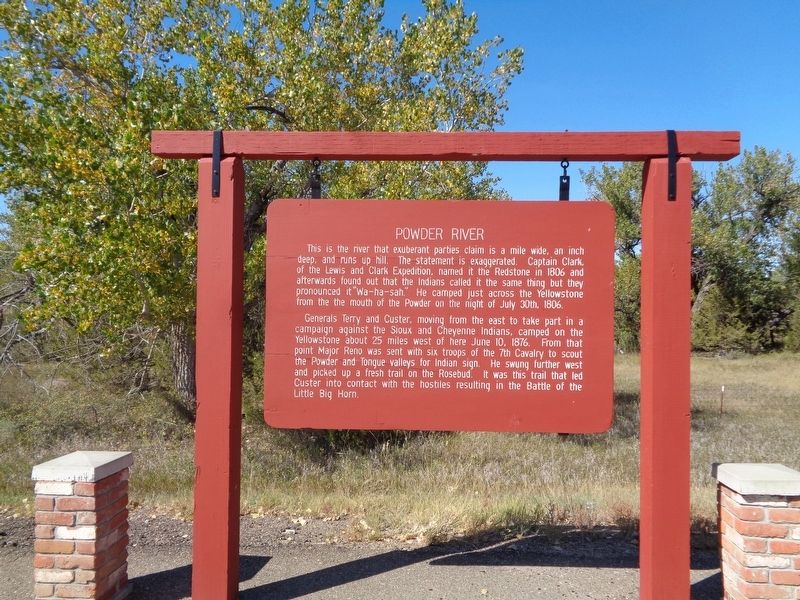
Photographed by Roger Dean Meyer, September 22, 2015
1. Powder River Marker
This is the river that exuberant parties claim is a mile wide, an inch deep, and runs up hill. The statement is exaggerated. Captain Clark, of the Lewis and Clark Expedition, named it the Redstone in 1806 and afterwards found out that the Indians called it the same thing but they pronounced it “Wah-ha-sah.” He camped just across the Yellowstone from the mouth of the Powder on the night of July 30, 1806.
Generals Terry and Custer, moving from the east to take part in a campaign against the Sioux and Cheyenne Indians, camped on the Yellowstone about 25 miles west of here June 10, 1876. From that point Major Reno was sent with six troops of the 7th Cavalry to scout the Powder and Tongue valleys for Indian sign. He swung further west and picked up a fresh trail on the Rosebud. It was this trail that led Custer into contact with the hostiles resulting in the Battle of the Little Big Horn.
Topics. This historical marker is listed in these topic lists: Exploration • Indigenous Peoples and Communities • Wars, US Indian. A significant historical date for this entry is June 10, 1876.
Location. Marker has been reported permanently removed. It was located near 46° 25.585′ N,
this page online
We have been informed that this marker is no longer there and will not be replaced. This page is an archival view of what was.
Regionally, this marker was in Southeast Montana, in Custer Country and in the Powder River Basin. It was also in the American Mountain West, in the Lewis & Clark Corridor, on the prairies, on the Great Plains, and specifically on the Northern Plains. Globally, it was in North America, the Western Hemisphere, the Western World, and the Anglosphere. Historically, it found itself in what was once Rupert’s Land and also the Louisiana Purchase.

Other nearby markers. within walking distance of this location:
Another marker is no longer nearby. The Powder River and the Red Trail (was a few steps from this marker but has been permanently removed).

Photographed by Roger Dean Meyer, September 22, 2015
2. Wide View of Powder River Marker
Credits. This page was last revised on September 26, 2024. It was originally submitted on September 2, 2020, by Roger Dean Meyer of Yankton, South Dakota. This page has been viewed 583 times since then and 67 times this year. Photos: 1, 2. submitted on September 2, 2020, by Roger Dean Meyer of Yankton, South Dakota.
