Near Cordova in Talbot County, Maryland — The American Northeast (Mid-Atlantic)
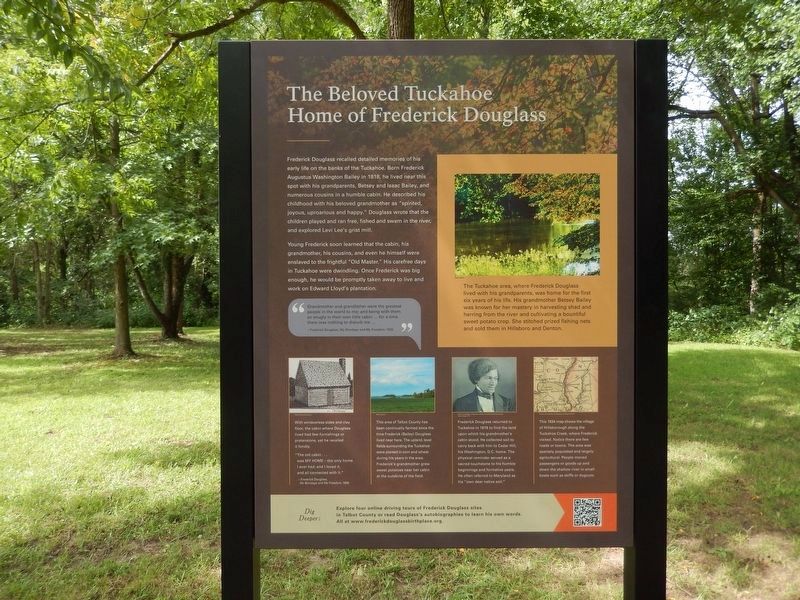
The Beloved Tuckahoe Home of Frederick Douglass
Photographed by Bill Pfingsten, September 2, 2020
1. The Beloved Tuckahoe Home of Frederick Douglass Marker
Frederick Douglass reclled detailed memories of his early life on the banks of the Tuckahoe. Born Frederick Augustus Washington Bailey in 1818, he lived near this spot with his grandparents, Betsey and Isaac Bailey, and numerous cousins in a humble cabin. He described his childhood with his beloved grandmother as "spirited, joyous, uproarious and happy." Douglass wrote that the children played and ran free, fished and swam in the river, and explored Levi Lee's grist mill.
Young Frederick soon learned that the cabin, his grandmother, his cousins, and even he himself were enslaved to the frightful "Old Master." His carefree days in Tuckahoe were dwindling. Once Frederick was big enough, he would be promptly taken away to live and work on Edward Lloyd's plantation.
"Grandmother and grandfather were the greatest people in the world to me and being with them so snugly in their own little cabin…for a time there was nothing to disturb me…"
— Frederick Douglass, My Bondage and My Freedom, 1855
The Tuckahoe area, where Frederick Douglass lived with his grandpparents, was home for the first six years of his live.
this page online
[Captions:]
With windowless sides and clay floor, the cabin where Douglass lived had few furnishings or pretensions, yet he recalled it fondly.
"The old cabin… was MY HOME - the only home I ever had; and I loved it, and all connected with it."
— Frederick Douglass, My Bondage and My Freedom, 1855
This area of Talbot County has been continually farmed since the tine Frederick (Bailey) Douglass lived near here. The upland, level fields surrounding the Tuckahoe were planted in corn and wheat during his years in the area. Frederick's grandmother grew sweet potatoes near her cabin at the outskirts of the field.
Frederick Douglass returned to Tuckahoe in 1878 to find the land upon which his grandmother's cabin stood. He collected soil to carry back with him to Cedar Hill, his Washington, D.C. home. The physical reminder served as a sacred touchstone to his humble beginnings and formative years. He often referred to Maryland as his "own dear native soil."
This 1834 map shows the village of Hillsborough along the Tuckahoe Creek, where Frederick visited. Notice there are few roads or towns. The area was sparsely populated and largely agricultural. People moved passengers or goods up and down the shallow river in small boats such as skiffs or dugouts.
Dig Deeper:
Explore four online driving tours of Frederick Douglass sites in Talbot County or read Douglass's autobiographies to learn his own words. All at www.frederickdouglassbirthplace.org.
Erected by Talbot

Photographed by Devry Becker Jones (CC0), October 5, 2024
2. The Beloved Tuckahoe Home of Frederick Douglass Marker
Topics. This historical marker is listed in these topic lists: Abolition & Underground RR • African Americans • Waterways & Vessels. A significant historical year for this entry is 1818.
Location. 38° 54.675′ N, 75° 57.004′ W. Marker is near Cordova, Maryland, in Talbot County. It can be reached from Lewistown Road (Maryland Route 303) north of Norwich Creek Road, on the right when traveling north. Touch for map. Marker is at or near this postal address: 32408 Norwich Creek Rd, Cordova MD 21625, United States of America. Touch for directions.

Regionally, this marker is on the Eastern Shore. It is also in the American Mid-Atlantic, on the Delmarva Peninsula, in the Tidewater, in the Chesapeake Bay Region, and on the Eastern Seaboard. Globally, it is in the North Atlantic Region, North America, the Western Hemisphere, the Western World, and the Anglosphere. Historically, it finds itself in what was once one of the original Thirteen
Photographed by Bill Pfingsten, September 2, 2020
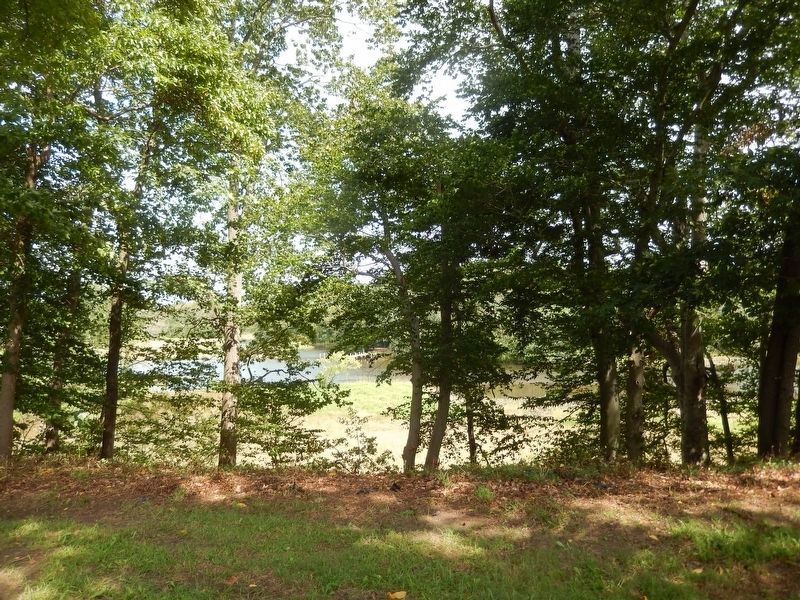
3. Tuckahoe Creek as seen from marker.
Other nearby markers. At least 8 other markers are within 3 miles of this marker, measured as the crow flies: A Champion for Equality (here, next to this marker); Forging Freedom from Places of Bondage (here, next to this marker); Honoring an American Hero (within shouting distance of this marker); Frederick Douglass (approx. half a mile away); St. Paul’s Episcopal Church (approx. half a mile away); a different marker also named Frederick Douglass (approx. 1.9 miles away); Tuckahoe Roots (approx. 2.7 miles away); Wood Ducks (approx. 3 miles away). Touch for a list and map of all markers in Cordova.
Another marker is no longer nearby. Frederick Douglass (was approx. half a mile away but has been replaced with another marker now near it).
Credits. This page was last revised on October 5, 2024. It was originally submitted on September 4, 2020, by Bill Pfingsten of Bel Air, Maryland. This page has been viewed 1,230 times since then and 106 times this year. Photos: 1. submitted on September 4, 2020, by Bill Pfingsten of Bel Air, Maryland. 2. submitted on October 5, 2024, by Devry Becker Jones of Washington, District of Columbia. 3. submitted on September 4, 2020, by Bill Pfingsten of Bel Air, Maryland.
